
Research, Development, and Application of the Unified Post-Processing System for the CMA-GEPS/REPS Ensemble Prediction
Received date: 2022-09-17
Revised date: 2022-10-25
Online published: 2022-12-16
Supported by
the National Natural Science Foundation of China “Medium-range weather predictability and ensemble-based probabilistic forecasting method of extreme temperature event in China”(41875138);“Classification interpretation and probability correction methods of ensemble forecasting of summer rainfall in the eastern China”(42175015)
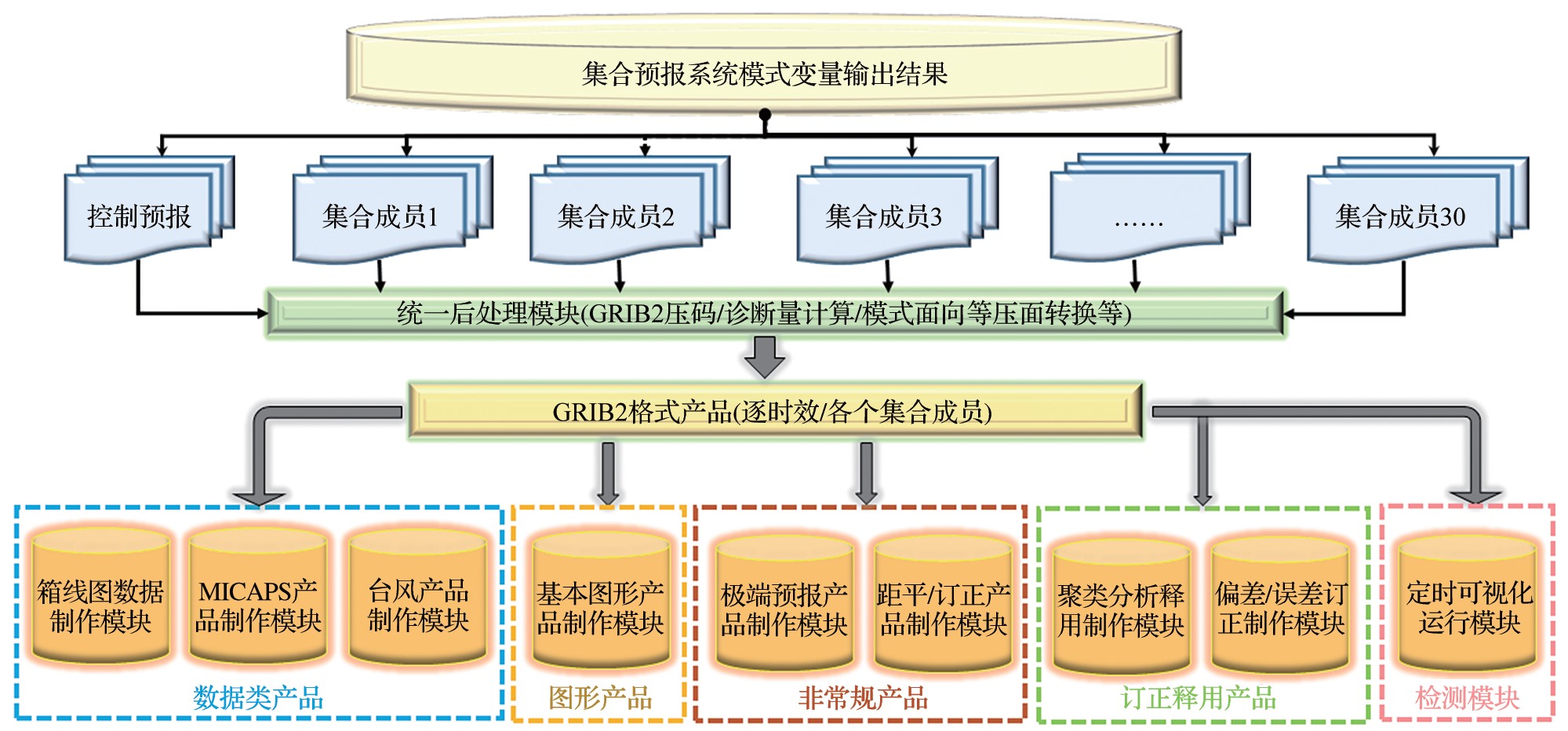
Ensemble prediction, one of the most rapid developments in numerical weather prediction, has presently become a vital basis for accurate forecasting and assessment of product abundance. In the past three decades, accompanied by the rapid developments in prediction research and techniques, a significant progress has been made in operational technology and systems for ensemble prediction. As the output end of the information facing downstream users in the ensemble prediction chain, the post-processing system has been an integrated platform for the generation of numerous ensemble data, the unification of product-making functions, and the intensification of multilevel forecasting approaches and techniques. In this study, a comprehensive local-to-global review was first conducted for the historical development, current stage, and future direction of the post-processing system and technology for ensemble prediction. Second, the following seven main functions of the post-processing system were summarized:
Li GAO , Jiawen ZHENG , Zuosen ZHAO , Yuelin LUO , Pengfei REN , Guohua YAO . Research, Development, and Application of the Unified Post-Processing System for the CMA-GEPS/REPS Ensemble Prediction[J]. Advances in Earth Science, 2022 , 37(12) : 1211 -1222 . DOI: 10.11867/j.issn.1001-8166.2022.096
| 1 | EPSTEIN E S. Stochastic dynamic prediction[J]. Tellus, 1969, 21(6): 739-759. |
| 2 | LEITH C E. Theoretical skill of Monte Carlo forecasts[J]. Monthly Weather Review, 1974, 102(6): 409-418. |
| 3 | TOTH Z, KALNAY E. Ensemble forecasting at NCEP and the breeding method[J]. Monthly Weather Review, 1997, 125(12): 3 297-3 319. |
| 4 | MOLTENI F, BUIZZA R, PALMER T N, et al. The ECMWF ensemble prediction system: methodology and validation[J]. Quarterly Journal of the Royal Meteorological Society, 1996, 122(529): 73-119. |
| 5 | TIAN Hua, DENG Guo, YAO Mingming, et al. Research progress of T213 global ensemble forecast[C]//Proceedings of the 2005 Annual Meeting of China Meteorological Society. Suzhou: China Meteorological Society, 2005:5 580-5 585. |
| 5 | 田华, 邓国, 姚明明,等. T213全球集合预报的研究进展[C]//中国气象学会2005年年会论文集. 苏州:中国气象学会, 2005:5 580-5 585. |
| 6 | LIN Jian, ZONG Zhiping, JIANG Xing. 2010-2011 multi-model integrated quantitative precipitation forecast product inspection and evaluation report[J]. Weather Forecast, 2013,5(1): 67-74. |
| 6 | 林建, 宗志平, 蒋星. 2010—2011年多模式集成定量降水预报产品检验评估报告[J]. 天气预报, 2013, 5(1):67-74. |
| 7 | HAGEDORN R. Using the ECMWF reforecast dataset to calibrate EPS forecasts[Z]. ECMWF Newsl, 2017. |
| 8 | TAKANO K, KOBAYASHI C. Verification of dynamical one-month forecast at JMA[C]. Seventh ECMWF Workshop on Meteorological Operational System, 1999. |
| 9 | PLANTE A. Canadian Meteorological Centre. CMC dynamical seasonal forecast system method and results[C]. Seventh ECMWF Workshop on Meteorological Operational System, 1999. |
| 10 | MAO Hengqing, CHEN Yi, CHEN Dehui. The development of ensemble products based on the Shenwei medium-range ensemble prediction system[J]. Quarterly Journal of Applied Meteorlolgy, 2002, 13(1): 47-55. |
| 10 | 毛恒青, 陈谊, 陈德辉. 基于神威中期集合数值预报系统的产品开发[J]. 应用气象学报, 2002, 13(1): 47-55. |
| 11 | BUIZZA R, LEUTBECHER M, ISAKSEN L. Potential use of an ensemble of analyses in the ECMWF Ensemble Prediction System[J]. Quarterly Journal of the Royal Meteorological Society, 2008, 134(637): 2 051-2 066. |
| 12 | BUIZZA R, LEUTBECHER M, ISAKSEN L, et al. Combined use of EDA- and SV-based perturbations in the EPS[J]. ECMWF Newsletter, 2010, 123:22-28. |
| 13 | TOTH Z, KALNAY E. Ensemble forecasting at NMC: the generation of perturbations[J]. Bulletin of the American Meteorological Society, 1993, 74(12): 2 317-2 330. |
| 14 | WEI M Z, TOTH Z, WOBUS R, et al. Initial perturbations based on the Ensemble Transform (ET) technique in the NCEP global operational forecast system[J]. Tellus A, 2008. DOI: 10.1111/j.1600-0870.2007.00273.x . |
| 15 | HOUTEKAMER P L, LEFAIVRE L, DEROME J, et al. A system simulation approach to ensemble prediction[J]. Monthly Weather Review, 1996, 124(6): 1 225-1 242. |
| 16 | HOUTEKAMER P L, MITCHELL H L. Ensemble Kalman filtering[J]. Quarterly Journal of the Royal Meteorological Society, 2005, 131(613): 3 269-3 289. |
| 17 | HOUTEKAMER P L, CHARRON M, MITCHELL H L, et al. Status of the global EPS at environment Canada[C]//Proceedings of ECMWF Workshop on Ensemble Prediction. United Kingdom: ECMWF, 2007: 57-68. |
| 18 | ZHOU X Q, ZHU Y J, HOU D C, et al. A comparison of perturbations from an ensemble transform and an ensemble Kalman filter for the NCEP global ensemble forecast system[J]. Weather and Forecasting, 2016, 31(6): 2 057-2 074. |
| 19 | ZHOU X Q, ZHU Y J, HOU D C, et al. The NCEP global ensemble forecast system with the EnKF initialization[J]. Weather Forecasting, 2017, 32:1 989-2 004. |
| 20 | ZHU Y J, LI W, ZHOU X Q, et al. Stochastic representation of NCEP GEFS to improve sub-seasonal forecast[M]//Springer atmospheric sciences. Singapore: Springer Singapore, 2019: 317-328. |
| 21 | ZHU Y J, LI W, SINSKY E, et al. An investigation of prediction and predictability of NCEP Global Ensemble Forecast System (GEFS)[M]. Iowa State: Environmental Science, 2019. |
| 22 | ZHU Y J, TOTH Z, WOBUS R, et al. The economic value of ensemble-based weather forecasts[J]. Bulletin of the American Meteorological Society, 2002, 83(1): 73-83. |
| 23 | ZHU Y J. Ensemble forecast: a new approach to uncertainty and predictability[J]. Advances in Atmospheric Sciences, 2005, 22(6): 781-788. |
| 24 | ZHU Y J. An assessment of subseasonal forecast skill using an extended Global Ensemble Forecast System (GEFS)[M]. Iowa State: Environmental Science, 2018. |
| 25 | LIN Liangxun. Ensemble forecast and application of products[J]. Guangdong Meteorology, 2001, 23(2): 44-46. |
| 25 | 林良勋. 集合预报系统及其产品应用综述[J]. 广东气象, 2001, 23(2): 44-46. |
| 26 | LI W T, DUAN Q Y, MIAO C Y, et al. A review on statistical postprocessing methods for hydrometeorological ensemble forecasting[J]. WIREs Water, 2017, 4(6). DOI:10.1002/wat2.1246 . |
| 27 | DUAN Q Y, PAPPENBERGER F, WOOD A, et al. Handbook of Hydrometeorological Ensemble Forecasting[M]. Berlin, Heidelberg: Springer Berlin Heidelberg, 2020. |
| 28 | MAO Hengqing, WANG Jianjie. The operational use of ensemble prediction products and its future[J]. Meteorological Monthly, 2000, 26(6): 26-29. |
| 28 | 毛恒青, 王建捷. 集合预报业务使用现状和趋势[J]. 气象, 2000, 26(6): 26-29. |
| 29 | SUN Lingdong. An overview of Global Ensemble Forecasting System(GEFS)[J]. Technology Innovation and Application, 2018(12): 49-50. |
| 29 | 孙令东. 全球集合预报系统综述[J]. 科技创新与应用, 2018(12): 49-50. |
| 30 | HAMILL T M, SNYDER C, MORSS R E. A comparison of probabilistic forecasts from bred, singular-vector, and perturbed observation ensembles[J]. Monthly Weather Review, 2000, 128(6): 1 835-1 851. |
| 31 | YANG Xuesheng, CHEN Dehui, LENG Tingbo, et al. The comparison experiments of SV and LAF initial perturbation techniques used at the NMC ensemble prediction system[J]. Quarterly Journal of Applied Meteorlolgy, 2002, 13(1): 62-66. |
| 31 | 杨学胜, 陈德辉, 冷亭波, 等. 时间滞后与奇异向量初值生成方法的比较试验[J]. 应用气象学报, 2002, 13(1): 62-66. |
| 32 | LI Weijing, JI Liren. Monthly dynamic extended range forecast [M]. Beijing: China Meteorological Press, 2000. |
| 32 | 李维京, 纪立人. 月动力延伸预报研究[M]. 北京: 气象出版社, 2000. |
| 33 | WANG X, BISHOP C H. A comparison between ETKF and breeding ensemble forecast scheme [J]. Journal of the Atmospheric Sciences, 2003, 60:1 140-1 158. |
| 34 | STENSRUD D J, BAO J W, WARNER T T. Using initial condition and model physics perturbations in short-range ensemble simulations of mesoscale convective systems[J]. Monthly Weather Review, 2000, 128(7): 2 077-2 107. |
| 35 | WANDISHIN M S, MULLEN S L, STENSRUD D J, et al. Evaluation of a short-range multimodel ensemble system[J]. Monthly Weather Review, 2001, 129(4): 729-747. |
| 36 | SIVILLO J K, AHLQUIST J E, TOTH Z. An ensemble forecasting primer[J]. Weather and Forecasting, 1997, 12(4): 809-818. |
| 37 | MANOUSOS P C. NCEP Medium-range forecasting at NCEP-Overview[C]. Seventh ECMWF Workshop on Meteorological Operational Systems,1999. |
| 38 | LALAURETTE F. Use of ECMWF products and performance of the forecasting system[M]. Seventh ECMWF Workshop on Meteorological Operational Systems,1999. |
| 39 | BOTTGER H, ECMWF. Extreme weather event forecasting[C]. Seventh ECMWF Workshop on Meterorological Operational Systems, 1999. |
| 40 | TRACTON M S, KALNAY E. Operational ensemble prediction at the national meteorological center: practical aspects[J]. Weather and Forecasting, 1993, 8(3): 379-398. |
| 41 | HAMILL T M, COLUCCI S J. Evaluation of eta-RSM ensemble probabilistic precipitation forecasts[J]. Monthly Weather Review, 1998, 126(3): 711-724. |
| 42 | DU J, MULLEN S L, SANDERS F. Removal of distortion error from an ensemble forecast[J]. Monthly Weather Review, 2000, 128(9): 3 347-3 351. |
| 43 | RICHARDSON D S. Skill and relative economic value of the ECMWF ensemble prediction system[J]. Quarterly Journal of the Royal Meteorological Society, 2000, 126(563): 649-667. |
| 44 | ECKEL F A, WALTERS M K. Calibrated probabilistic quantitative precipitation forecasts based on the MRF ensemble[J]. Weather and Forecasting, 1998, 13(4): 1 132-1 147. |
| 45 | BARKER T W. The relationship between spread and forecast error in extended-range forecasts[J]. Journal of Climate, 1991, 4(7): 733-742. |
| 46 | LI Li, LI Yinglin, TIAN Hua, et al. Study of bias-correction in T213 global ensemble forecast[J]. Meteorological Monthly, 2011, 37(1): 31-38. |
| 46 | 李莉, 李应林, 田华, 等. T213全球集合预报系统性误差订正研究[J]. 气象, 2011, 37(1): 31-38. |
| 47 | HAMILL T M, WHITAKER J S. Probabilistic quantitative precipitation forecasts based on reforecast analogs: theory and application[J]. Monthly Weather Review, 2006, 134(11): 3 209-3 229. |
| 48 | ZHU Y J, LUO Y. Precipitation calibration based on the frequency-matching method[J]. Weather and Forecasting, 2015, 30(5): 1 109-1 124. |
| 49 | DU Jun. Present situation and prospects of ensemble numerical prediction[J]. Quarterly Journal of Applied Meteorlolgy, 2002, 13(1): 16-28. |
| 49 | 杜钧. 集合预报的现状和前景[J]. 应用气象学报, 2002, 13(1): 16-28. |
| 50 | LI Zechun, CHEN Dehui. The development and application of the operational ensemble prediction system at national meteorological center[J]. Quarterly Journal of Applied Meteorlolgy, 2002, 13(1): 1-15. |
| 50 | 李泽椿, 陈德辉. 国家气象中心集合数值预报业务系统的发展及应用[J]. 应用气象学报, 2002, 13(1): 1-15. |
| 51 | GUAN Jiping, ZHANG Lifeng, ZHANG Ming. Review of the ensemble forecast[J]. Scientia Meteorologica Sinica, 2006, 26(2): 228-235. |
| 51 | 关吉平, 张立凤, 张铭. 集合预报研究现状与展望[J]. 气象科学, 2006, 26(2): 228-235. |
| 52 | CHEN Qiying, YAO Mingming, WANG Yu. A new generation of operational medium-range weather forecast model T213L31 in national meteorological center[J]. Meteorological Monthly, 2004, 30(10): 16-21. |
| 52 | 陈起英, 姚明明, 王雨. 国家气象中心新一代业务中期预报模式T213L31的主要特点[J]. 气象, 2004, 30(10): 16-21. |
| 53 | LI Zechun. Review on the development of numerical forecasting operation[M]. Beijing: China Meteorological Daily, 2010. |
| 53 | 李泽椿. 回顾数值预报业务的建立发展历程[M]. 北京:中国气象报社, 2010. |
| 54 | HUANGPU Xueguan. The medium range numerical weather prediction spectral model T63[J]. Meteorological Monthly, 1995, 21(5): 18-21. |
| 54 | 皇甫雪官. T63中期数值天气预报谱模式[J]. 气象, 1995, 21(5): 18-21. |
| 55 | HE Dengxin, ZHOU Zhimin, KANG Zhaoping, et al. Variational method study to correct the forecast error of GRAPES model[J]. Torrential Rain and Disasters, 2020, 39(4): 392-399. |
| 55 | 何邓新, 周志敏, 康兆萍, 等. GRAPES模式预报误差订正的变分方法研究[J]. 暴雨灾害, 2020, 39(4): 392-399. |
| 56 | SU Xiang, YUAN Huiling, ZHU Yuejian. A comparative study of four objective quantitative precipitation forecast calibration methods[J]. Acta Meteorologica Sinica, 2021, 79(1): 132-149. |
| 56 | 苏翔, 袁慧玲, 朱跃建. 四种定量降水预报客观订正方法对比研究[J]. 气象学报, 2021, 79(1): 132-149. |
| 57 | ZHANG Xiaowen, ZHENG Yongguang, SHENG Jie, et al. Application and verification of extreme forecast index in severe convection weather[J]. Journal of the Meteorological Sciences, 2018, 38(6): 768-779. |
| 57 | 张小雯, 郑永光, 盛杰, 等. 极端天气指数在强对流天气中的应用及检验[J]. 气象科学, 2018, 38(6): 768-779. |
| 58 | XIA Fan, CHEN Jing. The research of extreme forecast index based on the T213 ensemble forecast and the experiment in predicting temperature[J]. Meteorological Monthly, 2012, 38(12): 1 492-1 501. |
| 58 | 夏凡, 陈静. 基于T213集合预报的极端天气预报指数及温度预报应用试验[J]. 气象, 2012, 38(12): 1 492-1 501. |
| 59 | ZHENG Jiawen, GAO Li, REN Hongli, et al. Verification of China extreme temperature forecasts in 2016 based on T639 ensemble forecast[J]. Meteorological Monthly, 2019, 45(4): 469-482. |
| 59 | 郑嘉雯, 高丽, 任宏利, 等. 基于T639集合预报的我国2016年极端温度预报检验[J]. 气象, 2019, 45(4): 469-482. |
| 60 | GAO Li, REN Pengfei, ZHOU Fang, et al. Evaluations and ensemble approaches of western-Pacific subtropical high and south-Asian high ensemble forecasting in GRAPES-GEPS[J]. Advances in Earth Science, 2020, 35(7): 715-730. |
| 60 | 高丽, 任鹏飞, 周放, 等. GRAPES-GEPS对西太平洋副热带高压和南亚高压的集合预报评估与集合方法研究[J]. 地球科学进展, 2020, 35(7): 715-730. |
| 61 | LUO Yuelin, GAO Li, CHEN Quanliang, et al. Classification interpretation method and verification of circulation ensemble forecasts in GRAPES-GEPS[J]. Acta Meteorologica Sinica, 2021, 79(4): 646-658. |
| 61 | 罗月琳, 高丽, 陈权亮, 等. GRAPES-GEPS环流集合预报的分类释用方法研究与检验[J]. 气象学报, 2021, 79(4): 646-658. |
| 62 | GAO Li, CHEN Jing, ZHENG Jiawen, et al. Progress in researches on ensemble forecasting of extreme weather based on numerical models[J]. Advances in Earth Science, 2019, 34(7): 706-716. |
| 62 | 高丽, 陈静, 郑嘉雯, 等. 极端天气的数值模式集合预报研究进展[J]. 地球科学进展, 2019, 34(7): 706-716. |
| 63 | DAI Kan, ZHU Yuejian, BI Baogui. The review of statistical post-process technologies for quantitative precipitation forecast of ensemble prediction system[J]. Acta Meteorologica Sinica, 2018, 76(4): 493-510. |
| 63 | 代刊, 朱跃建, 毕宝贵. 集合模式定量降水预报的统计后处理技术研究综述[J]. 气象学报, 2018, 76(4): 493-510. |
| 64 | ZHAO Bin, ZHANG Bo. Application of a bias correction scheme for 2-meter temperature levels over complex terrain[J]. Transactions of Atmospheric Sciences, 2018, 41(5): 657-667. |
| 64 | 赵滨, 张博. 一种2 m温度误差订正方法在复杂地形区数值预报中的应用[J]. 大气科学学报, 2018, 41(5): 657-667. |
| 65 | LALAURETTE F. Early detection of abnormal weather conditions using a probabilistic extreme forecast index[J]. Quarterly Journal of the Royal Meteorological Society, 2003, 129(594): 3 037-3 057. |
| 66 | LALAURETTE F. Two proposals to enhance the EFI response near the tails of the climate distribution [EB/OL]. 2003:1-8.[2022-10-20]. . |
| 67 | ZSOTER E. Recent developments in extreme weather forecasting[J]. ECMWF Newsletter, 2006, 107: 8-17. |
| 68 | GUAN H, ZHU Y J. Development of verification methodology for extreme weather forecasts[J]. Weather and Forecasting, 2017, 32(2): 479-491. |
| 69 | LAVERS D A, ZSOTER E, RICHARDSON D S, et al. An assessment of the ECMWF extreme forecast index for water vapor transport during boreal winter[J]. Weather and Forecasting, 2017, 32(4): 1 667-1 674. |
| 70 | WU Jiankun, GAO Li, QIAO Lin, et al. Research on Chinese extreme temperature forecasting method based on T213 ensemble forecast[J]. Journal of the Meteorological Sciences, 2015, 35(4): 438-444. |
| 70 | 吴剑坤, 高丽, 乔林, 等. 基于T213集合预报的中国极端温度预报方法研究[J]. 气象科学, 2015, 35(4): 438-444. |
| 71 | GAO L, REN P F, ZHENG J W. Medium-range predictability of boreal summer western north Pacific subtropical high and its ENSO modulation[J]. Frontiers in Earth Science, 2022, 10: 862989. |
| 72 | LIU Yunyun, LI Weijing, AI Wanxiu, et al. Reconstruction and application of the monthly western Pacific subtropical high indices[J]. Journal of Applied Meteorological Science, 2012, 23(4): 414-423. |
| 72 | 刘芸芸, 李维京, 艾 秀, 等. 月尺度西太平洋副热带高压指数的重建与应用[J]. 应用气象学报, 2012, 23(4): 414-423. |
/
| 〈 |
|
〉 |
 甘公网安备62010202000687