
Spatial-Temporal Analysis of Land Use/Cover Change in Naiman Banner over the Past 40 Years
Received date: 2025-07-09
Revised date: 2025-11-24
Online published: 2025-12-10
Supported by
the National Natural Science Foundation of China(42430515)
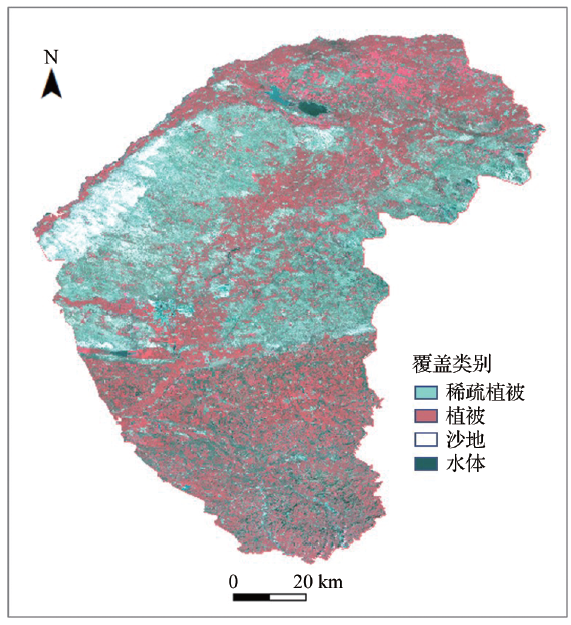
Dynamic changes in land use are vital for ecological balance and sustainable development. Based on the case of Naiman Banner in Tongliao City, Inner Mongolia, time-series remote sensing data were examined to monitor changes in land use and conduct spatiotemporal analysis to support the sustainable development of this region. Given the complexities of this agro-pastoral region, the seasonal characteristics of time-series satellite imagery were utilized to produce high-precision land use products. Based on which, this study analyzes the spatiotemporal changes in land use in Naiman Banner over the past 40 years and assesses the ecological impacts of various land use changes. The results indicate differentiated spatiotemporal characteristics in land use, with the northern region exhibiting trends of desertification recovery, urban expansion, and an increase in arable land, while the southern mountainous areas show a trend of returning farmland to grass and forest. Factor contribution analysis reveals that changes in agricultural land use, ecological recovery from desertification, and deceased surface water significantly affect soil moisture content in the area, underscoring the importance of water-saving agriculture, ecological restoration of sandy areas, and water resource protection for sustainable agricultural development. This study provides important data for land resource management in Naiman Banner and offers scientific evidence for sustainable development strategies in this region, facilitating the coordinated advancement of ecological environments and economic development.
Key words: Naiman Banner; Land use; Remote sensing analysis; Desertification; Soil moisture
Yong XU , Di HU , Liang HONG . Spatial-Temporal Analysis of Land Use/Cover Change in Naiman Banner over the Past 40 Years[J]. Advances in Earth Science, 2025 , 40(12) : 1297 -1306 . DOI: 10.11867/j.issn.1001-8166.2025.089
| [1] | ZHAO Jie, ZHAO Shidong. Study on land cover/use change in Naiman Banner based on RS and GIS[J]. Arid Zone Geography, 2004, 27(3): 414-418. |
| 赵杰, 赵士洞. 基于 RS, GIS 的奈曼旗土地覆盖/利用变化研究[J]. 干旱区地理, 2004, 27(3): 414-418. | |
| [2] | YIN H, PFLUGMACHER D, LI A, et al. Land use and land cover change in Inner Mongolia-understanding the effects of China’s re-vegetation programs[J]. Remote Sensing of Environment, 2018, 204: 918-930. |
| [3] | DUAN Hanchen, WANG Tao, XUE Xian, et al. Spatiotemporal evolution and landscape pattern of desertification in the Horqin Sandy Land: a case study of Naiman Banner, Inner Mongolia Autonomous Region[J]. Acta Geographica Sinica, 2012, 67(7): 917-928. |
| 段翰晨, 王涛, 薛娴, 等. 科尔沁沙地沙漠化时空演变及其景观格局[J]. 地理学报, 2012, 67(7): 917-928. | |
| [4] | LI Xuliang, YANG Lixiao, TIAN Wei, et al. Review of land use/cover change in the agro-pastoral transition zone of northern China[J]. Journal of Applied Ecology, 2018, 29(10): 3 487-3 495. |
| 李旭亮, 杨礼箫, 田伟, 等. 中国北方农牧交错带土地利用/覆盖变化研究综述[J]. 应用生态学报, 2018, 29(10): 3 487-3 495. | |
| [5] | LIU Feng, YANG Guang, HAN Xueying, et al. Dynamic monitoring of ecological environment quality in the Horqin Sandy Land using remote sensing[J]. Soil and Water Conservation Research, 2020, 27(5): 244-249. |
| 刘峰,杨光,韩雪莹,等. 科尔沁沙地生态环境质量遥感动态监测[J]. 水土保持研究, 2020, 27(5): 244-249. | |
| [6] | HAO J M, LIN Q R, WU T H, et al. Spatial-temporal and driving factors of land use/cover change in Mongolia from 1990 to 2021[J]. Remote Sensing, 2023, 15(7). DOI:10.3390/rs15071813 . |
| [7] | ZHANG X, LIU L Y, CHEN X D, et al. GLC_FCS30: global land-cover product with fine classification system at 30?m using time-series Landsat imagery[J]. Earth System Science Data, 2021, 13(6): 2 753-2 776. |
| [8] | MOUSIVAND A, ARSANJANI J J. Insights on the historical and emerging global land cover changes: the case of ESA-CCI-LC datasets[J]. Applied Geography, 2019, 106: 82-92. |
| [9] | STANIMIROVA R, TARRIO K, TURLEJ K, et al. A global land cover training dataset from 1984 to 2020[J]. Scientific Data, 2023, 10. DOI:10.1038/s41597-023-02798-5 . |
| [10] | ARINO O, GROSS D, RANERA F, et al. GlobCover: ESA service for global land cover from MERIS[C]// 2007 IEEE international geoscience and remote sensing symposium. Barcelona, Spain: IEEE, 2007. DOI:10.1109/igarss.2007.4423328 . |
| [11] | HUA T, ZHAO W W, LIU Y X, et al. Spatial consistency assessments for global land-cover datasets: a comparison among GLC2000, CCI LC, MCD12, GLOBCOVER and GLCNMO[J]. Remote Sensing, 2018, 10(11). DOI:10.3390/rs10111846 . |
| [12] | LIU L Y, ZHANG X, GAO Y, et al. Finer-resolution mapping of global land cover: recent developments, consistency analysis, and prospects[J]. Journal of Remote Sensing, 2021, 2021. DOI: 10.34133/2021/5289697 . |
| [13] | XU P P, TSENDBAZAR N E, HEROLD M, et al. Comparative validation of recent 10 m-resolution global land cover maps[J]. Remote Sensing of Environment, 2024, 311. DOI:10.1016/j.rse.2024.114316 . |
| [14] | CHEN J, CHEN J, LIAO A P, et al. Global land cover mapping at 30 m resolution: a POK-based operational approach[J]. ISPRS Journal of Photogrammetry and Remote Sensing, 2015, 103: 7-27. |
| [15] | YANG J, HUANG X. 30 m annual land cover and its dynamics in China from 1990 to 2019[J]. Earth System Science Data Discussions, 2021, 13(8): 3 907-3 925. |
| [16] | CHEN B, XU B, GONG P. Mapping Essential Urban Land Use Categories (EULUC) using geospatial big data: progress, challenges, and opportunities[J]. Big Earth Data, 2021, 5(3): 410-441. |
| [17] | XU Y, REN C, CAI M, et al. Classification of local climate zones using ASTER and landsat data for high-density cities[J]. IEEE Journal of Selected Topics in Applied Earth Observations and Remote Sensing, 2017, 10(7): 3 397-3 405. |
| [18] | SUN W Y, DING X T, SU J B, et al. Land use and cover changes on the Loess Plateau: a datasets[J]. Land Use Policy, 2022, 119. DOI: 10.1016/j.landusepol.2022.106165 . |
| [19] | WANG Y Z, SUN Y H, CAO X Y, et al. A review of regional and global scale Land Use/Land Cover (LULC) mapping products generated from satellite remote sensing[J]. ISPRS Journal of Photogrammetry and Remote Sensing, 2023, 206: 311-334. |
| [20] | ZHAO Kai, YUE Yongjie, HE Rong, et al. Study on the spatial distribution of land desertification sensitivity in Naiman Banner[J]. Forest Resources Management, 2022(1): 52-60. |
| 赵恺, 岳永杰, 贺嵘, 等. 奈曼旗土地沙漠化敏感性空间分布研究[J]. 林业资源管理, 2022(1): 52-60. | |
| [21] | ZHANG L, LI X, ZHENG D H, et al. Merging multiple satellite-based precipitation products and gauge observations using a novel double machine learning approach[J]. Journal of Hydrology, 2021, 594. DOI:10.1016/j.jhydrol.2021.125969 . |
| [22] | ZHANG Fuquan. A brief analysis of the trends in groundwater level changes in Naiman Banner, Tongliao City[J]. Inner Mongolia Water Resources, 2019(9): 22-23. |
| 张福泉. 浅析通辽市奈曼旗地下水位变化趋势[J]. 内蒙古水利, 2019(9):22-23. | |
| [23] | CHEN Xueping, ZHAO Xueyong, ZHUANG Haiyan, et al. Characteristics of groundwater depth in Naiman, Inner Mongolia in 1985-2020[J]. Journal of Desert Research, 2025, 45(4): 166-175. |
| 陈雪萍, 赵学勇, 庄海艳, 等. 内蒙古奈曼旗1985—2020年地下水埋深时空变化特征[J]. 中国沙漠, 2025, 45(4): 166-175. |
/
| 〈 |
|
〉 |
 甘公网安备62010202000687