Advances in Resource Potential and Mineralization Mechanism of REY in Marine Apatite-rich Sediment
Received date: 2025-06-18
Revised date: 2025-08-04
Online published: 2025-10-31
Supported by
the Open Research Fund of the State Key Laboratory of Critical Earth Material Cycling and Mineral Deposits, Nanjing University(2024-LAMD-K02)
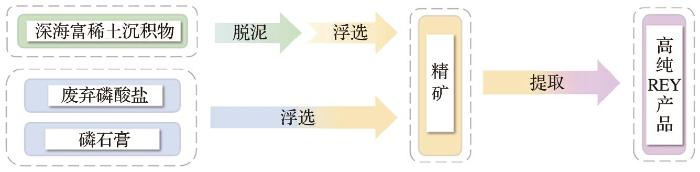
Rare Earth Elements and Yttrium (REY) are one of the most critical strategic resources in the world today. However, the intensive exploitation and supply of conventional rare metal deposits—primarily those associated with alkaline igneous rocks and ion-adsorption clays, have led to mounting challenges for the rare earth industry, including declining resource security and increasing environmental pressure. This situation underscores the urgent need to seek alternative rare earth resources. Sedimentary phosphate rocks and deep sea REY-rich sediments have emerged as promising alternatives. They are widely distributed, possess large reserves, and are enriched in heavy rare earth elements. In recent years, considerable research have focused on the REY resource potential and mineralization mechanism of these two deposits. They found that there are several economically valuable the mineral concentrated area, distributing globally. Several studies have established mining and utilization models and developed REY extraction strategies. In terms of the ore formation mechanism, current knowledge suggests that the enrichment of REY in deep-sea sediments and phosphorus deposits is closely tied to phosphorus-enrichment, although these deposits have certain differences in terms of occurrence form, mineralization environment, and rare earth source, etc. Sorption at mineral-solution interface along with early diagenesis, are considered as the key processes to REY enrichment. However, Most of these studies were published in the past 15 years, and their systematicness and depth still fall short. For example, despite their potential, commercial development remains constrained by technical, environmental, and economic challenges—including mining equipment limitations, ecological risks, and uncertain market revenues. As a result, large-scale industrial extraction from deep-sea sediments has yet to be realized. Additionally, REY enrichment mechanisms is poorly understood. In the future, multidisciplinary collaboration will be essential. Collaborative research involving multiple disciplines and multiple technical methods will enable more precise estimation of resource reserves and contribute to the metallogenic enrichment theories. This paper provides a comprehensive overview of recent advances in the understanding of the rare earth resource replacement potential and offers perspectives for future research directions in this field.
Yufan YUAN , Wenxian GOU , Yihan LIU , Yi HUANG , Chao REN , Wei LI . Advances in Resource Potential and Mineralization Mechanism of REY in Marine Apatite-rich Sediment[J]. Advances in Earth Science, 2025 , 40(11) : 1148 -1165 . DOI: 10.11867/j.issn.1001-8166.2025.056
| [1] | ELISEEVA S V, BüNZLI J G. Rare earths: jewels for functional materials of the future[J]. New Journal of Chemistry, 2011, 35(6): 1 165-1 176. |
| [2] | HATCH G P. Dynamics in the global market for rare earths[J]. Elements, 2012, 8(5): 341-346. |
| [3] | Geological Survey U.S.. Mineral commodity summaries 2024[R]. Mineral Commodity Summaries, 2024. |
| [4] | HE Hongping, YANG Wubin. REE mineral resources in China: review and perspective[J]. Geotectonica et Metallogenia, 2022, 46(5): 829-841. |
| 何宏平, 杨武斌. 我国稀土资源现状和评价[J]. 大地构造与成矿学, 2022, 46(5): 829-841. | |
| [5] | FAN Hongrui, NIU Hecai, LI Xiaochun, et al. The types, ore genesis and resource perspective of endogenic REE deposits in China[J]. Chinese Science Bulletin, 2020, 65(33): 3 778-3 793. |
| 范宏瑞, 牛贺才, 李晓春, 等. 中国内生稀土矿床类型、成矿规律与资源展望[J]. 科学通报, 2020, 65(33): 3 778-3 793. | |
| [6] | HUMPHRIES M. Rare earth elements: the global supply chain[R]. Congressional Research Service Report for Congress, 2010. |
| [7] | LIAO J L, CHEN J Y, SUN X M, et al. Controlling factors on REY enrichments in basins from the Pacific Ocean: early diagenesis and local constraints[J]. Geochemistry, Geophysics, Geosystems, 2024, 25(1). DOI: 10.1029/2023gc011111 . |
| [8] | KATO Y, FUJINAGA K, NAKAMURA K, et al. Deep-sea mud in the Pacific Ocean as a potential resource for rare-earth elements[J]. Nature Geoscience, 2011, 4: 535-539. |
| [9] | ZHANG X Y, TAO C H, SHI X F, et al. Geochemical characteristics of REY-rich pelagic sediments from the GC02 in central Indian Ocean Basin[J]. Journal of Rare Earths, 2017, 35(10): 1 047-1 058. |
| [10] | MENENDEZ A, JAMES R H, ROBERTS S, et al. Controls on the distribution of rare earth elements in deep-sea sediments in the North Atlantic Ocean[J]. Ore Geology Reviews, 2017, 87: 100-113. |
| [11] | HUANG S C, FU Y Z. Enrichment characteristics and mechanisms of critical metals in marine Fe-Mn crusts and nodules: a review[J]. Minerals, 2023, 13(12). DOI: 10.3390/min13121532 . |
| [12] | ZHAO Zesong. A review on the leaching and extraction of rare earth elements associated with phosphate ore [J]. Chemical Enterprise Management, 2015(26): 232. |
| 赵泽松. 磷矿中伴生稀土元素的浸出与提取综述[J]. 化工管理, 2015(26): 232. | |
| [13] | CHRISTMANN P. A forward look into rare earth supply and demand: a role for sedimentary phosphate deposits?[J]. Procedia Engineering, 2014, 83: 19-26. |
| [14] | SANTOS A J G, MAZZILLI B P, FáVARO D I T, et al. Partitioning of radionuclides and trace elements in phosphogypsum and its source materials based on sequential extraction methods[J]. Journal of Environmental Radioactivity, 2006, 87(1): 52-61. |
| [15] | JORJANI E, SHAHBAZI M. The production of rare earth elements group via tributyl phosphate extraction and precipitation stripping using oxalic acid[J]. Arabian Journal of Chemistry, 2016, 9: S1532-S1539. |
| [16] | NAGAPHANI K B, RADHIKA S, RAMACHANDRA R B. Solid-liquid extraction of heavy rare-earths from phosphoric acid solutions using Tulsion CH-96 and T-PAR resins[J]. Chemical Engineering Journal, 2010, 160(1): 138-144. |
| [17] | DENG Shanzhi, DENG Jie, XIONG Wenliang, et al. Mineral features and current utilization situation of the rare earth resource in the deep-sea sediments[J]. Multipurpose Utilization of Mineral Resources, 2018(4): 17-22. |
| 邓善芝, 邓杰, 熊文良, 等. 深海沉积物中稀土资源特征及开发利用现状[J]. 矿产综合利用, 2018(4): 17-22. | |
| [18] | CHANG Lin, ZHANG Yongbo, MA Zhe, et al. Research frontiers in exploitation and utilization of rare earth mineral resources in the deep-sea sediments[J]. Marine Geology Frontiers, 2022, 38(12): 1-7. |
| 常琳, 张永波, 马哲, 等. 深海稀土矿产资源研究现状及开发利用前景[J]. 海洋地质前沿, 2022, 38(12): 1-7. | |
| [19] | ZHU Kechao, REN Jiangbo, WANG Haifeng, et al. Enrichment mechanism of REY and geochemical characteristics of REY-rich pelagic clay from the central Pacific[J]. Earth Science, 2015, 40(6): 1 052-1 060. |
| 朱克超, 任江波, 王海峰, 等. 太平洋中部富REY深海粘土的地球化学特征及REY富集机制[J]. 地球科学, 2015, 40(6): 1 052-1 060. | |
| [20] | ZHANG Kuifang, WU Yukun, LIU Zhiqiang, et al. Extraction of yttrium from hydrochloric acid leaching solution of pelagic clay from central Pacific[J]. Journal of the Chinese Society of Rare Earths, 2016, 34(1): 62-69. |
| 张魁芳, 吴宇坤, 刘志强, 等. 从太平洋中部深海粘土盐酸浸出液中萃取回收钇的研究[J]. 中国稀土学报, 2016, 34(1): 62-69. | |
| [21] | YANG Yamin, ZENG Zhigang, YIN Xuebo, et al. Advances in research on the host and the enrichment mechanism of REY-rich mud in deep-sea sediments[J]. Marine Sciences, 2019, 43(8): 93-107. |
| 杨娅敏, 曾志刚, 殷学博, 等. 深海富REY泥中稀土元素赋存载体及其富集机制研究进展[J]. 海洋科学, 2019, 43(8): 93-107. | |
| [22] | ZHANG Xiaoyu, SHI Xuefa, HUANG Mu, et al. Some problems in research of deep sea rare earth rich deposit[J]. Journal of the Chinese Society of Rare Earths, 2019, 37(5): 517-529. |
| 张霄宇, 石学法, 黄牧, 等. 深海富稀土沉积研究的若干问题[J]. 中国稀土学报, 2019, 37(5): 517-529. | |
| [23] | EMSBO P, MCLAUGHLIN P I, BREIT G N, et al. Rare earth elements in sedimentary phosphate deposits: solution to the global REE crisis?[J]. Gondwana Research, 2015, 27(2): 776-785. |
| [24] | Guizhou Provincial Department of Land and Resources. Guizhou Provincial land and resources bulletin[R]. Guiyang: Guizhou Provincial Department of Land and Resources, 2013. |
| 贵州省国土厅. 贵州省国土资源公告[R]. 贵阳: 贵州省国土厅, 2013. | |
| [25] | TAKAYA Y, YASUKAWA K, KAWASAKI T, et al. The tremendous potential of deep-sea mud as a source of rare-earth elements[J]. Scientific Reports, 2018, 8(1). DOI: 10.1038/s41598-018-23948-5 . |
| [26] | HONG S K, KIM Y, KIM Y M. Assessment of REY resource potential in deep-sea sediments with Fe-Mn (oxyhydr)oxides in the Pacific Ocean[J]. Journal of Geochemical Exploration, 2024, 267. DOI: 10.1016/j.gexplo.2024.107581 . |
| [27] | JIANG Xunxiong, FENG Linyong. Comprehensive utilization of the associated rare earth in phosphate ore[C]// Chinese Society for Sustain-able Development. Special issue of the China sustainable devel-opment forum 2011(I). Beijing: General Research Institute of Mining and Metallurgy, 2011: 201-205. |
| 蒋训雄, 冯林永. 磷矿中伴生稀土资源综合利用[C]//中国可持续发展研究会. 2011中国可持续发展论坛2011年专刊(一). 北京:矿冶研究总院, 2011: 201-205. | |
| [28] | DAR S A, BALARAM V, ROY P, et al. Phosphorite deposits: a promising unconventional resource for rare earth elements[J]. Geoscience Frontiers, 2025, 16(3). DOI: 10.1016/j.gsf.2025.102044 . |
| [29] | LI D F, PENG J Z, CHEW D, et al. Dating rare earth element enrichment in deep-sea sediments using U-Pb geochronology of bioapatite[J]. Geology, 2023, 51(5): 428-433. |
| [30] | IIJIMA K, YASUKAWA K, FUJINAGA K, et al. Discovery of extremely REY-rich mud in the western north Pacific Ocean[J]. Geochemical Journal, 2016, 50(6): 557-573. |
| [31] | BI D J, SHI X F, HUANG M, et al. Geochemical and mineralogical characteristics of deep-sea sediments from the western North Pacific Ocean: constraints on the enrichment processes of rare earth elements[J]. Ore Geology Reviews, 2021, 138. DOI: 10.1016/j.oregeorev.2021.104318 . |
| [32] | DENG Y N, REN J B, GUO Q J, et al. Rare earth element geochemistry characteristics of seawater and porewater from deep sea in western Pacific[J]. Scientific Reports, 2017, 7(1).DOI: 10.1038/s41598-017-16379-1 . |
| [33] | LIAO J L, SUN X M, WU Z W, et al. Fe-Mn (oxyhydr)oxides as an indicator of REY enrichment in deep-sea sediments from the central North Pacific[J]. Ore Geology Reviews, 2019, 112. DOI: 10.1016/j.oregeorev.2019.103044 . |
| [34] | PAUL S A L, VOLZ J B, BAU M, et al. Calcium phosphate control of REY patterns of siliceous-ooze-rich deep-sea sediments from the central equatorial Pacific[J]. Geochimica et Cosmochimica Acta, 2019, 251: 56-72. |
| [35] | LIAO J L, CHEN J Y, SUN X M, et al. Quantifying the controlling mineral phases of rare-earth elements in deep-sea pelagic sediments[J]. Chemical Geology, 2022, 595. DOI: 10.1016/j.chemgeo.2022.120792 . |
| [36] | SA R N, SUN X M, HE G W, et al. Enrichment of rare earth elements in siliceous sediments under slow deposition: a case study of the central North Pacific[J]. Ore Geology Reviews, 2018, 94: 12-23. |
| [37] | XU Y H, LI D Y, YANG Y A, et al. Uptake time and enrichment mechanism of rare earth elements in deep-sea bioapatite[J]. Chemical Geology, 2024, 669. DOI: 10.1016/j.chemgeo.2024.122371 . |
| [38] | YASUKAWA K, OHTA J, MIMURA K, et al. A new and prospective resource for scandium: evidence from the geochemistry of deep-sea sediment in the western North Pacific Ocean[J]. Ore Geology Reviews, 2018, 102: 260-267. |
| [39] | YASUKAWA K, OHTA J, MIYAZAKI T, et al. Statistic and isotopic characterization of deep-sea sediments in the western north Pacific Ocean: implications for genesis of the sediment extremely enriched in rare earth elements[J]. Geochemistry, Geophysics, Geosystems, 2019, 20(7): 3 402-3 430. |
| [40] | MIMURA K, NAKAMURA K, YASUKAWA K, et al. Significant impacts of pelagic clay on average chemical composition of subducting sediments: new insights from discovery of extremely rare-earth elements and yttrium-rich mud at Ocean Drilling Program Site 1149 in the western North Pacific Ocean[J]. Journal of Asian Earth Sciences, 2019, 186. DOI: 10.1016/j.jseaes.2019.104059 . |
| [41] | FUJINAGA K, YASUKAWA K, NAKAMURA K, et al. Geochemistry of REY-rich mud in the Japanese exclusive economic zone around minamitorishima island[J]. Geochemical Journal, 2016, 50(6): 575-590. |
| [42] | TANAKA E, NAKAMURA K, YASUKAWA K, et al. Chemostratigraphy of deep-sea sediments in the western north Pacific Ocean: implications for genesis of mud highly enriched in rare-earth elements and yttrium[J]. Ore Geology Reviews, 2020, 119. DOI: 10.1016/j.oregeorev.2020.103392 . |
| [43] | REN Jiangbo, YAO Huiqiang, ZHU Kechao, et al. Enrichment mechanism of rare earth elements and yttrium in deep-sea mud of Clarion-Clipperton region[J]. Earth Science Frontiers, 2015, 22(4): 200-211. |
| 任江波, 姚会强, 朱克超, 等. 稀土元素及钇在东太平洋CC区深海泥中的富集特征与机制[J]. 地学前缘, 2015, 22(4): 200-211. | |
| [44] | WANG Tianyi, DONG Yanhui, CHU Fengyou, et al. Classification and genesis of deep-sea REY-rich sediments in the Pacific Ocean[J]. Journal of Marine Sciences, 2024, 42(1): 23-35. |
| 王添翼, 董彦辉, 初凤友, 等. 太平洋深海富稀土沉积物的分类及成因[J]. 海洋学研究, 2024, 42(1): 23-35. | |
| [45] | VALETICH M, ZIVAK D, SPANDLER C, et al. REE enrichment of phosphorites: an example of the Cambrian Georgina Basin of Australia[J]. Chemical Geology, 2022, 588. DOI: 10.1016/j.chemgeo.2021.120654 . |
| [46] | LINARES E, VELASQUEZ G, MANRIQUE J, et al. REE +Y signatures of the Navay phosphate deposit, SW Venezuela: seawater paleoredox conditions and diagenetic implications[J]. Journal of South American Earth Sciences, 2023, 129. DOI: 10.2139/ssrn.4379723 . |
| [47] | BUCCIONE R, KECHICHED R, MONGELLI G, et al. REEs in the north Africa P-bearing deposits, paleoenvironments, and economic perspectives: a review[J]. Minerals, 2021, 11(2). DOI: 10.3390/min11020214 . |
| [48] | AHMED A H, ASERI A A, ALI K A. Geological and geochemical evaluation of phosphorite deposits in northwestern Saudi Arabia as a possible source of trace and rare-earth elements[J]. Ore Geology Reviews, 2022, 144. DOI: 10.1016/j.oregeorev.2022.104854 . |
| [49] | XIE Yuling, QIN Xuyan, DAI Zuowen, et al. By-product rare earth elements deposits in China and their resource potential[J]. Journal of Geomechanics, 2024, 30(5): 723-746. |
| 谢玉玲, 秦绪岩, 代作文, 等. 中国伴生稀土元素资源类型及资源潜力[J]. 地质力学学报, 2024, 30(5): 723-746. | |
| [50] | XIE Y L, VERPLANCK P L, HOU Z Q, et al. Chapter 12 rare earth element deposits in China: a review and new understandings[J]. Economic Geology, 2019, 22. DOI: 10.5382/SP.22 . |
| [51] | SHI Xuefa, BI Dongjie, HUANG Mu, et al. Distribution and metallogenesis of deep-sea rare earth elements[J]. Geological Bulletin of China, 2021, 40(2/3): 195-208. |
| 石学法, 毕东杰, 黄牧, 等. 深海稀土分布规律与成矿作用[J]. 地质通报, 2021, 40(2/3): 195-208. | |
| [52] | HE Gaowen, WANG Haifeng, REN Jiangbo, et al. Research on the metallogenic mechanism of deep sea sedimentary mineral resources: review and outlook[J]. Acta Geologica Sinica, 2024, 98(11): 3 202-3 212. |
| 何高文, 王海峰, 任江波, 等. 深海沉积矿产成矿机制研究: 进展与展望[J]. 地质学报, 2024, 98(11): 3 202-3 212. | |
| [53] | HUANG Mu, SHI Xuefa, BI Dongjie, et al. Advances on study of exploration and development of deep-sea rare earth resources[J]. The Chinese Journal of Nonferrous Metals, 2021, 31(10): 2 665-2 681. |
| 黄牧, 石学法, 毕东杰, 等. 深海稀土资源勘查开发研究进展[J]. 中国有色金属学报, 2021, 31(10): 2 665-2 681. | |
| [54] | YANG Jianmin, LIU Lei, Haining Lü, et al. Deep-sea mining equipment in China: current status and prospect[J]. Strategic Study of CAE, 2020, 22(6): 1-9. |
| 杨建民, 刘磊, 吕海宁, 等. 我国深海矿产资源开发装备研发现状与展望[J]. 中国工程科学, 2020, 22(6): 1-9. | |
| [55] | YASUKAWA K, NAKAMURA K, FUJINAGA K, et al. Tracking the spatiotemporal variations of statistically independent components involving enrichment of rare-earth elements in deep-sea sediments[J]. Scientific Reports, 2016, 6: 29 603-29 615. |
| [56] | WANG Fenlian, HE Gaowen, REN Jiangbo, et al. Comparative study on the geochemical characteristics of rare earth elements in deep-sea sediments from different regions of the Pacific Ocean[J]. Acta Petrologica Sinica, 2023, 39(3): 719-730. |
| 王汾连, 何高文, 任江波, 等. 太平洋不同海域深海沉积物的稀土元素地球化学特征对比研究[J]. 岩石学报, 2023, 39(3): 719-730. | |
| [57] | LIANG Huijia, YANG Jie, HAN Changye, et al. Analysis of the extraction and utilization of the associated rare earth in phosphate ore[J]. Yunnan Chemical Technology, 2024, 51(): 49-51. |
| 梁惠佳, 杨杰, 韩昌业, 等. 磷矿中伴生稀土的提取和利用探析[J]. 云南化工, 2024, 51(): 49-51. | |
| [58] | OUYANG Anni, XIONG Wenliang, ZHOU Zheng, et al. Mineral features and current extraction situation of rare earth resources in deep-sea deposit[J]. Multipurpose Utilization of Mineral Resources, 2023(4): 71-77. |
| 欧阳安妮, 熊文良, 周政, 等. 深海富稀土沉积物中稀土资源特征及其分离提取现状[J]. 矿产综合利用, 2023(4): 71-77. | |
| [59] | ZHENG Kai, XIA Yong, WEN Xiaoying, et al. Development of concentration and extraction of rare earth from rare earth-containing phosphorite[J]. Conservation and Utilization of Mineral Resources, 2017, 37(5): 93-98. |
| 郑凯, 夏勇, 温小英, 等. 从伴生稀土磷矿中富集与提取稀土元素的研究进展[J]. 矿产保护与利用, 2017, 37(5): 93-98. | |
| [60] | CHEN Manzhi, FU Yong, XIA Yong, et al. A prospective analysis on REE resources of the phosphorite-type REE ore deposits in China[J]. Acta Mineralogica Sinica, 2019, 39(4): 345-358. |
| 陈满志, 付勇, 夏勇, 等. 中国磷块岩型稀土矿资源前景分析[J]. 矿物学报, 2019, 39(4): 345-358. | |
| [61] | KANDIL A T, ALY M M, MOUSSA E M, et al. Column leaching of lanthanides from Abu Tartur phosphate ore with kinetic study[J]. Journal of Rare Earths, 2010, 28(4): 576-580. |
| [62] | LIU Zhiqiang, WU Yukun, ZHANG Kuifang, et al. Acid leaching of rare earth yttrium in pelagic clay from central Pacific Ocean[J]. Mining and Metallurgical Engineering, 2017, 37(3): 94-96, 100. |
| 刘志强, 吴宇坤, 张魁芳, 等. 太平洋中部深海粘土中稀土钇的酸浸研究[J]. 矿冶工程, 2017, 37(3): 94-96, 100. | |
| [63] | YANG Wenjuan, HE Binbin, ZHU Guihua, et al. Review on the technology of wet-process phosphoric acid from phosphate rock[J]. Phosphate & Compound Fertilizer, 2022, 37(8): 26-28. |
| 杨文娟, 何宾宾, 朱桂华, 等. 磷矿制湿法磷酸技术综述[J]. 磷肥与复肥, 2022, 37(8): 26-28. | |
| [64] | GAO Wenlong, ZHANG Jiangang, CHEN Xuehang, et al. Research progress in extraction of phosphorite associated rare earths[J]. Inorganic Chemicals Industry, 2017, 49(9): 5-8. |
| 高文龙, 张建刚, 陈学航, 等. 磷矿伴生稀土提取研究进展[J]. 无机盐工业, 2017, 49(9): 5-8. | |
| [65] | ZHAO Xinju, QIN Ling, LI Huping, et al. Summary of leaching and extraction for the associated rare-earth elements in the phosphorus ore[J]. Science & Technology in Chemical Industry, 2014, 22(2): 65-69. |
| 赵新菊, 秦令, 李沪萍, 等. 磷矿中伴生稀土元素的浸出与提取综述[J]. 化工科技, 2014, 22(2): 65-69. | |
| [66] | FENG Linyong, JIANG Xunxiong, WANG Shengdong, et al. Recovery of heavy rare earth elements from phosphorite[J]. Nonferrous Metals (Extractive Metallurgy), 2012(2): 34-36. |
| 冯林永, 蒋训雄, 汪胜东, 等. 磷矿中伴生重稀土的提取[J]. 有色金属(冶炼部分), 2012(2): 34-36. | |
| [67] | JU J R, FENG Y L, LI H R, et al. Mineralogical characterization of deep-sea sediments from a grain size perspective: implications for commercial REE recovery[J]. Minerals Engineering, 2024, 216. DOI: 10.1016/j.mineng.2024.108891 . |
| [68] | LI Chaorong, SU Shu, YANG Xiushan, et al. Research progress of wet phosphoric acid process by nitric acid method[C]// Chinese Society for Environmental Sciences, Proceedings of the 2020 annual conference of the chinese society for environmental sciences(I). Nanjing, 2020: 557-561. |
| 李朝荣, 苏殊, 杨秀山, 等. 硝酸法湿法磷酸工艺的研究进展[C]// 中国环境科学学会, 中国环境科学学会科学技术年会论文集(第一卷). 南京, 2020: 557-561. | |
| [69] | KUANG Jingzhong, XIAO Kunming, ZENG Junlong. Progress in research on rare earth recovery from bauxite, phosphorite and Nb-Ta minerals[J]. Chinese Rare Earths, 2021, 33(1): 81-85. |
| 匡敬忠, 肖坤明, 曾军龙. 从铝土矿、磷矿及铌钽矿中综合回收稀土的研究进展[J]. 稀土, 2012, 33(1): 81-85. | |
| [70] | WANG Shengdong, JIANG Kaixi, JIANG Xunxiong, et al. Study on leaching of rare earth in preparing phosphoric acid with nitric acid[J]. Nonferrous Metals (Extractive Metallurgy), 2011(8): 25-27. |
| 汪胜东, 蒋开喜, 蒋训雄, 等. 硝酸法生产磷酸过程中稀土的浸出研究[J]. 有色金属(冶炼部分), 2011(8): 25-27. | |
| [71] | FENG Linyong, JIANG Xunxiong, WANG Shengdong, et al. Study on kinetics model of leaching of REES with phosphoric acid[J]. Nonferrous Metals (Extractive Metallurgy), 2016(1): 18-21. |
| 冯林永, 蒋训雄, 汪胜东, 等. 磷酸法中稀土溶出的动力学模型研究[J]. 有色金属(冶炼部分), 2016(1): 18-21. | |
| [72] | BASHIR M, KIM S H, KIOSODOU E, et al. A concept for seabed rare earth mining in the eastern South Pacific[M]// The LRET collegium 2012 series. Southampton: University of Southampton, 2012. |
| [73] | NAKAMURA K, FUJINAGA K, YASUKAWA K, et al. Chapter 268-REY-rich mud: a deep-sea mineral resource for rare earths and Yttrium[M]// Handbook on the physics and chemistry of rare earths. Elsevier Science & Technology, 2015. |
| [74] | CHAI Zhifang, MAO Xueying, MA Shulan. Research progress on the nitric acid process for wet-process phosphoric acid[J]. Chinese Science Bulletin, 1985(24):1 898-1 899. |
| 柴之芳, 毛雪瑛, 马淑兰. 硝酸法湿法磷酸工艺的研究进展[J]. 科学通报, 1985(24): 1 898-1 899. | |
| [75] | NEIRA P, ROMERO-FREIRE A, BASALLOTE M D, et al. Review of the concentration, bioaccumulation, and effects of lanthanides in marine systems[J]. Frontiers in Marine Science, 2022, 9. DOI: 10.3389/fmars.2022.920405 . |
| [76] | LéCUYER C. Seawater residence times of some elements of geochemical interest and the salinity of the oceans[J]. Bulletin de la Société Géologique de France, 2016, 187(6): 245-260. |
| [77] | ABBOTT A N, HALEY B A, MCMANUS J, et al. The sedimentary flux of dissolved rare earth elements to the ocean[J]. Geochimica et Cosmochimica Acta, 2015, 154: 186-200. |
| [78] | ZHENG X Y, PLANCHEREL Y, SAITO M A, et al. Rare Earth Elements (REEs) in the tropical South Atlantic and quantitative deconvolution of their non-conservative behavior[J]. Geochimica et Cosmochimica Acta, 2016, 177: 217-237. |
| [79] | PIEPGRAS D J, JACOBSEN S B. The behavior of rare earth elements in seawater: precise determination of variations in the North Pacific water column[J]. Geochimica et Cosmochimica Acta, 1992, 56(5): 1 851-1 862. |
| [80] | SCHIJF J, CHRISTENSON E A, BYRNE R H. YREE scavenging in seawater: a new look at an old model[J]. Marine Chemistry, 2015, 177: 460-471. |
| [81] | ELDERFIELD H, GREAVES M J. The rare earth elements in seawater[J]. Nature, 1982, 296: 214-219. |
| [82] | ZHANG J, NOZAKI Y. Rare earth elements and yttrium in seawater: ICP-MS determinations in the East Caroline, Coral Sea, and South Fiji basins of the western South Pacific Ocean[J]. Geochimica et Cosmochimica Acta, 1996, 60(23): 4 631-4 644. |
| [83] | HALEY B A, KLINKHAMMER G P, MCMANUS J. Rare earth elements in pore waters of marine sediments[J]. Geochimica et Cosmochimica Acta, 2004, 68(6): 1 265-1 279. |
| [84] | MILAKOVSKA Z, HIKOV A, STOYANOVA V, et al. REY in pore waters of sediments hosting Fe-Mn nodules of the Interoceanmetal exploration area in the Clarion-Clipperton Fracture Zone, NE Pacific[J]. Geologica Balcanica, 2022, 51(2): 27-35. |
| [85] | SMRZKA D, ZWICKER J, BACH W, et al. The behavior of trace elements in seawater, sedimentary pore water, and their incorporation into carbonate minerals: a review[J]. Facies, 2019, 65(4). DOI: 10.1007/s10347-019-0581-4 . |
| [86] | ZHOU T C, SHI X F, HUANG M, et al. The influence of hydrothermal fluids on the REY-rich deep-sea sediments in the yupanqui basin, eastern south Pacific Ocean: constraints from bulk sediment geochemistry and mineralogical characteristics[J]. Minerals, 2020, 10(12). DOI: 10.3390/min10121141 . |
| [87] | LI J, HUANG M, YU M, et al. Provenance and sedimentary environment of REY-rich sediments from the Wharton Basin, Indian Ocean[J]. Journal of Asian Earth Sciences, 2024, 263. DOI: 10.1016/j.jseaes.2023.105996 . |
| [88] | XIANG B, DONG Y H, HAN X B, et al. Enrichment of smectite in the REY-rich mud of the clarion-clipperton fracture zone in the eastern Pacific and its geological significance[J]. Geochemistry, Geophysics, Geosystems, 2024, 25(2). DOI:10.1029/2023GC011283 . |
| [89] | REN J B, LIU Y, WANG F L, et al. Mechanism and influencing factors of REY enrichment in deep-sea sediments[J]. Minerals, 2021, 11(2). DOI: 10.3390/min11020196 . |
| [90] | KASHIWABARA T, TODA R, NAKAMURA K, et al. Synchrotron X-ray spectroscopic perspective on the formation mechanism of REY-rich muds in the Pacific Ocean[J]. Geochimica et Cosmochimica Acta, 2018, 240: 274-292. |
| [91] | LI J, SHI X F, HUANG M, et al. The transformation and accumulation mechanism of rare earth elements in deep-sea sediments from the Wharton Basin, Indian Ocean[J]. Ore Geology Reviews, 2023, 161. DOI: 10.1016/j.oregeorev.2023.105655 . |
| [92] | WANG J Y, QIAO Z K. Study on the material source and enrichment mechanism of REE-rich phosphorite in Zhijin, Guizhou[J]. Scientific Reports, 2024, 14(1). DOI: 10.1038/s41598-024-57074-2 . |
| [93] | MANCEAU A, PAUL S A L, SIMIONOVICI A, et al. Fossil bioapatites with extremely high concentrations of rare earth elements and yttrium from deep-sea pelagic sediments[J]. ACS Earth and Space Chemistry, 2022, 6(8): 2 093-2 103. |
| [94] | WANG Fenlian, HE Gaowen, SUN Xiaoming, et al. The host of REE+Y elements in deep-sea sediments from the Pacific Ocean[J]. Acta Petrologica Sinica, 2016, 32(7): 2 057-2 068. |
| 王汾连, 何高文, 孙晓明, 等. 太平洋富稀土深海沉积物中稀土元素赋存载体研究[J]. 岩石学报, 2016, 32(7): 2 057-2 068. | |
| [95] | HU Q N, YU M, BI D J, et al. Grain size analyses and mineral compositions of core sediments in the western north Pacific Ocean: implications for the rare earth element and yttrium enrichment and deposition environment[J]. Minerals, 2023, 13(12). DOI: 10.3390/min13121470 . |
| [96] | LIU Y, JING Y T, ZHAO W C. Distribution of rare earth elements and implication for Ce anomalies in the clay-sized minerals of deep-sea sediment, western Pacific Ocean[J]. Applied Clay Science, 2023, 235. DOI: 10.1016/j.clay.2023.106876 . |
| [97] | KON Y, HOSHINO M, SANEMATSU K, et al. Geochemical characteristics of apatite in heavy REE-rich deep-sea mud from minami-torishima area, southeastern Japan[J]. Resource Geology, 2014, 64(1): 47-57. |
| [98] | DUBININ A V. Geochemistry of rare earth elements in oceanic phillipsites[J]. Lithology and Mineral Resources, 2000, 35(2): 101-108. |
| [99] | CHEN W X, ZHOU F, WANG H Q, et al. The occurrence states of rare earth elements bearing phosphorite ores and rare earth enrichment through the selective reverse flotation[J]. Minerals, 2019, 9(11). DOI: 10.3390/min9110698 . |
| [100] | CHEN Wenxiang. Study on the occurrence state of rare earth elements in Zhijin phosphate ore and its extraction and separation [D]. Wuhan: China University of Geosciences, 2022. |
| 陈文祥. 织金磷矿稀土元素赋存状态及其浸出提取分离研究[D]. 武汉: 中国地质大学, 2022. | |
| [101] | LIU Shirong, JIN Zhisheng, ZHOU Guofu, et al. Electron microprobe study of the rare earth-bearing phosphate deposit in Xinhua, Zhijin, Guizhou[J]. Journal of Chinese Electron Microscopy Society, 2006, 25(): 318-319. |
| 刘世荣, 金志升, 周国富, 等. 贵州织金新华含稀土磷矿床的电子探针研究[J]. 电子显微学报, 2006, 25(): 318-319. | |
| [102] | LIU Yi, CHEN Ting, ZHENG Song, et al. Mode occurrence of REE and flotation processing of the low phosphorous phosphorite-type REE ore in the Zhijin deposit, Guizhou[J]. Acta Mineralogica Sinica, 2019, 39(4): 397-402. |
| 刘意, 陈婷, 郑松, 等. 贵州织金低磷层磷矿稀土赋存状态与磷矿浮选工艺研究[J]. 矿物学报, 2019, 39(4): 397-402. | |
| [103] | DUAN Kaibo, WANG Denghong, XIONG Xianxiao, et al. A review of a preliminary quantitative study and genetic analysis for rare earth elements of ionic adsorption state in phosphate ore deposit in Zhijin, Guizhou Province[J]. Rock and Mineral Analysis, 2014, 33(1): 118-125. |
| 段凯波, 王登红, 熊先孝, 等. 贵州织金磷矿床中离子吸附型稀土的存在及初步定量[J]. 岩矿测试, 2014, 33(1): 118-125. | |
| [104] | GARNIT H, BOUHLEL S, JARVIS I. Geochemistry and depositional environments of Paleocene-Eocene phosphorites: metlaoui group, Tunisia[J]. Journal of African Earth Sciences, 2017, 134: 704-736. |
| [105] | LIANG Kunping, HE Mingqin, TIAN Huanhuan, et al. The geochemical characterics of rare earth elements in the chuanyandong oreblock of the Wengfu phosphorus deposit, Guizhou, China[J]. Bulletin of Mineralogy, Petrology and Geochemistry, 2022, 41(3): 572-586. |
| 梁坤萍, 何明勤, 田欢欢, 等. 瓮福磷矿穿岩洞矿段磷块岩稀土元素地球化学特征[J]. 矿物岩石地球化学通报, 2022, 41(3): 572-586. | |
| [106] | XIA Liangliang, HAO Naixuan, FAN Chenzi, et al. Distribution and occurrence state of rare earth elements in Anning phosphate ore, Yunnan Province[J]. Acta Petrologica et Mineralogica, 2022, 41(4): 759-770. |
| 夏亮亮, 郝乃轩, 范晨子, 等. 云南安宁磷矿中稀土元素分布规律和赋存状态研究[J]. 岩石矿物学杂志, 2022, 41(4): 759-770. | |
| [107] | DAI Zuowen, XIE Yuling, XU Hanghang, et al. Enrichment regularity and resource potential of medium and heavy rare earth elements in Shifang-type phosphorite deposits, Sichuan: a case study of Qingping phosphorite deposit in Mianzhu[J]. Acta Petrologica et Mineralogica, 2024, 43(5): 1 175-1 187. |
| 代作文, 谢玉玲, 徐航航, 等. 四川什邡式磷矿床中、重稀土元素富集规律及资源潜力: 以绵竹清平磷矿为例[J]. 岩石矿物学杂志, 2024, 43(5): 1 175-1 187. | |
| [108] | LIANG P, WANG J Y, CHEN L, et al. Multi-mechanism REYs enrichment in early Cambrian phosphorites within inner-shelf: constraints from the geochemistry characteristics of francolite in Kunyang, Yangtze Block[J]. Geoscience Frontiers, 2025, 16(2). DOI: 10.1016/j.gsf.2024.101996 . |
| [109] | R?NSBO J G. Coupled substitutions involving REEs and Na and Si in apatites in alkaline rocks from the Ilimaussaq intrusion, South Greenland, and the petrological implications[J]. American Mineralogist, 1989, 74: 896-901. |
| [110] | PAN Y, FLEET M E. Compositions of the apatite-group minerals: substitution mechanisms and controlling factors[J]. Reviews in Mineralogy and Geochemistry, 2002, 48(1): 13-49. |
| [111] | HUGHES J M, RAKOVAN J F. Structurally robust, chemically diverse: apatite and apatite supergroup minerals[J]. Elements, 2015, 11(3): 165-170. |
| [112] | BONNET C, MU?OZ M, MATHON O, et al. Sorption model for yttrium in fluorapatite: geochemical implications[J]. Geochemical Perspectives Letters, 2023, 27: 1-7. |
| [113] | FLEET M E, PAN Y M. Site preference of rare earth elements in fluorapatite[J]. American Mineralogist, 1995, 80(3/4): 329-335. |
| [114] | CHERNIAK D J. Rare earth element diffusion in apatite[J]. Geochimica et Cosmochimica Acta, 2000, 64(22): 3 871-3 885. |
| [115] | XING Jieqi, ZHANG Zeyang, XIAN Haiyang, et al. Enrichment mechanism, occurrence state and availability of REEs in the Zhijin phosphorite deposit, Guizhou, China[J]. Bulletin of Mineralogy, Petrology and Geochemistry, 2022, 41(3): 505-516, 463-464. |
| 邢介奇, 张泽阳, 鲜海洋, 等. 贵州织金磷矿稀土富集机制、赋存状态及可利用性[J]. 矿物岩石地球化学通报, 2022, 41(3): 505-516, 463-464. | |
| [116] | FRANCOVSCHI I, GR?DINARU E, ROBAN R D, et al. Rare Earth Element (REE) enrichment of the late Ediacaran Kalyus Beds (East European Platform) through diagenetic uptake[J]. Geochemistry, 2020, 80(2). DOI: 10.1016/j.chemer.2020.125612 . |
| [117] | LIU Huade, HE Mingqin, JIANG Zongxu, et al. Geochemical study of rare earth elements in the yingping phosphate deposit of wengfu phosphorus mine[J]. Journal of Kunming University of Science and Technology (Natural Science), 2025, 50(2): 45-54. |
| 刘华德, 何明勤, 蒋宗旭, 等. 瓮福磷矿英坪矿段磷矿床稀土元素地球化学研究[J]. 昆明理工大学学报(自然科学版), 2025, 50(2): 45-54. | |
| [118] | ZHANG Fang, FAN Haifeng, LIU Xiqiang, et al. The different sources of REEs recorded in the Doushan Tou Formation phosphorite deposits[C]// Chinese Society for Mineralogy Petrology and Geochemistry-Mineral Deposit Geochemistry Committee. Abstract collection of papers from the 10th National Symposium on metallogenic theory and prospecting methods. Institute of Geochemistry, Chinese Academy of Sciences; University of Chinese Academy of Sciences of Earth and Planetary Sciences; Chang’an University of Earth Science and Resources; Key Laboratory of High-Temperature and High-Pressure Study of the Earth’s Interior; China Chemical Geology and Mine Bureau. 2023:2. |
| 张放, 樊海峰, 刘喜强, 等. 陡山沱组磷矿记录的不同来源稀土[C]//中国矿物岩石地球化学学会矿床地球化学专业委员会. 第十届全国成矿理论与找矿方法学术讨论会论文摘要集. 中国科学院地球化学研究所矿床地球化学国家重点实验室; 中国科学院大学地球与行星科学学院; 长安大学地球科学与资源学院; 中国科学院地球化学研究所地球内部物质高温高压重点实验室, 中国化工地质矿产局, 2023: 2. | |
| [119] | ZHANG Z Y, JIANG Y H, NIU H C, et al. Enrichment of rare earth elements in the early Cambrian Zhijin phosphorite deposit, SW China: evidence from francolite micro-petrography and geochemistry[J]. Ore Geology Reviews, 2021, 138. DOI: 10.1016/j.oregeorev.2021.104342 . |
| [120] | XING J Q, JIANG Y H, XIAN H Y, et al. Hydrothermal activity during the formation of REY-rich phosphorites in the early Cambrian Gezhongwu Formation, Zhijin, South China: a micro- and nano-scale mineralogical study[J]. Ore Geology Reviews, 2021, 136. DOI: 10.1016/j.oregeorev.2021.104224 . |
| [121] | XING J Q, JIANG Y H, XIAN H Y, et al. Hydrothermal alteration and the remobilization of rare earth elements during reprecipitation of nano-scale apatite in phosphorites[J]. Lithos, 2023, 444. DOI: 10.1016/j.lithos.2023.107113 . |
| [122] | TRUEMAN C N, TUROSS N. Trace elements in recent and fossil bone apatite[J]. Reviews in Mineralogy and Geochemistry, 2002, 48(1): 489-521. |
| [123] | KOEPPENKASTROP D, de CARLO E H. Sorption of rare-earth elements from seawater onto synthetic mineral particles: an experimental approach[J]. Chemical Geology, 1992, 95(3/4): 251-263. |
| [124] | TOYODA K, TOKONAMI M. Diffusion of rare-earth elements in fish teeth from deep-sea sediments[J]. Nature, 1990, 345: 607-609. |
| [125] | REYNARD B, LéCUYER C, GRANDJEAN P. Crystal-chemical controls on rare-earth element concentrations in fossil biogenic apatites and implications for paleoenvironmental reconstructions[J]. Chemical Geology, 1999, 155(3/4): 233-241. |
| [126] | BERNA F, MATTHEWS A, WEINER S. Solubilities of bone mineral from archaeological sites: the recrystallization window[J]. Journal of Archaeological Science, 2004, 31(7): 867-882. |
| [127] | TAKAHASHI Y, HAYASAKA Y, MORITA K, et al. Transfer of Rare Earth Elements (REE) from manganese oxides to phosphates during early diagenesis in pelagic sediments inferred from REE patterns, X-ray absorption spectroscopy, and chemical leaching method[J]. Geochemical Journal, 2015, 49(6): 653-674. |
| [128] | REN J B, JIANG X X, HE G W, et al. Enrichment and sources of REY in phosphate fractions: constraints from the leaching of REY-rich deep-sea sediments[J]. Geochimica et Cosmochimica Acta, 2022, 335: 155-168. |
| [129] | BI D J, SHI X F, HUANG M, et al. Enhanced deep-water circulation facilitated rare earth elements enrichment in pelagic sediments from the northwestern Pacific Ocean[J]. Global and Planetary Change, 2024, 242. DOI: 10.1016/j.gloplacha.2024.104564 . |
| [130] | XIONG C J, XIE H, WANG Y H, et al. Microdistribution and mode of rare earth element occurrence in the Zhijin rare earth element-bearing phosphate deposit, Guizhou, China[J]. Minerals, 2024, 14(3). DOI: 10.3390/min14030223 . |
| [131] | SCHULZ H N, SCHULZ H D. Large sulfur bacteria and the formation of phosphorite[J]. Science, 2005, 307(5 708): 416-418. |
| [132] | BENMORE R A, COLEMAN M L, MCARTHUR J M. Origin of sedimentary francolite from its sulphur and carbon isotope composition[J]. Nature, 1983, 302: 516-518. |
| [133] | JARVIS I, BURNETT W C, NATHAN Y. Phosphorite geochemistry-state-of-the-art and environmental concerns[J]. Eclogae Geologicae Helveticae, 1994, 87(3): 643-700. |
| [134] | MCCONNELL D. The crystal chemistry of dahllite[J]. American Mineralogist, 1960, 45(1/2): 209-216. |
| [135] | AKAGI T, EDANAMI K. Sources of rare earth elements in shells and soft-tissues of bivalves from Tokyo Bay[J]. Marine Chemistry, 2017, 194: 55-62. |
| [136] | CANFIELD D E. Factors influencing organic carbon preservation in marine sediments[J]. Chemical Geology, 1994, 114(3/4): 315-329. |
| [137] | KIM J H, TORRES M E, HALEY B A, et al. The effect of diagenesis and fluid migration on rare earth element distribution in pore fluids of the northern Cascadia accretionary margin[J]. Chemical Geology, 2012, 291: 152-165. |
| [138] | CHEN J B, ALGEO T J, ZHAO L S, et al. Diagenetic uptake of rare earth elements by bioapatite, with an example from Lower Triassic conodonts of South China[J]. Earth-Science Reviews, 2015, 149: 181-202. |
| [139] | ZHANG H J, FAN H F, WEN H J, et al. Controls of REY enrichment in the early Cambrian phosphorites[J]. Geochimica et Cosmochimica Acta, 2022, 324: 117-139. |
| [140] | OHNEMUS D. Trace elements in the ocean attributed to a surprising source[J]. Nature, 2025, 642(8 068): 575-576. |
| [141] | DU J H, HALEY B A, MCMANUS J, et al. Abyssal seafloor as a key driver of ocean trace-metal biogeochemical cycles[J]. Nature, 2025, 642: 620-627. |
| [142] | K?HLER S J, HAROUIYA N, CHA?RAT C, et al. Experimental studies of REE fractionation during water-mineral interactions: REE release rates during apatite dissolution from pH 2.8 to 9.2[J]. Chemical Geology, 2005, 222(3/4): 168-182. |
| [143] | HE Jinqiu, LI Haipeng, HOU Mingcai. Advances in numerical simulation research of source-to-sink systems: comparison and application of multiple models[J]. Advances in Earth Science, 2024, 39(11): 1 136-1 155. |
| 何锦秋, 李海鹏, 侯明才. 沉积源: 汇系统数值模拟研究进展: 多模型比较与应用[J]. 地球科学进展, 2024, 39(11): 1 136-1 155. |
/
| 〈 |
|
〉 |
 甘公网安备62010202000687