
Research Progress on Responses of Upper-ocean Nitrogen Uptake and Nitrification to Ocean Acidification and Warming

  • Jinyu YANG , 1 ,
  • Dongchen DAI 1 ,
  • Shuh-Ji KAO 2
Expand
  • 1. State Key Laboratory of Marine Environmental Science, College of Ocean and Earth Science, Xiamen University, Xiamen Fujian 361102, China
  • 2. State Key Laboratory of Marine Resource Utilization in South China Sea, Hainan University, Haikou 570228, China

Received date: 2025-06-20

  Revised date: 2025-07-24

  Online published: 2025-07-29

Supported by

the National Key Research and Development Program of China(2022YFC3105304)

The National Natural Science Foundation of China(42476032)

Abstract

Nitrogen uptake by phytoplankton and nitrification mediated by nitrifying microorganisms in the upper ocean are key processes affecting marine productivity and carbon sequestration. Understanding how these two critical nitrogen cycle processes respond to the dual stressors of ocean acidification and warming represents a pressing research frontier in marine biogeochemical cycles and global change. Elucidating this issue will provide a theoretical foundation for accurately assessing future changes in ocean productivity and the efficiency of the biological pump. However, most existing studies rely on laboratory-based pure culture experiments, which may fail to adequately reflect the complex interactions between phytoplankton and nitrifying microorganisms in natural marine ecosystems and their responses to changes in environmental factors. This study systematically summarizes the impacts and mechanisms of ocean acidification and warming on nitrogen uptake and nitrification. In addition, more attention needs to be paid to other factors, such as strengthened ocean stratification and decreased dissolved oxygen contents, induced by ocean acidification and warming, which could indirectly affect nitrogen uptake and nitrification. Existing problems such as insufficient in-situ monitoring of ecosystems, limited synergistic studies on multiple processes and stresses, and inadequate understanding of long-term adaptation processes, are highlighted. Finally, three key areas are proposed for future research: synchronous coupling analysis of nitrogen uptake and nitrification processes, and clarifying the interactive effects of acidification and warming, exploring the vertical differentiation response mechanisms of the above processes in the upper ocean, particularly in oligotrophic oceans, where critical knowledge gaps exist, and elucidating the long-term adaptation processes and nonlinear responses of phytoplankton and nitrifying microorganisms. A three-in-one research framework is constructed—encompassing the spatial dimension, temporal scale, and the experimental system—to provide a scientific basis for evaluating the evolution of key nitrogen processes and marine productivity under global change.

Cite this article

Jinyu YANG , Dongchen DAI , Shuh-Ji KAO . Research Progress on Responses of Upper-ocean Nitrogen Uptake and Nitrification to Ocean Acidification and Warming[J]. Advances in Earth Science, 2025 , 40(8) : 809 -820 . DOI: 10.11867/j.issn.1001-8166.2025.060

1 引 言

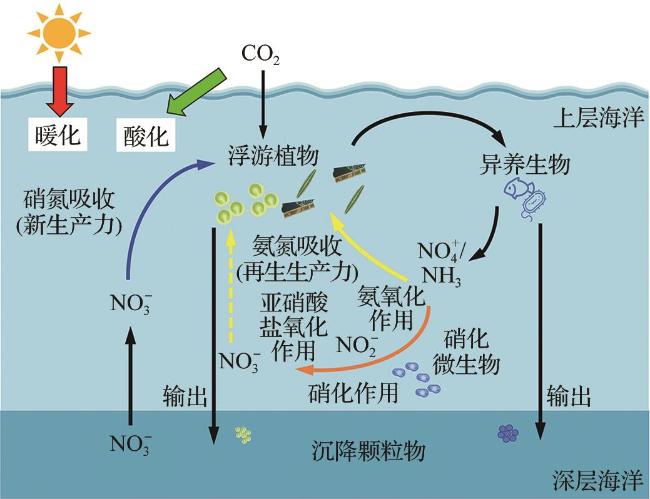
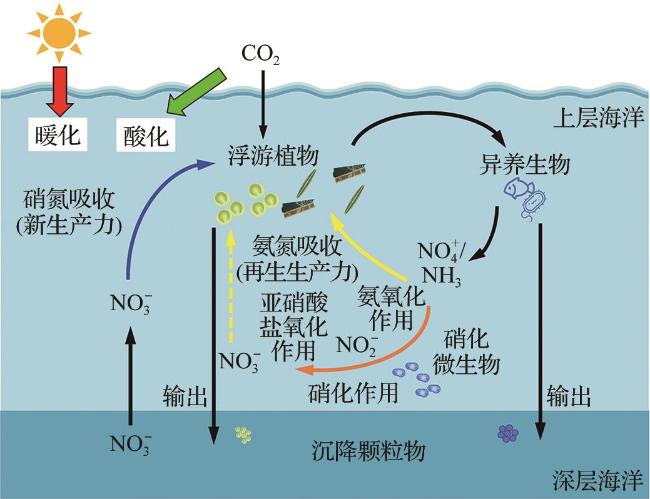
氮作为重要的生源要素,是调控海洋初级生产力和碳输出过程的主要限制因子。海洋氮循环与碳、磷等元素循环存在紧密的耦合关系,共同驱动海洋生物地球化学过程,并通过影响海洋对二氧化碳(CO2)的封存能力,成为调节全球气候的关键引擎1-2。上层海洋不仅是海洋初级生产的主要发生场所,也是氮、碳等元素周转速率最快的区域。其中,浮游植物对硝氮和氨氮的吸收过程直接决定海洋新生产力和再生生产力的量级,维系海洋食物网的稳定功能,并调控海洋生物泵的效率3-4。生物泵固定的大部分有机物在上层海洋发生再矿化,释放氨氮。在富氧的上层海洋中,硝化微生物介导的硝化作用可将氨氮逐步氧化为硝氮,使硝氮成为该区域氮素的主要赋存形态5-6。值得注意的是,上层海洋中经硝化作用生成的硝氮可能被浮游植物重新吸收利用;若忽略这一过程,将高估硝氮吸收速率,进而影响对海洋新生产力及生物泵效率评估的准确性。此外,硝化过程还会释放温室气体氧化亚氮(N2O),其具有能够部分抵消生物泵的碳汇潜力7。因此,在上层海洋中,硝氮和氨氮吸收过程以及硝化作用这些关键氮过程相互关联,共同影响海洋生产力和碳汇潜力,能够对全球气候产生重要反馈(图1)。
图1 上层海洋氮吸收和硝化作用及与生物泵相关的重要生物地球化学过程

Fig. 1 Nitrogen uptake and nitrification in the upper oceanalong with key biogeochemical processes associated with the biological pump

尽管科学界对上述过程的重要性已经达成共识8-13,但上层海洋中浮游植物与硝化微生物的代谢及其互作关系受强烈环境梯度调控,导致氮吸收和硝化过程对环境因子变化的响应极其复杂。目前,关于这些过程的关键驱动因素及其作用机制,尚未形成系统认知14-16。更值得关注的是,工业革命以来,人为活动导致大气CO2浓度从28.4 Pa上升至40.5 Pa以上,达到过去80万年以来的最高值;模型预测显示,至21世纪末,大气CO2浓度可能进一步翻倍17。据估算,约1/3人为排放的CO2被海洋吸收,引发全球多数海域上层水体快速酸化18-19。与此同时,大气CO2浓度升高引发的全球变暖可能导致21世纪末不同海域的海表温度上升1~10 °C17。快速的海洋酸化和变暖必然影响海洋生物的生长代谢过程,并扰动现有的海洋氮、碳循环平衡20-24。在当前以酸化和暖化为核心特征的全球海洋变化背景下,上层海洋是受冲击最显著的区域。因此,解析浮游植物介导的氮吸收过程和硝化微生物驱动的硝化过程对海水酸化和暖化双重胁迫的响应规律,已成为海洋氮循环与全球变化研究领域的前沿科学问题。
近20年来,国内外学者已逐步认识到,海洋氮循环的复杂过程及其与碳循环的耦合关系正受到一系列前所未有的全球海洋变化因素的显著干扰。其中,海水酸化和暖化作为全球海洋变化的核心驱动因子,已对上层海洋生态系统与生物地球化学过程产生深刻影响25-26。关于上层海洋关键氮循环过程对酸化、暖化等全球变化因子的响应,现有研究多聚焦于固氮作用、反硝化作用等氮循环的源汇过程2227-29,而针对氮吸收和硝化作用等氮循环的内循环过程的研究仍较为薄弱。基于此,本文系统梳理了近年来海洋酸化和暖化对上层海洋氮吸收与硝化作用影响的研究进展,强调加强生态系统现场观测研究的重要性,并探讨了该领域未来研究中亟须解决的关键科学问题。

2 海洋酸化对氮吸收和硝化作用的影响

2.1 酸化对氮吸收的影响

2.1.1 影响程度

海洋酸化对浮游植物光合作用的影响,特别是在光合固碳方面,是学界研究的焦点,相关研究已积累了大量研究成果。多数海洋光合自养浮游植物通过胞内CO2浓缩机制从外界获取碳源,CO2浓度升高能够降低该机制的能量消耗,进而提高浮游植物的固碳速率30-31。然而,pH值降低却可能产生相反的影响32;在当浮游植物处在非最适温度条件时,这种限制情况表现得尤为明显33。最新的研究也显示,在极度寡营养的流涡区中心,与流涡区边缘相比,CO2浓度升高引发的酸化效应会导致浮游群落生产力显著下降,这种负效应主要体现在受氮限制的小型真核浮游植物(粒径<20 μm)上;而对于原核浮游植物的固碳,CO2浓度升高的影响相对较小,甚至还存在正效应34。由此可见,不同的营养盐水平和浮游植物群落组成,可能会导致生态系统的固碳对酸化的响应存在差异。
相较而言,目前关于光合固碳过程中氮吸收过程如何响应酸化的研究,仍存在明显不足35,现有研究成果多基于室内纯培养实验,且不同研究的结果存在差异。例如,在酸化环境中,硅藻Nitzschia closteriumThalassiosira pseudonana吸收硝氮的速率下降了10%~30%,但这两株硅藻吸收氨氮的速率对酸化的响应并不一致,酸化仅抑制了N. closterium吸收氨氮(最大吸收速率下降了20%~40%),而对Thalassiosira pseudonana吸收氨氮的速率则没有显著影响36-37。另有最新研究发现,降低pH会使聚球藻Synechococcus吸收硝氮的速率增加约30%,但对硅藻T. weissflogii吸收硝氮的速率没有产生明显影响38。这一现象与为数不多的现场培养实验结果类似,即在海水pH值下降时,小粒径浮游植物(0.7~5.0 μm)吸收硝氮的速率会显著提升,而大粒径浮游植物(>5.0 μm)吸收硝氮的速率则基本不受影响39。综合来看,酸化对浮游植物吸收硝氮和氨氮的影响程度存在种间差异,并且对真核和原核不同浮游植物类群吸收硝氮的影响也有所不同3840。因此,与室内纯培养实验相比,针对现场群落响应的研究,需要综合考虑复杂的环境因子以及浮游生物群落组成的差异。

2.1.2 作用机制

海洋酸化影响氮吸收过程的作用机制,核心在于浮游植物的生理适应性响应,主要体现在以下3个方面:①酸化环境可能改变浮游植物细胞膜电势与渗透性,直接影响硝氮和氨氮转运体的活性,进而调控氮素的跨膜运输过程31;②低pH值条件下浮游植物碳浓缩机制的下调,可能通过碳—氮代谢的关联性间接作用于氮同化关键酶(如硝酸盐还原酶)的活性,干扰胞内氮素转化效率36;③部分大粒径真核浮游植物可通过调整细胞体积(如缩小体积)及提升硝氮利用效率等适应性策略,维持氮吸收过程的稳定38。鉴于不同浮游植物类群对酸化胁迫的生理适应策略存在显著分化,后续研究需着重关注酸化条件下浮游植物氮代谢网络的整体调控规律,深入解析其分子机制与生态效应,为阐明海洋酸化对海洋生态系统氮循环的影响提供理论支撑。

2.2 酸化对硝化作用的影响

2.2.1 影响程度

硝化作用由氨氧化与亚硝酸盐氧化两个连续步骤构成,其中氨氧化作用作为限速环节且伴随N2O生产,因此被广泛关注。在寡营养开阔大洋中,氨氧化古菌(Ammonia-Oxidizing Archaea,AOA)因较高的底物亲和力,是氨氧化作用的主要驱动者41。室内纯培养结果显示,典型AOA菌株(如SCM1和HCA1)在pH值为6.8~8.1的范围内均可快速生长,且在pH值约为7.0时达到最大生长速率,表明其具备适应弱酸性环境的潜力42。然而,现场培养实验呈现出不同的响应模式:在亚热带开阔海域及北冰洋的研究中,当pH值降低0.05~0.22时,AOA介导的氨氧化速率普遍下降3%~44%43-44;且pH值降幅显著时抑制效应尤为明显,如Huesemann等45在加拿大沿海的研究发现,当pH值从约8.0降至约7.0时,真光层与无光层的氨氧化速率降幅均超过50%。
在富营养的河口及近岸海域,氨氧化过程主要由氨氧化细菌(Ammonia-Oxidizing Bacteria,AOB)介导,其对pH变化表现出较高的敏感性46-47。酸化对近岸AOB介导的氨氧化作用存在显著抑制。整合全球近海生态系统研究发现,pH值下降约0.3时,氨氧化速率降低7.8%~14.2%48,且在较低pH环境中抑制效应更为显著,如Kitidis等49在英吉利海峡的研究发现,当pH值降至6.5时,水体氨氧化速率几乎无法检测到。然而,这一规律存在区域特异性,例如在美国温带河口的研究显示,低pH值环境下硝化速率反而升高50。这种看似矛盾的现象可能反映了近海不同生态型AOB对pH值的耐受性差异,暗示pH值对硝化作用的影响可能因硝化微生物群落组成的变化而产生分化50
从生态效应来看,海洋酸化对氨氧化作用的总体抑制可能会减少经由该过程产生的N2O排放量51;但近年来的研究却发现,酸化可提高氨氧化过程中N2O的产率,这一正效应在河口和北冰洋海域被广泛证实52-53,说明N2O生成与氨氧化过程对海洋酸化的响应可能存在解耦现象。

2.2.2 作用机制

在海洋自然环境中,酸化对氨氧化作用的抑制作用主要源于对底物有效性的调控。具体而言,pH值降低导致海水中H+浓度升高,会显著降低游离氨(NH3)的含量。由于氨氧化微生物(尤其是AOA)主要以NH3而非NH 4 +作为底物,环境中有效底物的减少直接导致氨氧化速率下降43。现场培养实验证实,当环境中氨氮浓度显著增加时,酸化对氨氧化作用的抑制效应会明显缓解48。这一现象进一步支持了底物限制是酸化抑制作用核心机制的观点。除底物限制外,酸性环境还会促进NO、NO2和HNO2等有毒中间产物的积累,这些活性物质可抑制氨氧化微生物细胞内氨单加氧酶(Ammonia Monooxygenase,AMO)的活性,从而间接降低氨氧化速率54
值得注意的是,当前研究多聚焦于海洋酸化对氨氧化微生物及氨氧化速率的影响,而对亚硝酸盐氧化细菌(Nitrite-Oxidizing Bacteria,NOB;海洋中以Nitropinae门为主)及其介导的亚硝酸盐氧化作用的响应程度和作用机制知之甚少55。最新研究发现,NOB可能通过“交叉供养”策略适应酸化环境:其可将尿素降解产生的氨氮供给AOB,同时利用AOB代谢产生的NO 2 -完成自身能量代谢56。这种种间互利关系可能是硝化微生物应对海洋酸化负效应的重要适应策略。

3 海洋暖化对氮吸收和硝化作用的影响

3.1 暖化对氮吸收的影响

3.1.1 影响程度

温度作为调控生物代谢的核心环境因子,对海洋生物的地理分布格局、群落结构及初级生产力水平均具有决定性影响57-58。在浮游植物生长的最适温度范围内,升温通常会促进其生长,但对氮吸收过程的影响会因氮的形态差异而可能呈现显著不同。具体而言,对于氨氮吸收,升温普遍表现出促进效应,且随着环境中氨氮浓度的升高,升温带来的促进作用会进一步增强59。相比之下,升温对硝氮吸收的影响更为复杂60。中尺度围隔实验结果显示,单纯升温(+4.5 °C)仅轻微刺激硝氮吸收速率(增幅<10%),但当磷酸盐供应充足时,同等幅度的升温反而会显著抑制硝氮吸收速率(降幅约50%)61。室内纯培养实验进一步证实,在硝氮限制条件下,硅藻生长的最适温度会降低3~6 °C62,此时升温会偏离其生理适应区间,可能导致其硝氮吸收速率下降。此外,在硅藻占主导的富营养近海环境中,现场观测发现,当温度从7 °C升至25 °C时,硝氮吸收速率平均下降46%63。这一结果既反映了硅藻对硝氮吸收的温度适应特征,也暗示在自然群落中,升温对硝氮吸收的抑制效应可能因优势种的生理特性而被放大。总体而言,温度对浮游植物氮吸收的影响具有形态特异性,反映了不同形态氮素在浮游植物代谢网络中的功能分化。

3.1.2 作用机制

温度对浮游植物吸收不同形态氮素的差异化影响,可能受氮源代谢途径的环境响应异质性、温度与营养限制的交互作用以及浮游植物细胞的表型可塑性等因素的协同调控。氨氮转运蛋白(Ammonium Transporter,AMT)和谷氨酰胺合成酶对温度变化敏感,升温可显著促进浮游植物对氨氮的吸收与利用过程64-65。硝酸盐还原酶的最适温度区间为10~20 °C,温度偏离该范围会显著降低其活性66;但也有研究显示,无论硝氮处于耗尽或充足状态,均能观测到硝酸盐还原酶活性的增加,这一现象的调控机制仍需深入解析60。高温条件下,浮游植物对磷和铁等元素的代谢需求增加,导致细胞内能量分配格局改变,进而影响硝氮吸收速率67。此外,温度可诱导大粒径浮游植物细胞发生形态变化,通过调整细胞大小和比表面积,改变其从环境中获取氮营养盐的能力68
值得注意的是,不同纬度海域浮游植物群落对升温的响应可能存在显著分化22。热带海域的典型类群(如固氮藻、微微型原核浮游植物等)长期适应高温环境,当升温接近其耐受阈值时,可能因“热胁迫”导致代谢效率下降。相比之下,中纬度海域的浮游植物(如硅藻)则可能因升温接近最适温度而受益。特别值得关注的是,极地海域作为全球变暖最快的区域,冰川融化带来的陆源氮输入增加,使局地水体氮营养盐浓度升高69,氮限制的缓解与升温的协同作用可能显著改变极地浮游植物的氮代谢特征。
海洋升温对浮游植物氮吸收的影响不仅体现在直接的生理和生化效应,还可通过改变海洋物理过程间接调控氮的可利用性。观测与模拟结果均表明,气候变暖导致的表层海水层化增强会显著减弱营养盐的垂直输送,这种环境变化将驱动浮游植物群落结构发生系统性转变:从以硅藻等大粒径为主的类群,逐步向微微型浮游植物占优势的群落结构过渡70-72。这种温度驱动的群落演替在空间上呈现双重梯度特征,一是从热带到高纬度的经向转变73,二是从海盆内部西边界流到东部上升流区的纬向变化74。不同浮游植物类群的氮利用策略差异,进一步放大了群落演替引发的生物地球化学效应。硅藻对硝氮具有较高亲和力,在硝氮利用中占据竞争优势,而微微型浮游植物更倾向于利用氨氮75。因此,未来暖化海洋中可能出现的浮游植物群落“小型化”趋势,将导致生态系统对氨氮的吸收速率增加、对硝氮的吸收速率降低,进而减弱海洋生物泵的效率。上述推论需要更多的现场实验验证,且需综合考量升温和高CO2浓度叠加对浮游植物吸收不同形态氮素的影响76

3.2 暖化对硝化作用的影响

3.2.1 影响程度

当前关于海洋暖化对硝化作用的影响研究较为有限,对其作用机制的认识仍存在局限性。室内纯培养实验显示,从天然海水中分离的AOA菌株在10~26 °C范围内,生长速率随温度升高而增加42。然而,有限的现场观测结果却呈现出不同规律:生态系统中AOA介导的氨氧化速率对温度变化不敏感。例如,在美国东北部沿海的研究中,当培养温度在8~20 °C区间波动时,上层水体的氨氧化速率未表现出显著差异77;类似结果在楚科奇海不同季节的观测中也得到验证59。此外,Zheng等78在中国东南沿海的研究发现,当存在AOB丰度和活性较高的大颗粒物(>3 μm)时,氨氧化作用的最适温度升高约5 °C。近期一项系统研究进一步揭示,在氨氮浓度较高的九龙江河口低盐区,升温4 °C使AOB主导的氨氧化速率增加0.4%~30%;而在低氨环境的九龙江河口高盐区和南海开阔海盆区,同等幅度的升温却导致AOA主导的氨氧化速率下降13%~33%79。上述结果表明,不同生态型硝化微生物对温度变化的适应性存在显著分化。

3.2.2 作用机制

综合现有研究可知,底物浓度、颗粒物含量与氨氧化微生物群落组成共同调控着氨氧化过程对温度变化的响应方向和强度。具体而言,AOB可能比AOA表现出更强的高温耐受性,更适应未来全球的变暖环境,这可能与其具备更稳定的细胞膜脂组成、更高效的热休克蛋白表达系统及更快速的能量代谢途径有关80,这种生理特性使得AOB在温度升高条件下能够维持较高的代谢活性。虽然室内纯培养实验中AOA生长呈现显著的正温度响应,但在自然环境中,其实际活性常受底物限制、光抑制效应和生物竞争压力等多重环境因素制约。
除温度对氨氧化作用的直接影响外,海洋暖化还可能通过改变其他环境因子间接作用于氨氧化过程:首先,升温降低气体溶解度,导致海洋内部氧气含量下降,而低氧环境(1~90 μmol O2/L)可能刺激氨氧化速率81;其次,暖化加剧海洋表层层化,使混合层内光照强度增加,可能抑制氨氧化微生物活性并降低氨氧化速率82。此外,与对酸化影响的认知类似,目前对NOB介导的亚硝酸盐氧化作用对温度的响应研究仍较匮乏,这限制了我们对海洋硝化过程响应气候变暖机制的全面理解。

4 总结与展望

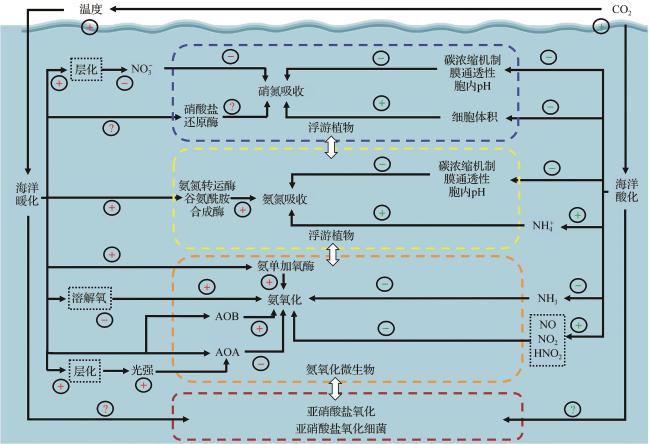
现有研究表明,海洋酸化和暖化对上层海洋氮吸收和硝化作用产生显著且复杂的影响(表1图2)。从整体效应来看,海水暖化通常会提升浮游植物的固碳效率,并加快其对氨氮的吸收速率,且这一促进作用受底物浓度的正向调节;但暖化对硝氮吸收的影响则呈现复杂的条件依赖性,其效应受营养盐协同作用、浮游植物类群及温度区间共同调控,在多数情况下更易表现为抑制作用。与此同时,酸化通过干扰细胞生理过程(尤其对大粒径浮游植物影响显著)对氮吸收过程产生负效应,这种负效应在一定程度上可抵消暖化带来的正效应。在硝化过程中,酸化通过降低海水中NH3浓度,对氨氧化速率形成显著抑制,该效应在寡营养环境中表现得尤为突出。值得注意的是,暖化会进一步加剧对开阔大洋中以AOA为主导的氨氧化过程的抑制,这种双重抑制作用将导致上层水体氨氮累积。此外,温度升高引发的群落呼吸速率增强,会进一步加速氨氮累积的趋势,使得上层水体中主要的无机氮形态逐渐从硝氮向氨氮转变,这可能对海洋氮循环及海洋生物泵的整体格局产生深远影响。另一方面,海洋酸化和暖化还会引发海水层化增强、溶解氧下降、有害活性物质累积等环境因素变化,进而间接影响氮吸收和硝化过程(图2),这为全面理解气候变化背景下海洋氮循环的动态变化提供了关键视角。
表1 不同天然水体中氮吸收和硝化作用对海洋酸化和暖化的响应

Table 1 Responses of nitrogen uptake and nitrification to ocean warming and acidification in natural waters

调控因子 研究内容 研究区域 控制条件 效应 参考文献
暖化 尿素吸收 美国加利福尼亚近海 原位温度+4 °C 促进 39
尿素吸收 美国切萨皮克湾 原位温度±9 °C 促进 63
尿素吸收 美国特拉华湾 原位温度±9 °C 促进 63
NH 4 +吸收 美国切萨皮克湾 原位温度±9 °C 促进 63
NH 4 +吸收 美国特拉华湾 原位温度±9 °C 促进 63
NH 4 +吸收 楚科奇海 温度范围-1.5~20 °C 由促进转为抑制 59
NO 3 -吸收 楚科奇海 原位温度±9 °C 抑制 63
氨氧化 楚科奇海 温度范围-1.5~20 °C 无响应 59
氨氧化 美国东北部海湾 温度范围8~20 °C 无响应 77
氨氧化 中国东南部海湾 温度范围9~34 °C 由促进转为抑制 78
氨氧化 中国东南部河口 温度范围14~34 °C 促进 79
氨氧化 中国南海 温度范围14~34 °C 抑制 79
氨氧化 中国长江口上游 温度范围10~35 °C 促进 83
氨氧化 中国长江口下游 温度范围10~35 °C 由促进转为抑制 83
酸化 NO 3 -吸收 美国Terminal Island CO2分压约81 Pa 促进 39
氨氧化 美国ALOHA站 pH7.42~8.00 抑制 43
氨氧化 加利福尼亚近海 pH7.91~8.07 抑制 43
氨氧化 北大西洋BATS站 pH7.93~8.06 抑制 43
氨氧化 马尾藻海 pH7.99~8.09 抑制 43
氨氧化 美国Sequim Bay pH6.0~8.0 抑制 45
氨氧化 中国长江口 pH降低0~1.2 抑制 48
氨氧化 英国英吉利海峡 pH6.1~8.1 抑制 49
氨氧化 西北太平洋 pH降低0.06~0.4 抑制 51
氨氧化 北大西洋 pH降低0~0.46 抑制 52
氨氧化 南大洋 pH降低0~0.46 抑制 52
氨氧化 中国长江口 pH7.8/CO2分压约81 Pa 抑制 53
图2 海洋酸化和暖化对上层海洋氮吸收和硝化过程的影响模式示意图

加号和减号分别表示正(促进)和负(减少)效应;虚线框内表示酸化和暖化引起的环境因素变化对氮吸收和硝化过程产生的间接影响;AOA:氨氧化古菌;AOB:氨氧化细菌。

Fig. 2 Schematic diagram illustrating the effects of ocean acidification and warming on nitrogen uptake and nitrification in the upper water column

The plus and minus signs indicate positive (increase) and negative (decrease) effects, respectively. The changes in environmental factors induced by acidification and warming that indirectly influence nitrogen uptake and nitrification are marked with dashed-line boxes; AOA: Ammonia-Oxidizing Archaea;AOB: Ammonia-Oxidizing Bacteria.

综上所述,现有研究成果虽已达成部分共识,但仍存有诸多争议,未来亟须从以下3个方面开展更深入、更具创新性的研究:
(1)强化氮吸收与硝化作用的同步耦合机制研究,解析酸化和暖化的交互影响。当前多数研究仅聚焦于单一胁迫因子(如酸化或暖化)对单一过程的影响,且主要依赖室内纯培养体系84。尽管这些研究在机理阐释方面具有一定价值,但忽略了浮游生物群落结构的动态变化及种间互作的关键影响,难以真实反映生态系统的整体响应。未来研究需突破单一过程研究范式,建立氮吸收与硝化过程的同步观测与耦合分析框架,重点研究二者在物质代谢(如氨氮与硝氮的转化)和能量传递上的联动机制;尤其需要在生态系统研究中,充分考虑群落内复杂的种间竞争和共生等互作关系,如浮游植物与硝化微生物对底物的竞争关系、NOB与AOB之间的“交叉供养”关系等在复合环境胁迫下的动态变化。
同时,针对NOB及其介导的亚硝酸盐氧化作用在酸化和暖化条件下的响应机制研究严重不足,需要予以重视,可借助宏基因组和宏转录组等多组学技术,解析NOB功能基因的表达调控规律,揭示其在亚硝酸盐氧化过程中的适应性策略。由于酸化和暖化对氮吸收和硝化作用的影响可能存在相反效应,二者综合作用的净结果取决于区域环境特征(营养盐水平、光照条件等)和浮游植物群落组成,因此需要量化不同海区复合环境胁迫对关键氮过程的影响程度,构建包含群落互助和环境特征的多参数评估模型,以阐明酸化和暖化相反效应的作用机制,并解释现有研究中观测到的空间异质性特征,为准确预测区域和全球氮循环变化提供理论支撑。
(2)填补低纬度寡营养海区研究不足,解析氮吸收和硝化过程的垂直分异响应机制。当前针对现场生态系统的研究存在明显的空间不均衡性,研究主要集中于近海和中高纬度海洋,而对低纬度寡营养海区的系统性研究较为缺乏。寡营养海区覆盖全球超过30%的海表面积,是最大的海洋生物群区,对大气CO2的吸收与封存发挥着至关重要的作用85。在气候变化背景下,这些海区正经历加速扩张,其生态系统可能因酸化和暖化的复合胁迫而跨越生态临界点,引发不可逆的生态后果86
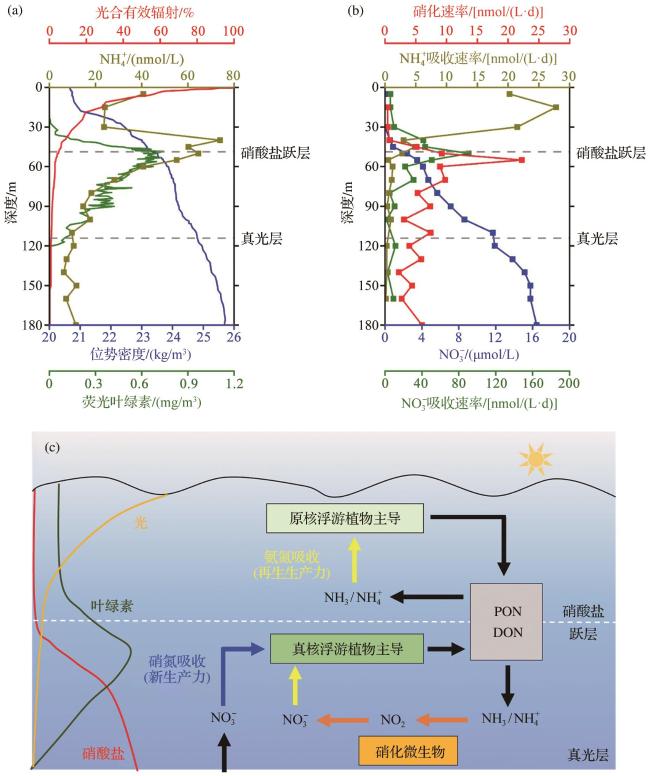
与其他海域相比,寡营养海上层水体氮吸收与硝化过程呈现独特的“营养盐双层结构”(即以硝酸盐跃层为分界的垂直结构)特征(图316:在硝酸盐跃层以上,原核浮游植物群落凭借其对氨氮的高亲和力占据竞争优势。同时,由于光限制和浮游植物对氨氮底物的竞争,硝化微生物的活性受到显著抑制;在跃层以下,随着真核浮游植物丰度的增加及其对硝氮利用的增强,硝化微生物所面临的竞争压力减轻,硝化速率明显提高。这种垂直分异特征暗示必须开展真光层内垂直精细结构的梯度研究,采用高分辨率的采样手段(如连续分层采样结合原位监测技术),重点解析硝酸盐跃层上下关键过程对全球变化的差异响应。
图3 寡营养海上层水体理化参数(a)、氮吸收和硝化过程速率(b)的典型分布,上述过程及其相关浮游微生物在垂直精细结构上的差异(c)(据参考文献[16]修改)

Fig. 3 Distribution of physical and chemical parametersa), and rates of nitrogen uptake and nitrificationb), as well as vertical distribution of these processes and their associated microorganismsin the upper water column of the oligotrophic oceanc) (modified after reference16])

此外,不同寡营养海域的硝酸盐跃层深度存在空间变异(通常介于30~150 m),这种变异直接调控着上层海洋营养盐的分布和微生物群落结构。这些因素可能导致氮吸收和硝化过程对暖化和酸化的响应在陆架边缘海与开阔大洋之间存在系统性差异,因此亟须通过跨区域比较研究加以验证。可选取典型的寡营养陆架边缘海(如南海)与开阔大洋(如北太平洋副热带流涡区),分析这些海域在群落结构和环境参数等方面的差异对于氮循环过程响应全球变化的影响,揭示其内在规律。
(3)突破时间尺度限制,探究长期适应过程与非线性响应机制。当前研究在时间尺度上存在局限性,绝大多数室内和现场实验仅关注短期(小时至天尺度)的环境胁迫效应,而对生态系统在长期(月际至年尺度)环境胁迫下的适应过程认知严重不足。为全面理解海洋氮循环对全球变化的响应,未来需开展长期的多重因子胁迫实验,重点解析微生物群落的演化规律(如群落结构的定向演替、优势种的更替等)及其功能基因表达的动态变化特征。可利用长期培养装置(如中尺度生态系统模拟实验),模拟不同程度的酸化和暖化条件,追踪微生物群落的长期变化,结合分子生物学技术,揭示其功能适应机制。
同时,应开发整合环境—生物地球化学耦合过程的高精度预测模型,定量评估底物浓度、溶解氧和层化强度等背景场参数改变导致的非线性响应;通过引入机器学习算法,结合长期适应与短期响应的关联机制,特别是要阐明群落结构重组对氮循环过程的影响阈值。这些研究将填补当前对生态系统长期适应能力认知的关键空白,为准确评估生态系统的稳定性和恢复力提供科学依据。
综上所述,未来研究应构建“三位一体”的创新研究框架:在实验体系上,实现实验室模拟与现场受控培养实验的有机结合,通过实验室研究明确具体机理,再通过现场实验验证并拓展至生态系统尺度;在空间维度上,开展富营养与寡营养海区的系统比较,揭示不同营养盐状态下海区氮循环过程对全球变化响应的共性与特异性;在时间尺度上,整合短期响应与长期适应的互补效应,阐明海洋生态系统在不同时间尺度上的响应规律。通过上述研究框架,可精准量化不同程度酸化和暖化对上层海洋氮吸收和硝化作用的交互影响,这将有助于准确评估人为干扰导致的全球变化背景下关键氮循环过程和海洋生产力的演变态势,深化对海洋生物地球化学循环与气候反馈机制的理解。
[1]
GRUBER N GALLOWAY J N. An Earth-system perspective of the global nitrogen cycle[J]. Nature2008451(7 176): 293-296.

[2]
ZHANG X N WARD B B SIGMAN D M. Global nitrogen cycle: critical enzymes, organisms, and processes for nitrogen budgets and dynamics[J]. Chemical Reviews2020120(12): 5 308-5 351.

[3]
SUN Jun LI Xiaoqian CHEN Jianfang, et al. Progress in oceanic biological pump [J]. Haiyang Xuebao201638(4): 1-21.

孙军, 李晓倩, 陈建芳,等. 海洋生物泵研究进展 [J]. 海洋学报201638(4): 1-21.

[4]
FLYNN R F HARAGUCHI L MCQUAID J, et al. Nanoplankton: the dominant vector for carbon export across the Atlantic Southern Ocean in spring[J]. Science Advances20239(48). DOI: 10.1126/sciadv.adi3059 . Epub 2023 Dec 1.

[5]
KUYPERS M M M MARCHANT H K KARTAL B. The microbial nitrogen-cycling network[J]. Nature Reviews Microbiology201816(5): 263-276.

[6]
QIN W WEI S P ZHENG Y, et al. Ammonia-oxidizing bacteria and Archaea exhibit differential nitrogen source preferences[J]. Nature Microbiology20249(2): 524-536.

[7]
WAN X S SHENG H X DAI M H, et al. Epipelagic nitrous oxide production offsets carbon sequestration by the biological pump[J]. Nature Geoscience202316: 29-36.

[8]
YANG Jinyu TANG Jinming GUO Xianghui, et al. Nitrogen cycling progress and its budget in China marginal sea: case studies in the South China Sea [J]. Oceanologia et Limnologia Sinica202152(2): 314-322.

杨进宇, 汤锦铭, 郭香会,等. 中国边缘海氮循环过程和源汇格局——以南海为例 [J]. 海洋与湖沼202152(2): 314-322.

[9]
CHEN F J LAO Q B ZHANG S W, et al. Nitrate sources and biogeochemical processes identified using nitrogen and oxygen isotopes on the eastern coast of Hainan Island[J]. Continental Shelf Research2020, 207. DOI: 10.1016/j.csr.2020.104209 .

[10]
LIU S M NING X Y DONG S H, et al. Source versus recycling influences on the isotopic composition of nitrate and nitrite in the East China Sea[J]. Journal of Geophysical Research: Oceans2020125(8). DOI: 10.1029/2020JC016061 .

[11]
MDUTYANA M THOMALLA S J PHILIBERT R, et al. The seasonal cycle of nitrogen uptake and nitrification in the Atlantic sector of the southern ocean[J]. Global Biogeochemical Cycles202034(7). DOI: 10.1029/2019GB006363 .

[12]
WANG W T YU Z M WU Z X, et al. Rates of nitrification and nitrate assimilation in the Changjiang River estuary and adjacent waters based on the nitrogen isotope dilution method[J]. Continental Shelf Research2018163: 35-43.

[13]
YOOL A MARTIN A P FERNÁNDEZ C, et al. The significance of nitrification for oceanic new production[J]. Nature2007447(7 147): 999-1 002.

[14]
BOYD P W COLLINS S DUPONT S, et al. Experimental strategies to assess the biological ramifications of multiple drivers of global ocean change-a review[J]. Global Change Biology201824(6): 2 239-2 261.

[15]
HUTCHINS D A JANSSON J K REMAIS J V, et al. Climate change microbiology: problems and perspectives[J]. Nature Reviews Microbiology201917: 391-396.

[16]
WAN X S SHENG H X DAI M H, et al. Ambient nitrate switches the ammonium consumption pathway in the euphotic ocean[J]. Nature Communications20189(1). DOI: 10.1038/s41467-018-03363-0 .

[17]
IPCC. Climate change 2021: the physical science basis: contribution of Working Group I to the sixth assessment report of the Intergovernmental Panel on Climate Change [M]. New York: Cambridge University Press, 2021.

[18]
GRUBER N CLEMENT D CARTER B R, et al. The oceanic sink for anthropogenic CO2 from 1994 to 2007[J]. Science2019363(6 432): 1 193-1 199.

[19]
LI C L WU Y X WANG X C, et al. Accelerated accumulation of anthropogenic CO2 drives rapid acidification in the north Pacific subtropical mode water during 1993-2020[J]. Geophysical Research Letters202249(24). DOI: 10.1029/2022GL101639 .

[20]
CHEN Jianfang ZHAI Weidong WANG Bin, et al. A review of the carbon cycle in river-estuary-coastal ocean continuum [J]. Journal of Marine Sciences202139(4): 11-21.

陈建芳, 翟惟东, 王斌,等. 河流—河口—近海连续体碳循环研究进展 [J]. 海洋学研究202139(4): 11-21.

[21]
QU Baoxiao SONG Jinming LI Xuegang. Advances in ocean acidification time-series studies [J]. Marine Science Bulletin202039(3): 281-290.

曲宝晓, 宋金明, 李学刚. 海洋酸化之时间序列研究进展 [J]. 海洋通报202039(3): 281-290.

[22]
HUTCHINS D A FU F X. Microorganisms and ocean global change[J]. Nature Microbiology2017, 2. DOI: 10.1038/nmicrobiol.2017.58 .

[23]
TAUCHER J BOXHAMMER T BACH L T, et al. Changing carbon-to-nitrogen ratios of organic-matter export under ocean acidification[J]. Nature Climate Change202111: 52-57.

[24]
WANG Y T FAN X GAO G, et al. Decreased motility of flagellated microalgae long-term acclimated to CO2-induced acidified waters[J]. Nature Climate Change202010: 561-567.

[25]
DUTKIEWICZ S MORRIS J J FOLLOWS M J, et al. Impact of ocean acidification on the structure of future phytoplankton communities[J]. Nature Climate Change20155: 1 002-1 006.

[26]
JONKERS L HILLEBRAND H KUCERA M. Global change drives modern plankton communities away from the pre-industrial state[J]. Nature2019570(7 761): 372-375.

[27]
SHI D L KRANZ S A KIM J M, et al. Ocean acidification slows nitrogen fixation and growth in the dominant diazotroph Trichodesmium under low-iron conditions[J]. Proceedings of the National Academy of Sciences of the United States of America2012109(45): E3094-E3100.

[28]
HONG H Z SHEN R ZHANG F T, et al. The complex effects of ocean acidification on the prominent N2-fixing Cyanobacterium Trichodesmium [J]. Science2017356(6 337): 527-531.

[29]
TAN E H ZOU W B ZHENG Z Z, et al. Warming stimulates sediment denitrification at the expense of anaerobic ammonium oxidation[J]. Nature Climate Change202010: 349-355.

[30]
BEARDALL J RAVEN J A. Carbon acquisition by microalgae [M]// BOROWITZKA M, BEARDALL J, RAVEN J. The physiology of microalgae (developments in applied phycology). Springer, 2016.

[31]
SHI D L HONG H Z SU X, et al. The physiological response of marine diatoms to ocean acidification: differential roles of seawater pCO2 and pH[J]. Journal of Phycology201955(3): 521-533.

[32]
GAO K S XU J T GAO G, et al. Rising CO2 and increased light exposure synergistically reduce marine primary productivity[J]. Nature Climate Change20122: 519-523.

[33]
XU D TONG S Y WANG B K, et al. Ocean acidification stimulation of phytoplankton growth depends on the extent of departure from the optimal growth temperature[J]. Marine Pollution Bulletin2022, 177. DOI: 10.1016/j.marpolbul.2022.113510 .

[34]
DAI R B WEN Z Z HONG H Z, et al. Eukaryotic phytoplankton drive a decrease in primary production in response to elevated CO2 in the tropical and subtropical oceans[J]. Proceedings of the National Academy of Sciences of the United States of America2025122(11). DOI: 10.1073/pnas.2423680122 .

[35]
WANNICKE N FREY C LAW C S, et al. The response of the marine nitrogen cycle to ocean acidification[J]. Global Change Biology201824(11): 5 031-5 043.

[36]
LI K Q LI M HE Y F, et al. Effects of pH and nitrogen form on Nitzschia closterium growth by linking dynamic with enzyme activity[J]. Chemosphere2020, 249. DOI: 10.1016/j.chemosphere.2020.126154 .

[37]
SHI D L LI W Y HOPKINSON B M, et al. Interactive effects of light, nitrogen source, and carbon dioxide on energy metabolism in the diatom Thalassiosira pseudonana [J]. Limnology and Oceanography201560(5): 1 805-1 822.

[38]
CHEN Y W YANG J T TANG J M, et al. Changes in isotope fractionation during nitrate assimilation by marine eukaryotic and prokaryotic algae under different pH and CO2 conditions[J]. Limnology and Oceanography202469(5): 1 045-1 055.

[39]
SPACKEEN J L SIPLER R E XU K, et al. Interactive effects of elevated temperature and CO2 on nitrate, urea, and dissolved inorganic carbon uptake by a coastal California, USA, microbial community[J]. Marine Ecology Progress Series2017577: 49-65.

[40]
GU X Y LI K Q PANG K, et al. Effects of pH on the growth and NH4-N uptake of Skeletonema costatum and Nitzschia closterium [J]. Marine Pollution Bulletin2017124(2): 946-952.

[41]
MARTENS-HABBENA W BERUBE P M URAKAWA H, et al. Ammonia oxidation kinetics determine niche separation of nitrifying Archaea and Bacteria[J]. Nature2009461(7 266): 976-979.

[42]
QIN W AMIN S A MARTENS-HABBENA W, et al. Marine ammonia-oxidizing archaeal isolates display obligate mixotrophy and wide ecotypic variation[J]. Proceedings of the National Academy of Sciences of the United States of America2014111(34): 12 504-12 509.

[43]
MICHAEL B J CHOW C E KING A L, et al. Global declines in oceanic nitrification rates as a consequence of ocean acidification[J]. Proceedings of the National Academy of Sciences of the United States of America2011108(1): 208-213.

[44]
SHIOZAKI T IJICHI M FUJIWARA A, et al. Factors regulating nitrification in the Arctic ocean: potential impact of sea ice reduction and ocean acidification[J]. Global Biogeochemical Cycles201933(8): 1 085-1 099.

[45]
HUESEMANN M H SKILLMAN A D CRECELIUS E A. The inhibition of marine nitrification by ocean disposal of carbon dioxide[J]. Marine Pollution Bulletin200244(2): 142-148.

[46]
BOWEN J L KEARNS P J HOLCOMB M, et al. Acidification alters the composition of ammonia-oxidizing microbial assemblages in marine mesocosms[J]. Marine Ecology Progress Series2013492: 1-8.

[47]
MA L TAN S J LIU H B, et al. Distribution and activity of ammonia-oxidizers on the size-fractionated particles in the Pearl River estuary[J]. Frontiers in Marine Science2021, 8. DOI: 10.3389/fmars.2021.685955 .

[48]
ZHOU J ZHENG Y L HOU L J, et al. Nitrogen input modulates the effects of coastal acidification on nitrification and associated N2O emission[J]. Water Research2024, 261. DOI: 10.1016/j.watres.2024.122041 .

[49]
KITIDIS V LAVEROCK B MCNEILL L C, et al. Impact of ocean acidification on benthic and water column ammonia oxidation[J]. Geophysical Research Letters201138(21). DOI: 10.1029/2011GL049095 .

[50]
FULWEILER R W EMERY H E HEISS E M, et al. Assessing the role of pH in determining water column nitrification rates in a coastal system[J]. Estuaries and Coasts201134(6): 1 095-1 102.

[51]
REES A P BROWN I J JAYAKUMAR A, et al. The inhibition of N2O production by ocean acidification in cold temperate and polar waters[J]. Deep Sea Research Part II: Topical Studies in Oceanography2016127: 93-101.

[52]
BREIDER F YOSHIKAWA C MAKABE A, et al. Response of N2O production rate to ocean acidification in the western North Pacific[J]. Nature Climate Change20199(12): 954-958.

[53]
ZHOU J ZHENG Y L HOU L J, et al. Effects of acidification on nitrification and associated nitrous oxide emission in estuarine and coastal waters[J]. Nature Communications202314(1). DOI: 10.1038/s41467-023-37104-9 .

[54]
PARK S, BAE W. Modeling kinetics of ammonium oxidation and nitrite oxidation under simultaneous inhibition by free ammonia and free nitrous acid[J]. Process Biochemistry200944(6): 631-640.

[55]
HONG Yiguo JIAO Lijing WU Jiapeng, et al. Progress on the community distribution and ecological functions of nitrite-oxidizing bacteria [J]. Journal of Tropical Oceanography202140(2): 139-146.

洪义国, 焦黎静, 吴佳鹏, 等. 海洋亚硝酸盐氧化细菌的多样性分布及其生态功能研究进展 [J]. 热带海洋学报202140(2): 139-146.

[56]
DAIMS H LEBEDEVA E V PJEVAC P, et al. Complete nitrification by Nitrospira bacteria[J]. Nature2015528(7 583): 504-509.

[57]
van de WAAL D B LITCHMAN E. Multiple global change stressor effects on phytoplankton nutrient acquisition in a future ocean[J]. Philosophical Transactions of the Royal Society of London Series B, Biological Sciences, 2020375(1 798). DOI: 10.1098/rstb.2019.0706 .

[58]
KEITH MOORE J FU W W PRIMEAU F, et al. Sustained climate warming drives declining marine biological productivity[J]. Science2018359(6 380): 1 139-1 143.

[59]
BAER S E CONNELLY T L SIPLER R E, et al. Effect of temperature on rates of ammonium uptake and nitrification in the western coastal Arctic during winter, spring, and summer[J]. Global Biogeochemical Cycles201428(12): 1 455-1 466.

[60]
ARANGUREN-GASSIS M LITCHMAN E. Thermal performance of marine diatoms under contrasting nitrate availability[J]. Journal of Plankton Research202042(6): 680-688.

[61]
YU C LI C WANG T, et al. Combined effects of experimental warming and eutrophication on phytoplankton dynamics and nitrogen uptake[J]. Water201810(8). DOI: 10.3390/w10081057 .

[62]
THOMAS M K ARANGUREN-GASSIS M KREMER C T, et al. Temperature-nutrient interactions exacerbate sensitivity to warming in phytoplankton[J]. Global Change Biology201723(8): 3 269-3 280.

[63]
LOMAS M W GLIBERT P M. Temperature regulation of nitrate uptake: a novel hypothesis about nitrate uptake and reduction in cool-water diatoms[J]. Limnology and Oceanography199944(3): 556-572.

[64]
CASEY J R BOITEAU R M ENGQVIST M K M, et al. Basin-scale biogeography of marine phytoplankton reflects cellular-scale optimization of metabolism and physiology[J]. Science Advances20228(3). DOI: 10.1126/sciadv.abl4930 .

[65]
FERNÁNDEZ-GONZÁLEZ C TARRAN G A SCHUBACK N, et al. Phytoplankton responses to changing temperature and nutrient availability are consistent across the tropical and subtropical Atlantic[J]. Communications Biology20225(1). DOI: 10.1038/s42003-022-03971-z .

[66]
GLEICH S J PLOUGH L V GLIBERT P M. Photosynthetic efficiency and nutrient physiology of the diatom Thalassiosira pseudonana at three growth temperatures[J]. Marine Biology2020167(9). DOI:10.1007/s00227-020-03741-7 .

[67]
JABRE L J ALLEN A E SCOTT P M J, et al. Molecular underpinnings and biogeochemical consequences of enhanced diatom growth in a warming southern ocean[J]. Proceedings of the National Academy of Sciences of the United States of America2021118(30). DOI: 10.1073/pnas.2107238118 .

[68]
MARAÑÓN E. Cell size as a key determinant of phytoplankton metabolism and community structure[J]. Annual Review of Marine Science20157: 241-264.

[69]
SANTOS-GARCIA M GANESHRAM R S TUERENA R E, et al. Nitrate isotope investigations reveal future impacts of climate change on nitrogen inputs and cycling in Arctic fjords: Kongsfjorden and Rijpfjorden (Svalbard)[J]. Biogeosciences202219(24): 5 973-6 002.

[70]
ARANGUREN-GASSIS M KREMER C T KLAUSMEIER C A, et al. Nitrogen limitation inhibits marine diatom adaptation to high temperatures[J]. Ecology Letters201922(11): 1 860-1 869.

[71]
FINKEL Z V BEARDALL J FLYNN K J, et al. Phytoplankton in a changing world: cell size and elemental stoichiometry[J]. Journal of Plankton Research201032(1): 119-137.

[72]
EDWARDS K F KLAUSMEIER C A LITCHMAN E. Evidence for a three-way trade-off between nitrogen and phosphorus competitive abilities and cell size in phytoplankton[J]. Ecology201192(11): 2 085-2 095.

[73]
MARINOV I DONEY S C LIMA I D. Response of ocean phytoplankton community structure to climate change over the 21st century: partitioning the effects of nutrients, temperature and light[J]. Biogeosciences20107(12): 3 941-3 959.

[74]
BARTON A D IRWIN A J FINKEL Z V, et al. Anthropogenic climate change drives shift and shuffle in North Atlantic phytoplankton communities[J]. Proceedings of the National Academy of Sciences of the United States of America2016113(11): 2 964-2 969.

[75]
GLIBERT P M WILKERSON F P DUGDALE R C, et al. Pluses and minuses of ammonium and nitrate uptake and assimilation by phytoplankton and implications for productivity and community composition, with emphasis on nitrogen-enriched conditions[J]. Limnology and Oceanography201661(1): 165-197.

[76]
TAUCHER J JONES J JAMES A, et al. Combined effects of CO2 and temperature on carbon uptake and partitioning by the marine diatoms Thalassiosira weissflogii and Dactyliosolen fragilissimus [J]. Limnology and Oceanography201560(3): 901-919.

[77]
HORAK R E A QIN W SCHAUER A J, et al. Ammonia oxidation kinetics and temperature sensitivity of a natural marine community dominated by Archaea[J]. The ISME Journal20137(10): 2 023-2 033.

[78]
ZHENG Z Z WAN X H XU M N, et al. Effects of temperature and particles on nitrification in a eutrophic coastal bay in southern China[J]. Journal of Geophysical Research: Biogeosciences2017122(9): 2 325-2 337.

[79]
ZHENG Z Z ZHENG L W XU M N, et al. Substrate regulation leads to differential responses of microbial ammonia-oxidizing communities to ocean warming[J]. Nature Communications202011(1). DOI: 10.1038/s41467-020-17366-3 .

[80]
TAYLOR A E GIGUERE A T ZOEBELEIN C M, et al. Modeling of soil nitrification responses to temperature reveals thermodynamic differences between ammonia-oxidizing activity of Archaea and bacteria[J]. The ISME Journal201711(4): 896-908.

[81]
HAWLEY A K BREWER H M NORBECK A D, et al. Metaproteomics reveals differential modes of metabolic coupling among ubiquitous oxygen minimum zone microbes[J]. Proceedings of the National Academy of Sciences of the United States of America2014111(31): 11 395-11 400.

[82]
XU M N LI X L SHI D L, et al. Coupled effect of substrate and light on assimilation and oxidation of regenerated nitrogen in the euphotic ocean[J]. Limnology and Oceanography201964(3): 1 270-1 283.

[83]
MAO T Q ZHANG Y OU Y F, et al. Temperature differentially regulates estuarine microbial N2O production along a salinity gradient[J]. Water Research2024, 267. DOI: 10.1016/j.watres.2024.122454 .

[84]
HUTCHINS D A CAPONE D G. The marine nitrogen cycle: new developments and global change[J]. Nature Reviews Microbiology202220(7): 401-414.

[85]
DAI M H LUO Y W ACHTERBERG E P, et al. Upper ocean biogeochemistry of the oligotrophic north Pacific subtropical gyre: from nutrient sources to carbon export[J]. Reviews of Geophysics202361(3). DOI: 10.1029/2022RG000800 .

[86]
HUANG Bangqin XIAO Wupeng LIU Xin. Spatial-temporal distributions and successional patterns of phytoplankton communities in the Chinese marginal seas [J]. Journal of Xiamen University (Natural Science)202160(2): 390-397.

黄邦钦, 肖武鹏, 柳欣. 中国边缘海浮游植物群落时空格局与演变趋势 [J]. 厦门大学学报(自然科学版)202160(2): 390-397.

Outlines

/