
Received date: 2025-02-25
Revised date: 2025-05-29
Online published: 2025-05-17
Supported by
the National Key Research and Development Program of China(2022YFC3106201);The National Natural Science Foundation of China(42206164)
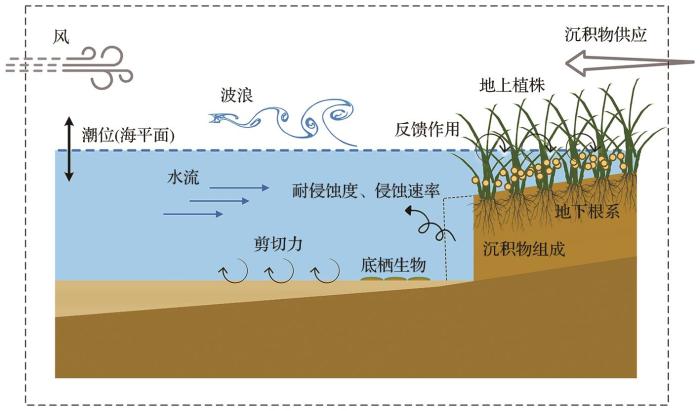
Salt marshes are among the most valuable ecosystems on Earth; however, they face ubiquitous cliff erosion at marsh edges globally. Understanding the mechanisms underlying the formation and evolution of marsh-edge cliffs has become an urgent necessity in the field of Earth science. However, owing to the complexity of marsh habitats at the interface between land and sea, our knowledge of marsh-edge cliffs remains limited. Through a literature review, we examined global research on cliff erosion at marsh edges to improve understanding of this process. First, by reviewing the influence of environmental factors such as hydrodynamic forces, sediment substrates, and biological processes, we discuss their coupling effects across spatiotemporal scales. Second, we conceptually examined three prevailing frameworks: “differential deposition fluctuations”, “self-organization”, and “autocyclic retreat”. By analyzing their differences and connections, we further discuss the comprehensive mechanisms of the formation and evolution of marsh-edge cliffs. Third, the development process and application scope of relevant mathematical models of marsh-edge cliff formation and evolution are introduced and discussed. Finally, we identified several problems to be solved following current transdisciplinary research trends in hydrodynamics, geomorphology, and ecology. Future research on the mechanisms driving marsh-edge cliff formation would be beneficial for deepening the current insights into salt marsh erosion and degradation, which can be used to identify early warning systems for vulnerable habitats and guide ecological restoration in response to global change and anthropogenic impacts.
Haobing CAO , Zeng ZHOU , Xiaotian ZHANG , Heyue ZHANG , Guangzhi ZHANG . Formation and Evolution Mechanism of Salt Marsh Edge Cliffs[J]. Advances in Earth Science, 2025 , 40(7) : 684 -703 . DOI: 10.11867/j.issn.1001-8166.2025.045
| [1] | ADAM P. Saltmarshes in a time of change[J]. Environmental Conservation, 2002, 29(1): 39-61. |
| [2] | BROMBERG G K, SILLIMAN B R, BERTNESS M D. Centuries of human-driven change in salt marsh ecosystems[J]. Annual Review of Marine Science, 2009, 1: 117-141. |
| [3] | MCOWEN C J, WEATHERDON L V, BOCHOVE J V, et al. A global map of saltmarshes[J]. Biodiversity Data Journal, 2017(5). DOI: 10.3897/BDJ.5.e11764 . |
| [4] | ZHAO Yangyang. Geomorphological dynamic process of salt marsh front in the central coast of Jiangsu Province[D]. Nanjing: Nanjing University, 2015. |
| 赵秧秧. 江苏中部海岸盐沼前缘的地貌动力过程[D]. 南京: 南京大学, 2015. | |
| [5] | BARBIER E B, HACKER S D, KENNEDY C, et al. The value of estuarine and coastal ecosystem services[J]. Ecological Monographs, 2011, 81(2): 169-193. |
| [6] | ZHU Z C, VUIK V, VISSER P J, et al. Historic storms and the hidden value of coastal wetlands for nature-based flood defence[J]. Nature Sustainability, 2020, 3: 853-862. |
| [7] | HAN Guangxuan, WANG Faming, MA Jun, et al. Blue carbon sink function, formation mechanism and sequestration potential of coastal salt marshes[J]. Chinese Journal of Plant Ecology, 2022, 46(4): 373-382. |
| 韩广轩, 王法明, 马俊, 等. 滨海盐沼湿地蓝色碳汇功能、形成机制及其增汇潜力[J]. 植物生态学报, 2022, 46(4): 373-382. | |
| [8] | KIRWAN M L, GUNTENSPERGEN G R. Feedbacks between inundation, root production, and shoot growth in a rapidly submerging brackish marsh[J]. Journal of Ecology, 2012, 100(3): 764-770. |
| [9] | KIRWAN M L, PATRICK M J. Tidal wetland stability in the face of human impacts and sea-level rise[J]. Nature, 2013, 504(7 478): 53-60. |
| [10] | FAGHERAZZI S, MARIOTTI G, WIBERG P, et al. Marsh collapse does not require sea level rise[J]. Oceanography, 2013, 26(3): 70-77. |
| [11] | TEMMERMAN S, MEIRE P, BOUMA T J, et al. Ecosystem-based coastal defence in the face of global change[J]. Nature, 2013, 504(7 478): 79-83. |
| [12] | SILLIMAN B R, GROSHOLZ T, BERTNESS M D. Human impacts on salt marshes: a global perspective[M]. Berkeley CA: University of California Press, 2009. |
| [13] | HUANG Y, SUN W J, ZHANG W, et al. Marshland conversion to cropland in northeast China from 1950 to 2000 reduced the greenhouse effect[J]. Global Change Biology, 2010, 16(2): 680-695. |
| [14] | MURRAY N J, WORTHINGTON T A, BUNTING P, et al. High-resolution mapping of losses and gains of Earth’s tidal wetlands[J]. Science, 2022, 376(6 594): 744-749. |
| [15] | DOODY J P. ‘Coastal squeeze’—an historical perspective[J]. Journal of Coastal Conservation, 2004, 10(1): 129-138. |
| [16] | NICHOLLS R J, WONG P P, BURKETT V R, et al. Coastal systems and low-lying areas climate change 2007: impacts, adaptation and vulnerability [C]// PARRY M L, CANZIANI O F, PALUTIKOF J P, et al. Contribution of working group II to the fourth assessment report of the intergovernmental panel on climate change. Cambridge, UK: Cambridge University Press, 2007: 315-357. |
| [17] | ZHAO Y Y, YU Q, WANG D D, et al. Rapid formation of marsh-edge cliffs, Jiangsu coast, China[J]. Marine Geology, 2017, 385: 260-273. |
| [18] | van der WAL D, PYE K. Patterns, rates and possible causes of saltmarsh erosion in the Greater Thames area (UK)[J]. Geomorphology, 2004, 61(3/4): 373-391. |
| [19] | MARIOTTI G, FAGHERAZZI S. Critical width of tidal flats triggers marsh collapse in the absence of sea-level rise[J]. Proceedings of the National Academy of Sciences of the United States of America, 2013, 110(14): 5 353-5 356. |
| [20] | FRANCALANCI S, BENDONI M, RINALDI M, et al. Ecomorphodynamic evolution of salt marshes: experimental observations of bank retreat processes[J]. Geomorphology, 2013, 195: 53-65. |
| [21] | WANG Heng. Temporal and spatial dynamics of estuarine wetland and scale effect of its influencing factors[D]. Shanghai: East China Normal University, 2018. |
| 王恒. 河口湿地时空动态及其影响因子的尺度效应[D]. 上海: 华东师范大学, 2018. | |
| [22] | GAO S, COLLINS M. Formation of salt-marsh cliffs in an accretional environment, Christchurch harbour, southern England[M]// Marine geology and palaeoceanography. Boca Raton: CRC Press, 2020: 95-110. |
| [23] | MARIOTTI G, FAGHERAZZI S. A numerical model for the coupled long-term evolution of salt marshes and tidal flats[J]. Journal of Geophysical Research: Earth Surface, 2010, 115(F1). DOI: 10.1029/2009JF001326 . |
| [24] | BENDONI M, MEL R, SOLARI L, et al. Insights into lateral marsh retreat mechanism through localized field measurements[J]. Water Resources Research, 2016, 52(2): 1 446-1 464. |
| [25] | BOUMA T J, van BELZEN J, BALKE T, et al. Short-term mudflat dynamics drive long-term cyclic salt marsh dynamics[J]. Limnology and Oceanography, 2016, 61(6): 2 261-2 275. |
| [26] | LEONARDI N, GANJU N K, FAGHERAZZI S. A linear relationship between wave power and erosion determines salt-marsh resilience to violent storms and hurricanes[J]. Proceedings of the National Academy of Sciences of the United States of America, 2016, 113(1): 64-68. |
| [27] | HUFF T P, FEAGIN R A, DELGADO A. Understanding lateral marsh edge erosion with Terrestrial Laser Scanning (TLS)[J]. Remote Sensing, 2019, 11(19). DOI: 10.3390/rs11192208 . |
| [28] | YAPP R H, JOHNS D, JONES O T. The salt marshes of the Dovey estuary[J]. The Journal of Ecology, 1917, 5(2). DOI:10.2307/2255448 . |
| [29] | RICHARDS F J. The salt marshes of the Dovey Estuary IV. the rates of vertical accretion, horizontal extension and scarp erosion[J]. Annals of Botany, 1934, 48: 225-259. |
| [30] | van EERDT M M. The influence of vegetation on erosion and accretion in salt marshes of the Oosterschelde, the Netherlands[J]. Vegetatio, 1985, 62(1): 367-373. |
| [31] | ALLEN J R L. Evolution of salt-marsh cliffs in muddy and sandy systems: a qualitative comparison of British West-Coast estuaries[J]. Earth Surface Processes and Landforms, 1989, 14(1): 85-92. |
| [32] | van de KOPPEL J, van der WAL D, BAKKER J P, et al. Self-organization and vegetation collapse in salt marsh ecosystems[J]. The American Naturalist, 2005, 165(1): E1-E12. |
| [33] | GAO Shu. Erosion of old Yellow River Delta in northern Jiangsu and coast protection[J]. Coastal Engineering, 1989, 8(1): 37-42. |
| 高抒. 废黄河口海岸侵蚀与对策[J]. 海岸工程, 1989, 8(1): 37-42. | |
| [34] | ZHANG Renshun, SHEN Yongming, LU Liyun, et al. Formation of Spartina alterniflora salt marsh on Jiangsu coast China [J]. Oceanologia et Limnologia Sinica, 2005, 36(4): 358-366. |
| 张忍顺, 沈永明, 陆丽云, 等. 江苏沿海互花米草(Spartina alterniflora)盐沼的形成过程[J]. 海洋与湖沼, 2005, 36(4): 358-366. | |
| [35] | CHEN Yining, GAO Shu, JIA Jianjun, et al. Tidalflat ecological changes by transplanting Spartina anglica and Spartina alterniflora, northern Jiangsu coast[J]. Oceanologia et Limnologia Sinica, 2005, 36(5): 394-403. |
| 陈一宁, 高抒, 贾建军, 等. 米草属植物Spartina angilica和Spartina alterniflora引种后江苏海岸湿地生态演化的初步探讨[J]. 海洋与湖沼, 2005, 36(5): 394-403. | |
| [36] | GAO Shu, ZHANG Jie. Modern geomorphology[M]. Beijing: Higher Education Press, 2006. |
| 高抒, 张捷. 现代地貌学[M]. 北京: 高等教育出版社, 2006. | |
| [37] | SHI Benwei, YANG Shilun, LUO Xiangxin, et al. A wave attenuation over the transitional zone of mudflat and salt marsh: a case study in the eastern Chongming on the Changjiang Delta[J]. Acta Oceanologica Sinica, 2010, 32(2): 174-178. |
| 史本伟, 杨世伦, 罗向欣, 等. 淤泥质光滩—盐沼过渡带波浪衰减的观测研究以长江口崇明东滩为例[J]. 海洋学报, 2010, 32(2): 174-178. | |
| [38] | ZHOU Z, YE Q H, COCO G. A one-dimensional biomorphodynamic model of tidal flats: sediment sorting, marsh distribution, and carbon accumulation under sea level rise[J]. Advances in Water Resources, 2016, 93: 288-302. |
| [39] | WANG H, van der WAL D, LI X Y, et al. Zooming in and out: scale dependence of extrinsic and intrinsic factors affecting salt marsh erosion[J]. Journal of Geophysical Research: Earth Surface, 2017, 122(7): 1 455-1 470. |
| [40] | CAO H B, ZHU Z C, HERMAN P M J, et al. Plant traits determining biogeomorphic landscape dynamics: a study on clonal expansion strategies driving cliff formation at marsh edges[J]. Limnology and Oceanography, 2021, 66(10): 3 754-3 767. |
| [41] | CALLAGHAN D P, BOUMA T J, KLAASSEN P, et al. Hydrodynamic forcing on salt-marsh development: distinguishing the relative importance of waves and tidal flows[J]. Estuarine, Coastal and Shelf Science, 2010, 89(1): 73-88. |
| [42] | WILLEMSEN P W J M, BORSJE B W, HULSCHER S J M H, et al. Quantifying bed level change at the transition of tidal flat and salt marsh: can we understand the lateral location of the marsh edge?[J]. Journal of Geophysical Research: Earth Surface, 2018, 123(10): 2 509-2 524. |
| [43] | FEAGIN R A, LOZADA-BERNARD S M, RAVENS T M, et al. Does vegetation prevent wave erosion of salt marsh edges?[J]. Proceedings of the National Academy of Sciences of the United States of America, 2009, 106(25): 10 109-10 113. |
| [44] | LO V B, BOUMA T J, van BELZEN J, et al. Interactive effects of vegetation and sediment properties on erosion of salt marshes in the Northern Adriatic Sea[J]. Marine Environmental Research, 2017, 131: 32-42. |
| [45] | van der WAL D, DOOL A W-V den, HERMAN P M J. Spatial patterns, rates and mechanisms of saltmarsh cycles (Westerschelde, the Netherlands)[J]. Estuarine, Coastal and Shelf Science, 2008, 76(2): 357-368. |
| [46] | MARANI M, D’ALPAOS A, LANZONI S, et al. Understanding and predicting wave erosion of marsh edges[J]. Geophysical Research Letters, 2011, 38(21). DOI:10.1029/2011GL048995 . |
| [47] | LEONARDI N, CARNACINA I, DONATELLI C, et al. Dynamic interactions between coastal storms and salt marshes: a review[J]. Geomorphology, 2018, 301: 92-107. |
| [48] | BOUMA T J, de VRIES M B, LOW E, et al. Flow hydrodynamics on a mudflat and in salt marsh vegetation: identifying general relationships for habitat characterisations[J]. Hydrobiologia, 2005, 540(1): 259-274. |
| [49] | WANG Biao, ZHU Jianrong, LI Lu. A study on the dynamics of the asymmetry between flood and ebb in the Changjiang Estuary[J]. Acta Oceanologica Sinica, 2011, 33(3): 19-27. |
| 王彪, 朱建荣, 李路. 长江河口涨落潮不对称性动力成因分析[J]. 海洋学报, 2011, 33(3): 19-27. | |
| [50] | WANG Yaping, GAO Shu, ZHANG Renshun. On geomorphological dynamic response of salt marsh-tidal gully system[J]. Chinese Science Bulletin, 1998, 43(21): 2 315-2 320. |
| 汪亚平, 高抒, 张忍顺. 论盐沼—潮沟系统的地貌动力响应[J]. 科学通报, 1998, 43(21): 2 315-2 320. | |
| [51] | FAGHERAZZI S, GABET E J, FURBISH D J. The effect of bidirectional flow on tidal channel planforms[J]. Earth Surface Processes and Landforms, 2004, 29(3): 295-309. |
| [52] | YANG Y, WANG Y P, GAO S, et al. Sediment resuspension in tidally dominated coastal environments: new insights into the threshold for initial movement[J]. Ocean Dynamics, 2016, 66(3): 401-417. |
| [53] | le HIR P, ROBERTS W, CAZAILLET O, et al. Characterization of intertidal flat hydrodynamics[J]. Continental Shelf Research, 2000, 20(12/13): 1 433-1 459. |
| [54] | RALSTON D K, GEYER W R, TRAYKOVSKI P A, et al. Effects of estuarine and fluvial processes on sediment transport over deltaic tidal flats[J]. Continental Shelf Research, 2013, 60: S40-S57. |
| [55] | TONELLI M, FAGHERAZZI S, PETTI M. Modeling wave impact on salt marsh boundaries[J]. Journal of Geophysical Research: Oceans, 2010, 115(C9). DOI:10.1029/2009JC006026 . |
| [56] | LEONARDI N, FAGHERAZZI S. Effect of local variability in erosional resistance on large-scale morphodynamic response of salt marshes to wind waves and extreme events[J]. Geophysical Research Letters, 2015, 42(14): 5 872-5 879. |
| [57] | ZHOU Zeng, CHEN Lei, LIN Weibo, et al. Advances in biogeomorphology of tidal flat-saltmarsh systems[J]. Advances in Water Science, 2021, 32(3): 470-484. |
| 周曾, 陈雷, 林伟波, 等. 盐沼潮滩生物动力地貌演变研究进展[J]. 水科学进展, 2021, 32(3): 470-484. | |
| [58] | PRIESTAS A, MARIOTTI G, LEONARDI N, et al. Coupled wave energy and erosion dynamics along a salt marsh boundary, hog island bay, Virginia, USA[J]. Journal of Marine Science and Engineering, 2015, 3(3): 1 041-1 065. |
| [59] | SCHWIMMER R. Rates and processes of marsh shoreline erosion in Rehoboth Bay, Delaware, USA [J]. Journal of Coastal Research, 2001, 17(3): 672-683. |
| [60] | SHI B W, COOPER J R, PRATOLONGO P D, et al. Erosion and accretion on a mudflat: the importance of very shallow-water effects[J]. Journal of Geophysical Research: Oceans, 2017, 122(12): 9 476-9 499. |
| [61] | SHI B W, COOPER J R, LI J S, et al. Hydrodynamics, erosion and accretion of intertidal mudflats in extremely shallow waters[J]. Journal of Hydrology, 2019, 573: 31-39. |
| [62] | CHEN Y N, LI Y, CAI T L, et al. A comparison of biohydrodynamic interaction within mangrove and saltmarsh boundaries[J]. Earth Surface Processes and Landforms, 2016, 41(13): 1 967-1 979. |
| [63] | MARIOTTI G, FAGHERAZZI S, WIBERG P L, et al. Influence of storm surges and sea level on shallow tidal basin erosive processes[J]. Journal of Geophysical Research: Oceans, 2010, 115(C11). DOI:10.1029/2009JC005892 . |
| [64] | ZHOU Z, COCO G, van der WEGEN M, et al. Modeling sorting dynamics of cohesive and non-cohesive sediments on intertidal flats under the effect of tides and wind waves[J]. Continental Shelf Research, 2015, 104: 76-91. |
| [65] | HOUWING E J. Determination of the critical erosion threshold of cohesive sediments on intertidal mudflats along the Dutch wadden sea coast[J]. Estuarine, Coastal and Shelf Science, 1999, 49(4): 545-555. |
| [66] | MITCHENER H, TORFS H. Erosion of mud/sand mixtures[J]. Coastal Engineering, 1996, 29(1/2): 1-25. |
| [67] | WINTERWERP J C, van KESTEREN W G M. Introduction to the physics of cohesive sediment in the marine environment[M]. Amsterdam: Elsevier Amsterdam, 2004. |
| [68] | WIDDOWS J, BRINSLEY M D, BOWLEY N, et al. A benthic annular flume for in situ measurement of suspension feeding/biodeposition rates and erosion potential of intertidal cohesive sediments[J]. Estuarine, Coastal and Shelf Science, 1998, 46(1): 27-38. |
| [69] | GUST G, MORRIS M J. Erosion thresholds and entrainment rates of undisturbed in situ sediments[J]. Journal of Coastal Research, 1989, 5: 87-99. |
| [70] | SCHüNEMANN M, KüHL H. Experimental investigations of the erosional behavior of naturally formed mud from the Elbe Estuary and adjacent Wadden Sea, Germany[M]// Nearshore and estuarine cohesive sediment transport. Washington D.C.: American Geophysical Union, 1993: 314-330. |
| [71] | SHI B W, WANG Y P, WANG L H, et al. Great differences in the critical erosion threshold between surface and subsurface sediments: a field investigation of an intertidal mudflat, Jiangsu, China[J]. Estuarine, Coastal and Shelf Science, 2018, 206: 76-86. |
| [72] | ANGELINI C, ALTIERI A H, SILLIMAN B R, et al. Interactions among foundation species and their consequences for community organization, biodiversity, and conservation[J]. BioScience, 2011, 61(10): 782-789. |
| [73] | WANG C, TEMMERMAN S. Does biogeomorphic feedback lead to abrupt shifts between alternative landscape states?an empirical study on intertidal flats and marshes[J]. Journal of Geophysical Research: Earth Surface, 2013, 118(1): 229-240. |
| [74] | BALKE T, HERMAN P M J, BOUMA T J. Critical transitions in disturbance-driven ecosystems: identifying windows of opportunity for recovery[J]. Journal of Ecology, 2014, 102(3): 700-708. |
| [75] | BOUMA T J, de VRIES M B, HERMAN P J. Comparing ecosystem engineering efficiency of two plant species with contrasting growth strategies[J]. Ecology, 2010, 91(9): 2 696-2 704. |
| [76] | BOUMA T J, FRIEDRICHS M, van WESENBEECK B K, et al. Density-dependent linkage of scale-dependent feedbacks: a flume study on the intertidal macrophyte Spartina anglica [J]. Oikos, 2009, 118(2): 260-268. |
| [77] | van BELZEN J, van de KOPPEL J, KIRWAN M L, et al. Vegetation recovery in tidal marshes reveals critical slowing down under increased inundation[J]. Nature Communications, 2017, 8. DOI: 10.1038/ncomms15811 . |
| [78] | CORENBLIT D. Species signatures in landscapes[J]. Nature Geoscience, 2018, 11: 621-622. |
| [79] | YANG Shilun, CHEN Jiyu. The role of vegetation in mud coast processes[J]. Oceanologia et Limnologia Sinica, 1994, 25(6): 631-635. |
| 杨世伦, 陈吉余. 试论植物在潮滩发育演变中的作用[J]. 海洋与湖沼. 1994, 25(6): 631-635. | |
| [80] | LEONARD L A, CROFT A L. The effect of standing biomass on flow velocity and turbulence in Spartina alterniflora canopies[J]. Estuarine, Coastal and Shelf Science, 2006, 69(3/4): 325-336. |
| [81] | MUDD S M, D’ALPAOS A, MORRIS J T. How does vegetation affect sedimentation on tidal marshes? Investigating particle capture and hydrodynamic controls on biologically mediated sedimentation[J]. Journal of Geophysical Research: Earth Surface, 2010, 115(F3). DOI: 10.1029/2009JF001566 . |
| [82] | MICHELI E R, KIRCHNER J W. Effects of wet meadow riparian vegetation on streambank erosion. 2. measurements of vegetated bank strength and consequences for failure mechanics[J]. Earth Surface Processes and Landforms, 2002, 27(7): 687-697. |
| [83] | TURNER R E. Beneath the salt marsh canopy: loss of soil strength with increasing nutrient loads[J]. Estuaries and Coasts, 2011, 34(5): 1 084-1 093. |
| [84] | SILLIMAN B R, van de KOPPEL J, BERTNESS M D, et al. Drought, snails, and large-scale die-off of southern U.S. salt marshes[J]. Science, 2005, 310(5 755): 1 803-1 806. |
| [85] | BORTOLUS A, SCHWINDT E, IRIBARNE O. Positive plant-animal interactions in the high marsh of an Argentinean coastal lagoon[J]. Ecology, 2002, 83(3): 733-742. |
| [86] | ANGELINI C, van MONTFRANS S G, HENSEL M J S, et al. The importance of an underestimated grazer under climate change: how crab density, consumer competition, and physical stress affect salt marsh resilience[J]. Oecologia, 2018, 187(1): 205-217. |
| [87] | CHEN Youyuan, LIU Daobin, JIA Yonggang, et al. A study of the effects of bioturbation on the surface sediments in the Yellow River estuarine intertidal zone[J]. Periodical of Ocean University of China, 2007, 37(5): 829-833. |
| 陈友媛, 刘道彬, 贾永刚, 等. 生物活动对黄河口潮滩表层沉积物扰动作用的研究[J]. 中国海洋大学学报(自然科学版), 2007, 37(5): 829-833. | |
| [88] | CHEN Xue, HE Qiang, XIN Pei, et al. Research progress on the biological disturbed behavior process of crabs in the tidal flats of estuaries and coasts[J]. Marine Sciences, 2021, 45(10): 113-122. |
| 陈雪, 贺强, 辛沛, 等. 河口海岸潮滩蟹类生物扰动行为过程研究进展[J]. 海洋科学, 2021, 45(10): 113-122. | |
| [89] | BERTNESS M D. Ribbed mussels and Spartina alterniflora production in a new England salt marsh[J]. Ecology, 1984, 65(6): 1 794-1 807. |
| [90] | SCYPHERS S B, POWERS S P, HECK K L, et al. Oyster reefs as natural breakwaters mitigate shoreline loss and facilitate fisheries[J]. PLoS ONE, 2011, 6(8). DOI: 10.1371/journal.pone.0022396 . |
| [91] | CHEN X D, ZHANG C K, PATERSON D M, et al. Hindered erosion: the biological mediation of noncohesive sediment behavior[J]. Water Resources Research, 2017, 53(6): 4 787-4 801. |
| [92] | ZHANG H Y, SUN T, CAO H B, et al. Movement of mud snails affects population dynamics, primary production and landscape heterogeneity in tidal flat ecosystems[J]. Landscape Ecology, 2021, 36(12): 3 493-3 506. |
| [93] | ZHANG Heyue, ZHOU Yi, SUN Tao, et al. Advances in biophysical feedbacks and the resulting stable states in tidal flat systems[J]. Chinese Science Bulletin, 2022, 67(5): 457-468. |
| 张荷悦, 周怡, 孙涛, 等. 潮滩生物—物理互馈机制与系统稳态效应研究进展[J]. 科学通报, 2022, 67(5): 457-468. | |
| [94] | SCHWARZ C, GOURGUE O, van BELZEN J, et al. Self-organization of a biogeomorphic landscape controlled by plant life-history traits[J]. Nature Geoscience, 2018, 11: 672-677. |
| [95] | MARANI M, D’ALPAOS A, LANZONI S, et al. The importance of being coupled: stable states and catastrophic shifts in tidal biomorphodynamics[J]. Journal of Geophysical Research: Earth Surface, 2010, 115(F4). DOI:10.1029/2009JF001600 . |
| [96] | MARANI M, da LIO C, D’ALPAOS A. Vegetation engineers marsh morphology through multiple competing stable states[J]. Proceedings of the National Academy of Sciences of the United States of America, 2013, 110(9): 3 259-3 263. |
| [97] | WEI Y Z, van MAANEN B, XIE D H, et al. Mangrove-saltmarsh ecotones: are species shifts determining eco-morphodynamic landform configurations?[J]. Earth’s Future, 2024, 12(10). DOI:10.1029/2024EF004990 . |
| [98] | M?LLER I, KUDELLA M, RUPPRECHT F, et al. Wave attenuation over coastal salt marshes under storm surge conditions[J]. Nature Geoscience, 2014, 7: 727-731. |
| [99] | HOUTTUIJN B L J, FITZGERALD D M, HUGHES Z J, et al. What controls marsh edge erosion?[J]. Geomorphology, 2021, 386. DOI:10.1016/j.geomorph.2021.107745 . |
| [100] | FAGHERAZZI S, WIBERG P L. Importance of wind conditions, fetch, and water levels on wave-generated shear stresses in shallow intertidal basins[J]. Journal of Geophysical Research: Earth Surface, 2009, 114(F3). DOI:10.1029/2008JF001139 . |
| [101] | YANG S L, MILLIMAN J D, LI P, et al. 50, 000 dams later: erosion of the Yangtze River and its delta[J]. Global and Planetary Change, 2011, 75(1/2): 14-20. |
| [102] | GAO Shu, DU Yongfen, XIE Wenjing, et al. Research progress on environmental-ecological dynamic process of Spartina alterniflora salt marsh in Jiangsu, Shanghai, Zhejiang and Fujian coastal areas[J]. Science China: Earth Sciences, 2014, 44(11): 2 339-2 357. |
| 高抒, 杜永芬, 谢文静, 等. 苏沪浙闽海岸互花米草盐沼的环境—生态动力过程研究进展[J]. 中国科学: 地球科学, 2014, 44(11): 2 339-2 357. | |
| [103] | DEEGAN L A, JOHNSON D S, WARREN R S, et al. Coastal eutrophication as a driver of salt marsh loss[J]. Nature, 2012, 490(7 420): 388-392. |
| [104] | SILLIMAN B R, van de KOPPEL J, MCCOY M W, et al. Degradation and resilience in Louisiana salt marshes after the BP-Deepwater Horizon oil spill[J]. Proceedings of the National Academy of Sciences of the United States of America, 2012, 109(28): 11 234-11 239. |
| [105] | CAO H B, ZHU Z C, BALKE T, et al. Effects of sediment disturbance regimes on Spartina seedling establishment: implications for salt marsh creation and restoration[J]. Limnology and Oceanography, 2018, 63(2): 647-659. |
| [106] | SILINSKI A, van BELZEN J, FRANSEN E, et al. Quantifying critical conditions for seaward expansion of tidal marshes: a transplantation experiment[J]. Estuarine, Coastal and Shelf Science, 2016, 169: 227-237. |
| [107] | LEVIN S A. Ecosystems and the biosphere as complex adaptive systems[M]. New York: Ecosystems, 1998, 1: 431-436. |
| [108] | SCHEFFER M, CARPENTER S, FOLEY J A, et al. Catastrophic shifts in ecosystems[J]. Nature, 2001, 413: 591-596. |
| [109] | RIETKERK M, BOERLIJST M C, van LANGEVELDE F, et al. Self-organization of vegetation in arid ecosystems[J]. The American Naturalist, 2002, 160(4): 524-530. |
| [110] | ALLEN J R L. Morphodynamics of Holocene salt marshes: a review sketch from the Atlantic and southern north sea coasts of Europe[J]. Quaternary Science Reviews, 2000, 19(12): 1 155-1 231. |
| [111] | OLLERHEAD J, DAVIDSON-ARNOTT R G D, SCOTT A. Cycles of saltmarsh extension and contraction, Cumberland Basin, Bay of Fundy, Canada[C]// SANJAUME E, MATEU J F. Geomorphologia littoral I quaternari: homenatge al professor VM Rossello I Verger. Valencia: Universitat de València, 2005, 293-305. |
| [112] | SINGH C P P. Autocyclic erosion in tidal marshes[J]. Geomorphology, 2009, 110(3/4): 45-57. |
| [113] | GRAY A J. The ecology of morecambe bay. V. the salt marshes of morecambe bay[J]. The Journal of Applied Ecology, 1972, 9(1): 207-220. |
| [114] | FAGHERAZZI S, KIRWAN M L, MUDD S M, et al. Numerical models of salt marsh evolution: ecological, geomorphic, and climatic factors[J]. Reviews of Geophysics, 2012, 50(1). DOI: 10.1029/2011RG000359 . |
| [115] | RINALDO A, FAGHERAZZI S, LANZONI S, et al. Tidal networks: 2. watershed delineation and comparative network morphology[J]. Water Resources Research, 1999, 35(12): 3 905-3 917. |
| [116] | PRITCHARD D, HOGG A J, ROBERTS W. Morphological modelling of intertidal mudflats: the role of cross-shore tidal currents[J]. Continental Shelf Research, 2002, 22(11/12/13): 1 887-1 895. |
| [117] | WAELES B, le HIR P, SILVA J R. Modélisation morphodynamique cross-shore d’un estran vaseux[J]. Comptes Rendus Geoscience, 2004, 336(11): 1 025-1 033. |
| [118] | D’ALPAOS A, LANZONI S, MARANI M, et al. Landscape evolution in tidal embayments: modeling the interplay of erosion, sedimentation, and vegetation dynamics[J]. Journal of Geophysical Research: Earth Surface, 2007, 112(F1). DOI:10.1029/2006JF000537 . |
| [119] | KIRWAN M L, BRAD M A. A coupled geomorphic and ecological model of tidal marsh evolution[J]. Proceedings of the National Academy of Sciences of the United States of America, 2007, 104(15): 6 118-6 122. |
| [120] | TEMMERMAN S, BOUMA T J, GOVERS G, et al. Impact of vegetation on flow routing and sedimentation patterns: three-dimensional modeling for a tidal marsh[J]. Journal of Geophysical Research: Earth Surface, 2005, 110(F4). DOI:10.1029/2005JF000301 . |
| [121] | ZAYTSEVA S, SHI J P, SHAW L B. Model of pattern formation in marsh ecosystems with nonlocal interactions[J]. Journal of Mathematical Biology, 2020, 80(3): 655-686. |
| [122] | ZAYTSEVA S, SHAW L B, SHI J P, et al. Pattern formation in marsh ecosystems modeled through the interaction of marsh vegetation, mussels and sediment[J]. Journal of Theoretical Biology, 2022, 543. DOI:10.1016/j.jtbi.2022.111102 . |
| [123] | BENDONI M, GEORGIOU I Y, ROELVINK D, et al. Numerical modelling of the erosion of marsh boundaries due to wave impact[J]. Coastal Engineering, 2019, 152. DOI: 10.1016/j.coastaleng.2019.103514 . |
| [124] | ZOCCARATO C, da LIO C, TOSI L, et al. A coupled biomorpho-geomechanical model of tidal marsh evolution[J]. Water Resources Research, 2019, 55(11): 8 330-8 349. |
| [125] | WILLEMSEN P W J M, SMITS B P, BORSJE B W, et al. Modeling decadal salt marsh development: variability of the salt marsh edge under influence of waves and sediment availability[J]. Water Resources Research, 2022, 58(1). DOI:10.1029/2020WR028962 . |
| [126] | PHILLIPS A W. Erosion of a cyclic saltmarsh in morecambe bay, north-west England[J]. Earth Surface Processes and Landforms, 1995, 20(5): 387-405. |
| [127] | SHEN Yongming, ZHANG Renshun, WANG Yanhong. The tidal creek character in salt marsh of Spartina alterniflora loisel on strong tide Coast[J]. Geographical Research, 2003, 22(4): 520-527. |
| 沈永明, 张忍顺, 王艳红. 互花米草盐沼潮沟地貌特征[J]. 地理研究, 2003, 22(4): 520-527. | |
| [128] | PEDERSEN J B T, BARTHOLDY J. Exposed salt marsh morphodynamics: an example from the Danish Wadden Sea[J]. Geomorphology, 2007, 90(1/2): 115-125. |
| [129] | XIE D F, WANG Z B, GAO S, et al. Modeling the tidal channel morphodynamics in a macro-tidal embayment, Hangzhou Bay, China[J]. Continental Shelf Research, 2009, 29(15): 1 757-1 767. |
| [130] | ZHAO Kun, GONG Zheng, WEN Tianyi, et al. Role of tidal meander migration on carbon release of tidal flat sediments: a case study of the central Jiangsu tidal flats[J]. Acta Ecologica Sinica, 2024, 44(14): 6 154-6 164. |
| 赵堃, 龚政, 文天翼, 等. 潮沟曲流摆动对潮滩沉积物碳输出的影响——以江苏中部潮滩为例[J]. 生态学报, 2024, 44(14): 6 154-6 164. | |
| [131] | YANG S L, EISMA D, DING P X. Sedimentary processes on an estuarine marsh island within the turbidity maximum zone of the Yangtze River mouth[J]. Geo-Marine Letters, 2000, 20(2): 87-92. |
| [132] | SILINSKI A, SCHOUTENS K, PUIJALON S, et al. Coping with waves: plasticity in tidal marsh plants as self-adapting coastal ecosystem engineers[J]. Limnology and Oceanography, 2018, 63(2): 799-815. |
| [133] | ZHU Z C, YANG Z F, BOUMA T J. Biomechanical properties of marsh vegetation in space and time: effects of salinity, inundation and seasonality[J]. Annals of Botany, 2020, 125(2): 277-290. |
| [134] | CHEN L, MOELLER I, ZHOU Z, et al. Seasonal biophysical interactions in tidal marsh evolution: insights from a synchronized dataset in Jiangsu, China[J]. Frontiers in Marine Science, 2024, 11. DOI:10.3389/fmars.2024.1469307 . |
| [135] | HU Z, LENTING W, van der WAL D, et al. Continuous monitoring bed-level dynamics on an intertidal flat: introducing novel, stand-alone high-resolution SED-sensors[J]. Geomorphology, 2015, 245: 223-230. |
| [136] | XIE W M, GUO L C, WANG X Y, et al. Detection of seasonal changes in vegetation and morphology on coastal salt marshes using terrestrial laser scanning[J]. Geomorphology, 2021, 380. DOI: 10.1016/j.geomorph.2021.107621 . |
/
| 〈 |
|
〉 |
 甘公网安备62010202000687