
Advances and Deficiencies in Land Surface Modeling Under Global Warming
Received date: 2023-09-02
Revised date: 2023-11-04
Online published: 2024-01-16
Supported by
the National Natural Science Foundation of China(42371130);The Second Tibetan Plateau Scientific Expedition and Research (STEP) Program(2019QZKK010203)
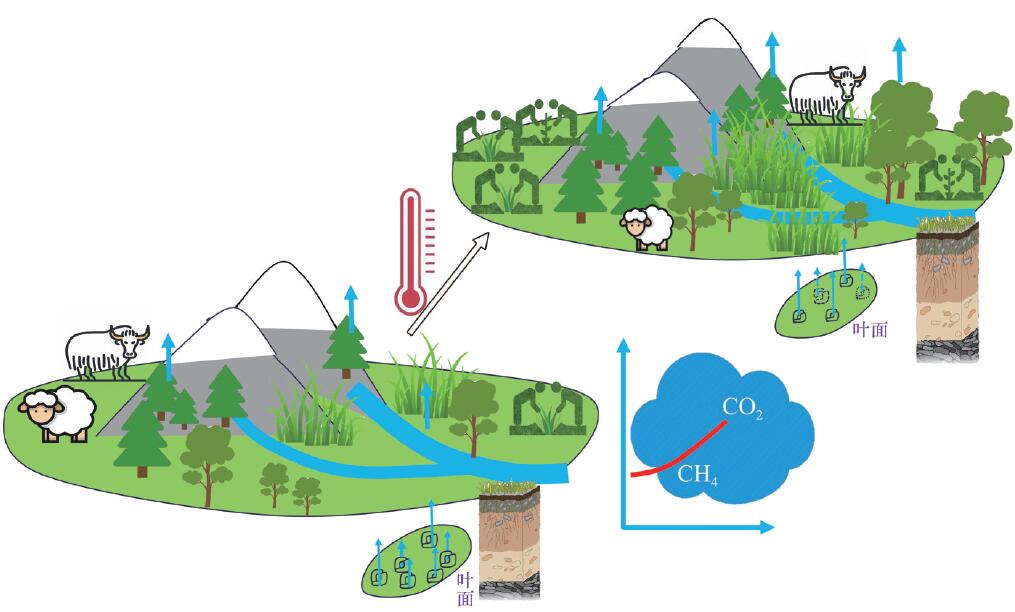
Global warming caused by human activities has resulted in significant changes in the climate system, including changes in the regional climate, extreme events, snow, ice, vegetation, air quality, water cycle, and responses and feedbacks among various components of the climate system. The land surface is where water, energy, and geochemical transports to and from the atmosphere occur, hydrological processes occur, and vegetation grows. Hence, the land surface is sensitive to climate change. Climate change affects the hydrological processes not only directly but also indirectly by affecting the vegetation structure and physiology. Land surface models are useful for studying climate change and its impacts on the land surface by modeling the relevant responses and feedbacks. There are three types of land surface models that simulate the mass and energy exchange between the land surface and atmosphere: the global land surface process model, global hydrological model, and global dynamic vegetation model. These three types of models focus on different specific components of the land surface. Since the 1990s, various land surface comparison projects have revealed many problems and shortcomings in land surface models and have furthered their development. However, various issues with these models still need to be addressed. For example, one major problem with the global hydrological model is that it does not incorporate dynamic vegetation growth; hence, it cannot project long-term vegetation change impacts on the hydrological processes—let alone extreme hydrological events such as flooding and drought—and cannot be useful with respect to future water resource management. Incorporating dynamic vegetation growth into hydrological models is a frontline research topic in hydrology. Moreover, many land surface models represent soil textures and heat exchanges among soil liquids, solids, and gases on the Tibetan Plateau insufficiently. This aspect requires improvement by enhancing the observations, understanding the relevant mechanisms, and realizing the mechanisms and processes in the land surface models. The Tibetan Plateau provides fresh water to the surrounding regions and forms and modulates climate and weather both regionally and globally; thus, it is dubbed the Asian Water Tower. Improving the land surface model capability of the plateau will improve the understanding of climate change and its impacts, both regionally and globally.
CUO Lan . Advances and Deficiencies in Land Surface Modeling Under Global Warming[J]. Advances in Earth Science, 2024 , 39(1) : 46 -55 . DOI: 10.11867/j.issn.1001-8166.2023.079
| 1 | IPCC. Summary for policymakers[M]// MASSON-DELMOTTE V, ZHAI P, PIRANI A, et al. Climate change 2021: the physical science basis. Contribution of working group I to the sixth assessment report of the intergovernmental panel on climate change. Cambridge: Cambridge University Press, 2021. |
| 2 | ARIAS P A, BELLOUIN N, COPPOLA E, et al. Technical summary[M]// MASSON-DELMOTTE V, ZHAI P, PIRANI A, et al. Climate change 2021: the physical science basis. Contribution of working group I to the sixth assessment report of the intergovernmental panel on climate change. Cambridge: Cambridge University Press, 2021. DOI:10.1017/9781009157896.002 . |
| 3 | KOSTER R D, SUD Y C, GUO Z C, et al. GLACE: the global land-atmosphere coupling experiment. part I: overview[J]. Journal of Hydrometeorology, 2006, 7(4): 590-610. |
| 4 | DOUVILLE H, RAGHAVAN K, RENWICK J. Water cycle changes[M]// MASSON-DELMOTTE V, ZHAI P, PIRANI A, et al. Climate change 2021: the physical science basis. Contribution of working group I to the sixth assessment report of the intergovernmental panel on climate change. Cambridge: Cambridge University Press, 2021. DOI:10.1017/9781009157896.010 . |
| 5 | SENEVIRATNE S I, ZHANG X, ADNAN M, et al. Weather and climate extreme events in a changing climate[M]// MASSON-DELMOTTE V, ZHAI P, PIRANI A, et al. Climate change 2021: the physical science basis. Contribution of working group I to the sixth assessment report of the intergovernmental panel on climate change. Cambridge: Cambridge University Press, 2021. DOI:10.1017/9781009157896.013 . |
| 6 | FOX-KEMPER B, HEWITT H T, XIAO C, et al. Ocean, cryosphere and sea level change[M]// MASSON-DELMOTTE V, ZHAI P, PIRANI A, et al. Climate change 2021: the physical science basis. Contribution of working group I to the sixth assessment report of the intergovernmental panel on climate change. Cambridge: Cambridge University Press, 2021. DOI:10.1017/9781009157896.011 . |
| 7 | YAO T D, XUE Y K, CHEN D L, et al. Recent third pole’s rapid warming accompanies cryospheric melt and water cycle intensification and interactions between monsoon and environment: multidisciplinary approach with observations, modeling, and analysis[J]. Bulletin of the American Meteorological Society, 2019, 100(3): 423-444. |
| 8 | YAO T D, BOLCH T, CHEN D L, et al. The imbalance of the Asian water tower[J]. Nature Reviews Earth & Environment, 2022, 3(10): 618-632. |
| 9 | WANG R J, DING Y J, SHANGGUAN D H, et al. Projections of glacier peak water and its timing in the Sanjiangyuan on the Tibet Plateau[J]. Journal of Hydrology: Regional Studies, 2023, 45. DOI:10.1016/j.ejrh.2022.101313 . |
| 10 | HETHERINGTON A M, WOODWARD F I. The role of stomata in sensing and driving environmental change[J]. Nature, 2003, 424(6 951): 901-908. |
| 11 | BL?SCHL G, HALL J, VIGLIONE A, et al. Changing climate both increases and decreases European River floods[J]. Nature, 2019, 573(7 772): 108-111. |
| 12 | TEUFEL B, SUSHAMA L, HUZIY O, et al. Investigation of the mechanisms leading to the 2017 Montreal flood[J]. Climate Dynamics, 2019, 52(7/8): 4 193-4 206. |
| 13 | ORTEGA J A, RAZOLA L, GARZóN G. Recent human impacts and change in dynamics and morphology of ephemeral rivers[J]. Natural Hazards and Earth System Sciences, 2014, 14(3): 713-730. |
| 14 | ROGGER M, AGNOLETTI M, ALAOUI A, et al. Land use change impacts on floods at the catchment scale: challenges and opportunities for future research[J]. Water Resources Research, 2017, 53(7): 5 209-5 219. |
| 15 | CUO L, ZHANG Y X, ZHU F X, et al. Characteristics and changes of streamflow on the Tibetan Plateau: a review[J]. Journal of Hydrology: Regional Studies, 2014, 2: 49-68. |
| 16 | CUO L, ZHANG Y X. Spatial patterns of wet season precipitation vertical gradients on the Tibetan Plateau and the surroundings[J]. Scientific Reports, 2017, 7. DOI:10.1038/s41598-017-05345-6 . |
| 17 | LAN Cuo, LIU Zhe, HOU Mei. Climate change on the Tibetan Plateau and its implications on natural environment and society[J]. Sanjiangyuan Ecology, 2022, 27: 26-37. |
| 17 | 兰措, 刘哲, 侯梅. 青藏高原气候变化及其对自然环境和社会的影响[J]. 三江源生态,2022, 27: 26-37. |
| 18 | YAO T D, THOMPSON L, YANG W, et al. Different glacier status with atmospheric circulations in Tibetan Plateau and surroundings[J]. Nature Climate Change, 2012, 2(9): 663-667. |
| 19 | CUO L, ZHANG Y X, LI N. Historical and future vegetation changes in the degraded frozen soil and the entire Tibetan Plateau and climate drivers[J]. Journal of Geophysical Research: Biogeosciences, 2022, 127(11). DOI:10.1029/2022JG006987 . |
| 20 | LI C H, SU F G, YANG D Q, et al. Spatiotemporal variation of snow cover over the Tibetan Plateau based on MODIS snow product, 2001-2014[J]. International Journal of Climatology, 2018, 38(2): 708-728. |
| 21 | DING J, CUO L, ZHANG Y X, et al. Monthly and annual temperature extremes and their changes on the Tibetan Plateau and its surroundings during 1963-2015[J]. Scientific Reports, 2018, 8. DOI:10.1038/s41598-018-30320-0 . |
| 22 | DING J, CUO L, ZHANG Y X, et al. Varied spatiotemporal changes in wind speed over the Tibetan Plateau and its surroundings in the past decades[J]. International Journal of Climatology, 2021, 41(13): 5 956-5 976. |
| 23 | DING J, CUO L, ZHANG Y X, et al. Annual and seasonal precipitation and their extremes over the Tibetan Plateau and its surroundings in 1963-2015[J]. Atmosphere, 2021, 12(5): 620. |
| 24 | CHENG G D, WU T H. Responses of permafrost to climate change and their environmental significance, Qinghai-Tibet Plateau[J]. Journal of Geophysical Research: Earth Surface, 2007, 112(F2). DOI: 10.1029/2006JF000631 . |
| 25 | OSTERKAMP T E. Characteristics of the recent warming of permafrost in Alaska[J]. Journal of Geophysical Research: Earth Surface, 2007, 112(F2). DOI: 10.1029/2006JF000578 . |
| 26 | JIN H J, HE R X, CHENG G D, et al. Changes in frozen ground in the source area of the Yellow River on the Qinghai-Tibet Plateau, China, and their eco-environmental impacts[J]. Environmental Research Letters, 2009, 4(4). DOI: 10.1088/1748-9326/4/4/045206 . |
| 27 | WALVOORD M, KURYLYK B. Hydrologic impacts of thawing permafrost—a review[J]. Vadose Zone Journal, 2016, 15(6). DOI:10.2136/vzj2016.01.0010 . |
| 28 | ZHU F X, CUO L, ZHANG Y X, et al. Spatiotemporal variations of annual shallow soil temperature on the Tibetan Plateau during 1983-2013[J]. Climate Dynamics, 2018, 51(5/6): 2 209-2 227. |
| 29 | CUO L, ZHANG Y X, XU Ri, et al. Decadal change and inter-annual variability of net primary productivity on the Tibetan Plateau[J]. Climate Dynamics, 2021, 56(5/6): 1 837-1 857. |
| 30 | LI N, CUO L, ZHANG Y X. On the freeze-thaw cycles of shallow soil and connections with environmental factors over the Tibetan Plateau[J]. Climate Dynamics, 2021, 57(11): 3 183-3 206. |
| 31 | IPCC-SRCCL. Climate change and land[M]. WMO, UNEP, 2019. |
| 32 | YANG D Q, KANE D L, HINZMAN L D, et al. Siberian Lena River hydrologic regime and recent change[J]. Journal of Geophysical Research: Atmospheres, 2002, 107(D23). DOI: 10.1029/2002JD002542 . |
| 33 | IMMERZEEL W W, van BEEK L P H, BIERKENS M F P. Climate change will affect the Asian water towers[J]. Science, 2010, 328(5 984): 1 382-1 385. |
| 34 | IMMERZEEL W W, LUTZ A F, ANDRADE M, et al. Importance and vulnerability of the world’s water towers[J]. Nature, 2020, 577(7 790): 364-369. |
| 35 | PRITCHARD H D. Asia’s shrinking glaciers protect large populations from drought stress[J]. Nature, 2019, 569(7 758): 649-654. |
| 36 | KHANAL S, LUTZ A F, KRAAIJENBRINK P D A, et al. Variable 21st century climate change response for rivers in high Mountain Asia at seasonal to decadal time scales[J]. Water Resources Research, 2021, 57(5). DOI:10.1029/2020WR029266 . |
| 37 | HOU M, CUO L, MURODOV A, et al. Streamflow composition and the contradicting impacts of anthropogenic activities and climatic change on streamflow in the Amu Darya Basin, central Asia[J]. Journal of Hydrometeorology, 2023, 24(2): 185-201. |
| 38 | WANG Y H, YANG H B, GAO B, et al. Frozen ground degradation may reduce future runoff in the headwaters of an inland river on the northeastern Tibetan Plateau[J]. Journal of Hydrology, 2018, 564: 1 153-1 164. |
| 39 | GAO B, YANG D W, QIN Y, et al. Change in frozen soils and its effect on regional hydrology, upper Heihe Basin, northeastern Qinghai-Tibetan Plateau[J]. The Cryosphere, 2018, 12(2): 657-673. |
| 40 | ZHANG L L, SU F G, YANG D Q, et al. Discharge regime and simulation for the upstream of major rivers over Tibetan Plateau[J]. Journal of Geophysical Research: Atmospheres, 2013, 118(15): 8 500-8 518. |
| 41 | SINGH A, KUMAR S, AKULA S, et al. Plant growth nullifies the effect of increased water-use efficiency on streamflow under elevated CO2 in the southeastern United States[J]. Geophysical Research Letters, 2020, 47(4). DOI:10.1029/2019GL086940 . |
| 42 | MANKIN J S, SEAGER R, SMERDON J E, et al. Mid-latitude freshwater availability reduced by projected vegetation responses to climate change[J]. Nature Geoscience, 2019, 12(12): 983-988. |
| 43 | PIAO S L, FRIEDLINGSTEIN P, CIAIS P, et al. Changes in climate and land use have a larger direct impact than rising CO2 on global river runoff trends[J]. Proceedings of the National Academy of Sciences of the United States of America, 2007, 104(39): 15 242-15 247. |
| 44 | de BOER H J, LAMMERTSMA E I, WAGNER-CREMER F, et al. Climate forcing due to optimization of maximal leaf conductance in subtropical vegetation under rising CO2 [J]. Proceedings of the National Academy of Sciences of the United States of America, 2011, 108(10): 4 041-4 046. |
| 45 | LAMMERTSMA E I, BOER H J D, DEKKER S C, et al. Global CO2 rise leads to reduced maximum stomatal conductance in Florida vegetation[J]. Proceedings of the National Academy of Sciences of the United States of America, 2011, 108(10): 4 035-4 040. |
| 46 | CAO L, BALA G, CALDEIRA K, et al. Importance of carbon dioxide physiological forcing to future climate change[J]. Proceedings of the National Academy of Sciences of the United States of America, 2010, 107(21): 9 513-9 518. |
| 47 | PRUDHOMME C, GIUNTOLI I, ROBINSON E L, et al. Hydrological droughts in the 21st century, hotspots and uncertainties from a global multimodel ensemble experiment[J]. Proceedings of the National Academy of Sciences of the United States of America, 2014, 111(9): 3 262-3 267. |
| 48 | LEMORDANT L, GENTINE P, STéFANON M, et al. Modification of land-atmosphere interactions by CO2 effects: implications for summer dryness and heat wave amplitude[J]. Geophysical Research Letters, 2016, 43(19). DOI:10.1002/2016GL069896 . |
| 49 | POKHREL Y, FELFELANI F, SATOH Y, et al. Global terrestrial water storage and drought severity under climate change[J]. Nature Climate Change, 2021, 11(3): 226-233. |
| 50 | BROWN A E, ZHANG L, MCMAHON T A, et al. A review of paired catchment studies for determining changes in water yield resulting from alterations in vegetation[J]. Journal of Hydrology, 2005, 310(1/2/3/4): 28-61. |
| 51 | CUO L. Land use/cover change impacts on hydrology in large river basins: a review[M]// TANG Qiuhong, OKI Taikan. Terrestrial water cycle and climate change: natural and human-induced impacts, Geophysical Monograph 221, First Edition. American Geophysical Union, 2016. |
| 52 | ZHANG L, DAWES W R, WALKER G R. Response of mean annual evapotranspiration to vegetation changes at catchment scale[J]. Water Resources Research, 2001, 37(3): 701-708. |
| 53 | CUO L, LETTENMAIER D P, ALBERTI M, et al. Effects of a century of land cover and climate change on the hydrology of the Puget Sound Basin[J]. Hydrological Processes, 2009, 23(6): 907-933. |
| 54 | CUO L, ZHANG Y X, GAO Y H, et al. The impacts of climate change and land cover/use transition on the hydrology in the upper Yellow River Basin, China[J]. Journal of Hydrology, 2013, 502: 37-52. |
| 55 | LIU Z, CUO L, LI Q J, et al. Impacts of climate change and land use/cover change on streamflow in Beichuan River Basin in Qinghai Province, China[J]. Water, 2020, 12(4). DOI:10.3390/w12041198 . |
| 56 | EYRING V, BONY S, MEEHL G A, et al. Overview of the Coupled Model Intercomparison Project Phase 6 (CMIP6) experimental design and organization[J]. Geoscientific Model Development, 2016, 9(5): 1 937-1 958. |
| 57 | van den HURK B, KIM H, KRINNER G, et al. LS3MIP (v1.0) contribution to CMIP6: the Land Surface, Snow and Soilmoisture Model Intercomparison Project-aims, setup and expected outcome[J]. Geoscientific Model Development, 2016, 9(8): 2 809-2 832. |
| 58 | HENDERSON-SELLERS A, McGUFFIE K, PITMAN A J. The Project for Intercomparison of Land-Surface Parametrization Schemes (PILPS): 1992 to 1995[J]. Climate Dynamics, 1996, 12(12): 849-859. |
| 59 | KOSTER R D, DIRMEYER P A, GUO Z C, et al. Regions of strong coupling between soil moisture and precipitation[J]. Science, 2004, 305(5 687): 1 138-1 140. |
| 60 | TELTEU C E, MüLLER SCHMIED H, THIERY W, et al. Understanding each other’s models: an introduction and a standard representation of 16 global water models to support intercomparison, improvement, and communication[J]. Geoscientific Model Development, 2021, 14(6): 3 843-3 878. |
| 61 | LI H Y, HUANG M Y, WIGMOSTA M S, et al. Evaluating runoff simulations from the Community Land Model 4.0 using observations from flux towers and a mountainous watershed[J]. Journal of Geophysical Research: Atmospheres, 2011, 116(D24). DOI:10.1029/2011JD016276 . |
| 62 | KNIGHTON J, CONNEELY J, WALTER M T. Possible increases in flood frequency due to the loss of Eastern Hemlock in the Northeastern United States: observational insights and predicted impacts[J]. Water Resources Research, 2019, 55, 5 342-5 359. |
| 63 | GAO B, QIN Y, WANG Y H, et al. Modeling ecohydrological processes and spatial patterns in the upper Heihe Basin in China[J]. Forests, 2015, 7(12). DOI:10.3390/f7010010 . |
| 64 | JI P, YUAN X, MA F, et al. Accelerated hydrological cycle over the Sanjiangyuan region induces more streamflow extremes at different global warming levels[J]. Hydrology and Earth System Sciences, 2020, 24(11): 5 439-5 451. |
| 65 | AICH V, LIERSCH S, VETTER T, et al. Flood projections within the Niger River Basin under future land use and climate change[J]. Science of the Total Environment, 2016, 562: 666-677. |
| 66 | LIN B Q, CHEN X W, YAO H X, et al. Analyses of landuse change impacts on catchment runoff using different time indicators based on SWAT model[J]. Ecological Indicators, 2015, 58: 55-63. |
| 67 | YANG L S, FENG Q, YIN Z L, et al. Separation of the climatic and land cover impacts on the flow regime changes in two watersheds of northeastern Tibetan Plateau[J]. Advances in Meteorology, 2017, 2017: 1-15. |
| 68 | GASHAW T, TULU T, ARGAW M, et al. Modeling the hydrological impacts of land use/land cover changes in the Andassa watershed, Blue Nile Basin, Ethiopia[J]. Science of the Total Environment, 2018, 619: 1 394-1 408. |
| 69 | WANG S F, KANG S Z, ZHANG L, et al. Modelling hydrological response to different land-use and climate change scenarios in the Zamu River Basin of northwest China[J]. Hydrological Processes, 2008, 22(14): 2 502-2 510. |
| 70 | KIM J, CHOI J, CHOI C, et al. Impacts of changes in climate and land use/land cover under IPCC RCP scenarios on streamflow in the Hoeya River Basin, Korea[J]. Science of the Total Environment, 2013, 452: 181-195. |
| 71 | GUO H, HU Q, JIANG T. Annual and seasonal streamflow responses to climate and land-cover changes in the Poyang Lake Basin, China[J]. Journal of Hydrology, 2008, 355(1/2/3/4): 106-122. |
| 72 | WEI P J, CHEN S Y, WU M H, et al. Using the InVEST model to assess the impacts of climate and land use changes on water yield in the upstream regions of the Shule River Basin[J]. Water, 2021, 13(9). DOI:10.3390/w13091250 . |
| 73 | WANG W, ZHANG Y, GENG X, et al. Impact classification of future land use and climate changes on flow regimes in the Yellow River Source Region, China[J]. Journal of Geophysical Research: Atmospheres, 2021, 126(13). DOI:10.1029/2020JD034064 . |
| 74 | CARETTA M A, MUKHERJI A, ARFANUZZAMAN M. Water[M]// PO?RTNER H O, ROBERTS D C, TIGNOR M, et al. Climate change 2022: impacts, adaptation and vulnerability. Contribution of working group II to the sixth assessment report of the intergovernmental panel on climate change. Cambridge: Cambridge University Press, 2021. DOI:10.1017/9781009325844.006 . |
| 75 | FENG X M, SUN G, FU B J, et al. Regional effects of vegetation restoration on water yield across the Loess Plateau, China[J]. Hydrology and Earth System Sciences, 2012, 16(8): 2 617-2 628. |
| 76 | DANKERS R, KUNDZEWICZ Z W. Grappling with uncertainties in physical climate impact projections of water resources[J]. Climatic Change, 2020, 163(3): 1 379-1 397. |
| 77 | LEE J Y, MAROTZKE J, BALA G, et al. Future global climate: scenario-based projections and near-term information[M]// MASSON-DELMOTTE V, ZHAI P, PIRANI A, et al. Climate change 2021: the physical science basis. Contribution of working group I to the sixth assessment report of the intergovernmental panel on climate change. Cambridge: Cambridge University Press,2021. DOI:10.1017/9781009157896.006 . |
| 78 | QIU Y, FENG J M, WANG J, et al. Memory of Land Surface and Subsurface Temperature (LST/SUBT) initial anomalies over Tibetan Plateau in different land models[J]. Climate Dynamics, 2021. DOI:10.1007/s00382-021-05937-2 . |
| 79 | ZHENG D H, van der VELDE R, SU Z B, et al. Assessment of Noah land surface model with various runoff parameterizations over a Tibetan River[J]. Journal of Geophysical Research: Atmospheres, 2017, 122(3): 1 488-1 504. |
| 80 | CHEN J L, WEN J, TIAN H, et al. A study of soil thermal and hydraulic properties and parameterizations for CLM in the SRYR[J]. Journal of Geophysical Research: Atmospheres, 2018, 123(16): 8 487-8 499. |
| 81 | DENG M S, MENG X H, LYV Y, et al. Comparison of soil water and heat transfer modeling over the Tibetan Plateau using two Community Land surface Model (CLM) versions[J]. Journal of Advances in Modeling Earth Systems, 2020, 12(10). DOI:10.1029/2020MS002189 . |
| 82 | MA S P, ZHOU L B, LI F, et al. Evaluation of WRF land surface schemes in land-atmosphere exchange simulations over grassland in Southeast Tibet[J]. Atmospheric Research, 2020, 234. DOI:10.1016/j.atmosres.2019.104739 . |
| 83 | YANG S H, LI R, WU T H, et al. Evaluation of soil thermal conductivity schemes incorporated into CLM5.0 in permafrost regions on the Tibetan Plateau[J]. Geoderma, 2021, 401. DOI:10.1016/j.geoderma.2021.115330 . |
| 84 | YIN M, HAN Y L, WANG Y, et al. Climate impacts of parameterizing subgrid variation and partitioning of land surface heat fluxes to the atmosphere with the NCAR CESM1.2[J]. Geoscientific Model Development, 2023, 16(1): 135-156. |
| 85 | YANG K, CHEN Y Y, QIN J. Some practical notes on the land surface modeling in the Tibetan Plateau[J]. Hydrology and Earth System Sciences, 2009, 13(5): 687-701. |
| 86 | COSBY B J, HORNBERGER G M, CLAPP R B, et al. A statistical exploration of the relationships of soil moisture characteristics to the physical properties of soils[J]. Water Resources Research, 1984, 20(6): 682-690. |
| 87 | CHERKAUER K A, LETTENMAIER D P. Hydrologic effects of frozen soils in the upper Mississippi River Basin[J]. Journal of Geophysical Research: Atmospheres, 1999, 104(D16): 19 599-19 610. |
| 88 | CUO L, ZHAO H Q, ZHANG Y X, et al. Spatiotemporally heterogeneous soil thermohydraulic processes in the frozen soil of the Tibetan Plateau[J]. Geoderma, 2023, 438. DOI:10.1016/j.geoderma.2023.116634 . |
| 89 | LUO D L, JIN H J, WU Q B, et al. Thermal regime of warm-dry permafrost in relation to ground surface temperature in the source areas of the Yangtze and Yellow Rivers on the Qinghai-Tibet Plateau, SW China[J]. Science of the Total Environment, 2018, 618: 1 033-1 045. |
| 90 | LUO D L, JIN H J, BENSE V F, et al. Hydrothermal processes of near-surface warm permafrost in response to strong precipitation events in the headwater area of the Yellow River, Tibetan Plateau[J]. Geoderma, 2020, 376. DOI:10.1016/j.geoderma.2020.114531 . |
| 91 | SHANGGUAN W, DAI Y J, LIU B Y, et al. A soil particle-size distribution dataset for regional land and climate modelling in China[J]. Geoderma, 2012, 171: 85-91. |
| 92 | YU L Y, ZENG Y J, WEN J, et al. Liquid-vapor-air flow in the frozen soil[J]. Journal of Geophysical Research: Atmospheres, 2018, 123(14): 7 393-7 415. |
| 93 | SU F, PRITCHARD H D, YAO T, et al. Contrasting fate of western third pole’s water resources under 21st century climate change[J]. Earth’s Future, 2022. DOI:10.1029/2022EF002776 . |
| 94 | JI P, YUAN X. High-resolution land surface modeling of hydrological changes over the Sanjiangyuan region in the eastern Tibetan Plateau: 2. impact of climate and land cover change[J]. Journal of Advances in Modeling Earth Systems, 2018, 10(11): 2 829-2 843. |
| 95 | CUO L, ZHANG Y X, PIAO S L, et al. Simulated annual changes in plant functional types and their responses to climate change on the northern Tibetan Plateau[J]. Biogeosciences, 2016, 13(12): 3 533-3 548. |
/
| 〈 |
|
〉 |
 甘公网安备62010202000687