
Optimization of the Stomatal Conductance Slope in the Conductance-Photosynthesis Model and Improved Estimation of Transpiration in Evergreen Forests
Received date: 2023-05-15
Revised date: 2023-07-29
Online published: 2023-09-25
Supported by
the National Natural Science Foundation of China(U2243203)
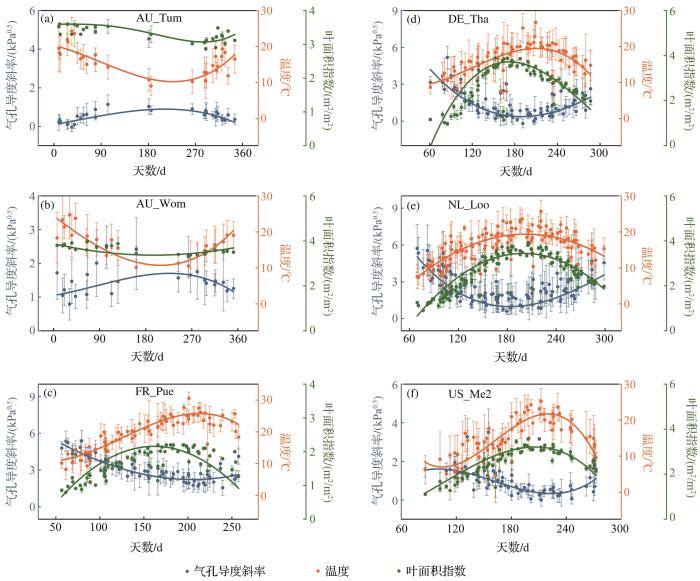
The conductance-photosynthesis (gs-A) model is widely used for estimating the transpiration rate (ETc). The stomatal conductance slope (g1) in the gs-A model is crucial, and is usually parameterized with a PFT-specific g1. However, because there is seasonal variation in g1, the scheme of constantizing g1 results in large potential uncertainties in ETc estimation. Therefore, optimizing the parameterized scheme of g1 is key for improving the estimation of ETc. Previous studies have shown that the dynamic parameterization of g1 using remote sensing-based Leaf Area Index (LAI) can effectively improve the accuracy of the estimated ETc in deciduous forests. However, it is still not clear whether this method is applicable to evergreen forests, in which the canopy shows slight seasonal variability. In addition, the First-Principles Theory indicates that g1 can be expressed as a function of temperature. Hence, whether temperature can be used to simulate g1 with a better performance than that when using LAI requires further investigations. In view of the above questions, six FLUXNET evergreen forest sites were selected to investigate the relationships between g1, and LAI and air temperature, and the ETc simulation results under the two parameterization schemes were compared. Results showed that g1 varied with both LAI and temperature at each site, showing a significant negative correlation, while the results of the dynamic parameterization scheme (DYN) were better than those of the constant g1 scheme (FIX). This showed that the simulation of g1 using LAI is still effective in evergreen forests, but the explanation of temperature on g1 (R2=0.45±0.12) is stronger than that of LAI (R2=0.28±0.23). Further comparing the gs and ETc obtained using the two schemes, we found that the scheme based on temperature performed better than that of LAI at the daily scale, with the Root Mean Square Error (RMSE) of the ETc estimation being significantly reduced (26.0%±24.4%). This study emphasizes the feasibility of the temperature-based parameterized scheme of g1 and helps to fundamentally improve the simulation of gs and ETc in evergreen forest landscapes.
Jiaxin JIN , Fengyan ZHANG , Han WANG , Ying LIU , Weiye HOU , Yulong CAI , Xiaolong PAN , Ying WANG , Qiuan ZHU , Xiuqin FANG , Yiqi YAN , Liliang REN . Optimization of the Stomatal Conductance Slope in the Conductance-Photosynthesis Model and Improved Estimation of Transpiration in Evergreen Forests[J]. Advances in Earth Science, 2023 , 38(9) : 931 -942 . DOI: 10.11867/j.issn.1001-8166.2023.052
| 1 | YU Guirui, FU Yuling, SUN Xiaomin, et al. Research progress and development ideas of China terrestrial ecosystem flux observation and research network (ChinaFLUX) [J]. Science in China Series D: Earth Sciences, 2006, 36 (): 1-21. |
| 1 | 于贵瑞,伏玉玲,孙晓敏,等.中国陆地生态系统通量观测研究网络(ChinaFLUX)的研究进展及其发展思路[J]. 中国科学D辑:地球科学,2006,36(): 1-21. |
| 2 | JUNG M, REICHSTEIN M, CIAIS P, et al. Recent decline in the global land evapotranspiration trend due to limited moisture supply[J]. Nature, 2010, 467(7 318): 951-954. |
| 3 | WANG K C, DICKINSON R E. A review of global terrestrial evapotranspiration: observation, modeling, climatology, and climatic variability[J]. Reviews of Geophysics, 2012, 50(2). DOI: 10.1029/2011RG000373 . |
| 4 | CHAPIN III F S, PICKETT S T A, POWER M E, et al. Earth stewardship: a strategy for social-ecological transformation to reverse planetary degradation[J]. Journal of Environmental Studies and Sciences, 2011, 1(1): 44-53. |
| 5 | MARSHALL M, THENKABAIL P, BIGGS T, et al. Hyperspectral narrowband and multispectral broadband indices for remote sensing of crop evapotranspiration and its components (transpiration and soil evaporation)[J]. Agricultural and Forest Meteorology, 2016, 218: 122-134. |
| 6 | KNOHL A, SCHULZE E D, KOLLE O, et al. Large carbon uptake by an unmanaged 250-year-old deciduous forest in Central Germany[J]. Agricultural and Forest Meteorology, 2003, 118(3/4): 151-167. |
| 7 | OKI T, KANAE S. Global hydrological cycles and world water resources[J]. Science, 2006, 313(5 790): 1 068-1 072. |
| 8 | TRENBERTH K E, SMITH L. The three dimensional structure of the atmospheric energy budget: methodology and evaluation[J]. Climate Dynamics, 2009, 32(7): 1 065-1 079. |
| 9 | VINUKOLLU R K, WOOD E F, FERGUSON C R, et al. Global estimates of evapotranspiration for climate studies using multi-sensor remote sensing data: evaluation of three process-based approaches[J]. Remote Sensing of Environment, 2011, 115(3): 801-823. |
| 10 | JASECHKO S, SHARP Z D, GIBSON J J, et al. Terrestrial water fluxes dominated by transpiration[J]. Nature, 2013, 496(7 445): 347-350. |
| 11 | PENMAN H L. Natural evaporation from open water,bare soil and grass[J]. Proceedings of the Royal Society of London, 1948, 193(1 032): 120-145. |
| 12 | LIU Yuanbo, QIU Guoyu, ZHANG Hongsheng, et al. Theoretical methods for terrestrial evapotranspiration: review and prospect[J]. Science China: Earth Sciences, 2021, 52(3): 381-399. |
| 12 | 刘元波,邱国玉,张宏昇,等.陆域蒸散的测算理论方法:回顾与展望[J]. 中国科学: 地球科学,2021, 52(3): 381-399. |
| 13 | ALLEN R G, PEREIRA L S, RAES D, et al. Crop evapotranspiration-Guidelines for computing crop water requirements-FAO irrigation and drainage paper 56[Z]. Rome: Food and Agricultural Organization of the U. N., 1998. |
| 14 | LU Xinjian. Research on calculation method of tree transpiration by Penman-Monteith equation[D]. Beijing: Beijing Forestry University,2008. |
| 14 | 芦新建. Penman-Monteith方程计算林木蒸腾量的方法研究[D]. 北京: 北京林业大学, 2008. |
| 15 | JIAO Xing, LIU Guangquan, KUANG Shangfu, et al. Review on application of Penman-Monteith equation to studying forest vegetation evapotranspiration[J]. Journal of Hydraulic Engineering, 2010, 41(2): 245-252. |
| 15 | 焦醒,刘广全,匡尚富,等.Penman-Monteith模型在森林植被蒸散研究中的应用[J].水利学报,2010,41(2):245-252. |
| 16 | LI Hongxia, ZHANG Yongqiang, ZHANG Xinhua, et al. Estimation of regional evapotranspiration by remote sensing Penman-Monteith model[J]. Engineering Journal of Wuhan University, 2011, 44(4): 457-461. |
| 16 | 李红霞,张永强,张新华,等.遥感Penman-Monteith模型对区域蒸散发的估算[J].武汉大学学报(工学版), 2011, 44(4): 457-461. |
| 17 | WANG Haibo, MA Mingguo. Estimation of transpiration and evaporation of different ecosystems in an inland river basin using remote sensing data and the Penman-Monteith equation[J]. Acta Ecologica Sinica, 2014, 34(19): 5 617-5 626. |
| 17 | 王海波,马明国.基于遥感和Penman-Monteith模型的内陆河流域不同生态系统蒸散发估算[J].生态学报,2014, 34(19): 5 617-5 626. |
| 18 | GAO Guanlong, ZHANG Xiaoyou, CHANG Zongqiang, et al. Environmental response simulation and the up-scaling of plant stomatal conductance[J]. Acta Ecologica Sinica, 2016, 36(6): 1 491-1 500. |
| 18 | 高冠龙,张小由,常宗强,等.植物气孔导度的环境响应模拟及其尺度扩展[J].生态学报, 2016, 36(6):1 491-1 500. |
| 19 | COWAN I R, FARQUHAR G D. Stomatal function in relation to leaf metabolism and environment[J]. Symposia of the Society for Experimental Biology, 1977, 31: 471-505. |
| 20 | WU J, SERBIN S P, ELY K S, et al. The response of stomatal conductance to seasonal drought in tropical forests[J]. Global Change Biology, 2020, 26(2): 823-839. |
| 21 | MU Q Z, ZHAO M S, RUNNING S W. Improvements to a MODIS global terrestrial evapotranspiration algorithm[J]. Remote Sensing of Environment, 2011, 115(8): 1 781-1 800. |
| 22 | LEUNING R. Modelling stomatal behaviour and and photosynthesis of eucalyptus grandis[J]. Australian Journal of Plant Physiology, 1990, 17: 159-175. |
| 23 | MISSON L, RATHGEBER C, GUIOT J. Dendroecological analysis of climatic effects on Quercus petraea and Pinus halepensis radial growth using the process-based MAIDEN model[J]. Canadian Journal of Forest Research, 2004, 34(4): 888-898. |
| 24 | HETHERINGTON A M, WOODWARD F I. The role of stomata in sensing and driving environmental change[J]. Nature, 2003, 424(6 951): 901-908. |
| 25 | YE Zipiao, YU Qiang. Mechanism model of stomatal conductance[J]. Chinese Journal of Plant Ecology, 2009, 33(4): 772-782. |
| 25 | 叶子飘,于强.植物gs的机理模型[J]. 植物生态学报,2009, 33(4): 772-782. |
| 26 | MEDLYN B E, DUURSMA R A, EAMUS D, et al. Reconciling the optimal and empirical approaches to modelling stomatal conductance[J]. Global Change Biology, 2011, 17(6): 2 134-2 144. |
| 27 | MINER G L, BAUERLE W L, BALDOCCHI D D. Estimating the sensitivity of stomatal conductance to photosynthesis: a review[J]. Plant, Cell & Environment, 2017, 40(7): 1 214-1 238. |
| 28 | MEDLYN B E, de KAUWE M G, LIN Y S, et al. How do leaf and ecosystem measures of water-use efficiency compare?[J]. New Phytologist, 2017, 216(3): 758-770. |
| 29 | KNAUER J, WERNER C, ZAEHLE S. Evaluating stomatal models and their atmospheric drought response in a land surface scheme: a multibiome analysis[J]. Journal of Geophysical Research: Biogeosciences, 2015, 120(10): 1 894-1 911. |
| 30 | JIN Jiaxin, YAN Tao, WANG Han, et al. Improved modeling of canopy transpiration for temperate forests by incorporating a LAI-based dynamic parametrization scheme of stomatal slope[J]. Agricultural and Forest Meteorology, 2022, 326(15). DOI: 10.1016/j.agrformet.2022.109157 . |
| 31 | LIN Y S, MEDLYN B E, DUURSMA R A, et al. Optimal stomatal behaviour around the world[J]. Nature Climate Change, 2015, 5(5): 459-464. |
| 32 | PRENTICE I C, DONG N, GLEASON S M, et al. Balancing the costs of carbon gain and water transport: testing a new theoretical framework for plant functional ecology[J]. Ecology Letters, 2014, 17(1): 82-91. |
| 33 | ZOU Mijun, YANG Kun, LU Hui, et al. Integrating eco-evolutionary optimality principle and land processes for evapotranspiration estimation[J]. Journal of Hydrology, 2023. DOI: 10.1016/j.jhydrol.2022.128855 . |
| 34 | WANG H, PRENTICE I C, KEENAN T F, et al. Towards a universal model for carbon dioxide uptake by plants[J]. Nature Plants, 2017, 3(9): 734-741. |
| 35 | TAN Shen, WANG Han. Towards a universal model for estimating gross primary productivity and evapotranspiration coupling based on First-Principles theory[J]. Acta Ecologica Sinica, 2022, 42(4): 1 487-1 499. |
| 35 | 谭深,王焓. 基于最优性原理的普适性碳水通量耦合估算方法研究[J]. 生态学报,2022,42(4): 1 487-1 499. |
| 36 | LEUNING R, CLEUGH H A, ZEGELIN S J, et al. Carbon and water fluxes over a temperate Eucalyptus forest and a tropical wet/dry savanna in Australia: measurements and comparison with MODIS remote sensing estimates[J]. Agricultural and Forest Meteorology, 2005, 129(3/4): 151-173. |
| 37 | GRIEBEL A, BENNETT L T, METZEN D, et al. Effects of inhomogeneities within the flux footprint on the interpretation of seasonal, annual, and interannual ecosystem carbon exchange[J]. Agricultural and Forest Meteorology, 2016, 221: 50-60. |
| 38 | RAMBAL S, JOFFRE R, OURCIVAL J M, et al. The growth respiration component in eddy CO2 flux from a Quercus ilex mediterranean forest[J]. Global Change Biology, 2004, 10(9): 1 460-1 469. |
| 39 | GRüNWALD T, BERNHOFER C. A decade of carbon, water and energy flux measurements of an old spruce forest at the Anchor Station Tharandt[J]. Tellus B: Chemical and Physical Meteorology, 2007, 59(3): 387-396. |
| 40 | MOORS E J. Water use of forests in the Netherlands[D]. Wageningen: Vrije Universiteit Amsterdam, 2012. |
| 41 | IRVINE J, LAW B E, MARTIN J G, et al. Interannual variation in soil CO2 efflux and the response of root respiration to climate and canopy gas exchange in mature ponderosa pine[J]. Global Change Biology, 2008, 14(12): 2 848-2 859. |
| 42 | PAPALE D, REICHSTEIN M, AUBINET M, et al. Towards a standardized processing of net ecosystem exchange measured with eddy covariance technique: algorithms and uncertainty estimation[J]. Biogeosciences, 2006, 3(4): 571-583. |
| 43 | ZHANG Kun, ZHU Gaofeng, MA Jinzhu, et al. Parameter analysis and estimates for the MODIS evapotranspiration algorithm and multiscale verification[J]. Water Resources Research, 2019, 55(3): 2 211-2 231. |
| 44 | MONTEITH J L. Evaporation and environment[J]. Symposia of the Society for Experimental Biology, 1965, 19: 205-234. |
| 45 | WANG L X, GOOD S P, CAYLOR K K. Global synthesis of vegetation control on evapotranspiration partitioning[J]. Geophysical Research Letters, 2014, 41(19): 6 753-6 757. |
| 46 | LAWRENCE D M, THORNTON P E, OLESON K W, et al. The partitioning of evapotranspiration into transpiration, soil evaporation, and canopy evaporation in a GCM: impacts on land-atmosphere interaction[J]. Journal of Hydrometeorology, 2007, 8(4): 862-880. |
| 47 | ZHOU Sha, YU Bofu, ZHANG Yao, et al. Partitioning evapotranspiration based on the concept of underlying water use efficiency[J]. Water Resources Research, 2016, 52(2): 1 160-1 175. |
| 48 | ZHOU Sha, YU Bofu, HUANG Yuefei, et al. Daily underlying water use efficiency for AmeriFlux sites[J]. Journal of Geophysical Research-Biogeosciences, 2015, 120(5): 887-902. |
| 49 | WEI Z W, YOSHIMURA K, WANG L X, et al. Revisiting the contribution of transpiration to global terrestrial evapotranspiration[J]. Geophysical Research Letters, 2017, 44(6): 2 792-2 801. |
| 50 | STOY P C, EL-MADANY T S, FISHER J B, et al. Reviews and syntheses: turning the challenges of partitioning ecosystem evaporation and transpiration into opportunities[J]. Biogeosciences, 2019, 16(19): 3 747-3 775. |
| 51 | ZHANG K, KIMBALL J S, NEMANI R R, et al. A continuous satellite-derived global record of land surface evapotranspiration from 1983 to 2006[J]. Water Resources Research, 2010, 46(9). DOI: 10.1029/2009WR008800 . |
| 52 | MOFFAT A M, PAPALE D, REICHSTEIN M, et al. Comprehensive comparison of gap-filling techniques for eddy covariance net carbon fluxes[J]. Agricultural and Forest Meteorology, 2007, 147(3/4). DOI: 10.1016/j.agrformet.2007.08.011 . |
| 53 | FRANKS P J, BONAN G B, BERRY J A, et al. Comparing optimal and empirical stomatal conductance models for application in Earth system models[J]. Global Change Biology, 2018, 24(12): 5 708-5 723. |
| 54 | FRANKS P J, BERRY J A, LOMBARDOZZI D L, et al. Stomatal function across temporal and spatial scales: deep-time trends, land-atmosphere coupling and global models[J]. Plant Physiology, 2017, 174(2): 583-602. |
| 55 | DEVI A F, GARKOTI S C. Variation in evergreen and deciduous species leaf phenology in Assam, India[J]. Trees, 2013, 27(4): 985-997. |
| 56 | FARQUHAR G D, CAEMMERER S V, BERRY J A. A biochemical model of photosynthetic CO2 assimilation in leaves of C3 species[J]. Planta, 1980, 149(1): 78-90. |
| 57 | MCMURTRIE R E, WANG Y P. Mathematical models of the photosynthetic response of tree stands to rising CO2 concentrations and temperatures[J]. Plant, Cell & Environment, 1993, 16(1): 1-13. |
| 58 | HARLEY P C, BALDOCCHI D D. Scaling carbon dioxide and water vapour exchange from leaf to capony in a deciduous forest[J]. Plant, Cell & Environment, 1995, 18: 1 146-1 156. |
/
| 〈 |
|
〉 |
 甘公网安备62010202000687