
Received date: 2021-11-03
Revised date: 2022-01-26
Online published: 2022-05-31
Supported by
the National Key Research and Development Program of China “Key technologies and applications in the subtropical regional model”(2017YFC1502101)
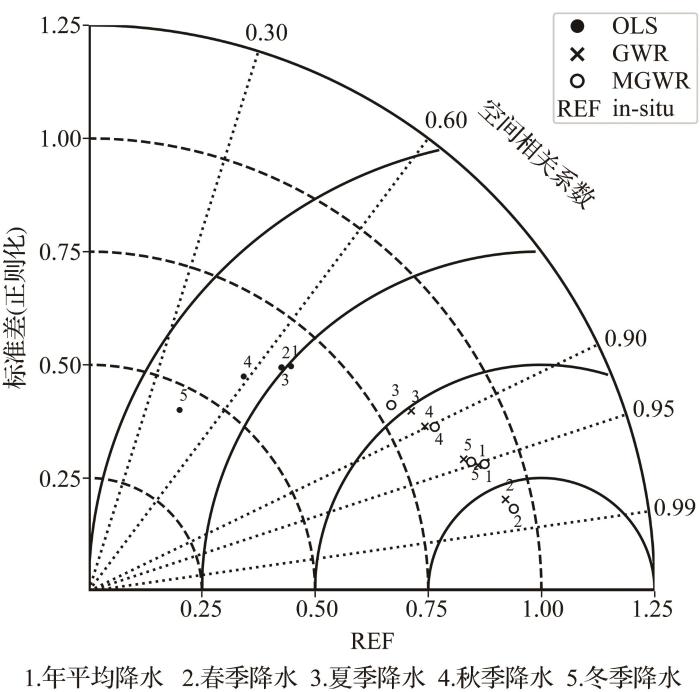
Precipitation is the main source of surface freshwater. The temporal and spatial heterogeneity of precipitation distribution brings great uncertainty to the study of the surface water cycle. The study of spatial heterogeneity and the factors influencing precipitation has always been the focus of water cycle research. To explore the relationship between the spatial distribution of precipitation and terrain factors, 351 precipitation observation stations in eastern China with abundant observational data were used according to the Ordinary Least Squares regression (OLS), Geographically Weighted Regression model (GWR), and Multi-scale Geographically Weighted Regression model (MGWR). The results show that OLS cannot show the influence of terrain factors on the spatial heterogeneity of precipitation distribution, while GWR and MGWR achieved a better goodness of fit and stronger interpretability (Goodness of fit R2>0.7). Furthermore, the MGWR can reflect the scale effects of terrain factors on the spatial distribution of precipitation based on bandwidths, and local influencing factors with smaller bandwidths have a stronger influence on the spatial heterogeneity of precipitation. For the annual average precipitation, the terrain elevation and terrain relief are the main terrain factors that affect the spatial heterogeneity of precipitation, while the terrain slope and Prevailing Wind-direction Effect Index (PWEI) have no significant impact on precipitation. However, seasonally, the influence of different terrain factors on the spatial distribution of precipitation is different. Specifically, in summer, terrain elevation is more important than other factors; in spring and autumn, the distance from the coast plays an important role in the mountain regions, and in winter local influencing factors such as terrain relief mainly affect the spatial distribution of precipitation. Clarifying the relationship between precipitation and terrain factors can help us understand the contribution of complex terrain factors (in all seasons) to precipitation and provide support for model simulation and improvement in regions with a complex topography.
Li ZENG , Yanhong GAO , Yingsha JIANG , Chaoyang LIU , Suosuo LI . Scale Effects of Terrain Factors on Precipitation in East China[J]. Advances in Earth Science, 2022 , 37(5) : 535 -548 . DOI: 10.11867/j.issn.1001-8166.2022.020
| 1 | LIAO Fei, HONG Yanchao, ZHENG Guoguang. Review of orographic influences on surface precipitation[J]. Meteorological Science and Technology, 2007, 35(3): 309-316. |
| 1 | 廖菲, 洪延超, 郑国光. 地形对降水的影响研究概述[J]. 气象科技, 2007, 35(3): 309-316. |
| 2 | WANG B, BAO Q, HOSKINS B, et al. Tibetan Plateau warming and precipitation changes in East Asia[J]. Geophysical Research Letters, 2008, 35(14): L14702. |
| 3 | WANG Qiwei, TAN Zhemin. Flow regimes for major topographic obstacles of China[J]. Chinese Journal of Geophysics, 2006, 49(4): 971-982. |
| 3 | 王其伟, 谈哲敏. 我国主要地形上空理想定常流的流域分界分析[J]. 地球物理学报, 2006, 49(4): 971-982. |
| 4 | ZHAO Yuchun, WANG Yehong. Impacts of vertical wind shear on mesoscale topographical convective precipitation[J]. Chinese Journal of Geophysics, 2012, 55(10): 3 213-3 229. |
| 4 | 赵玉春, 王叶红. 风垂直切变对中尺度地形对流降水影响的研究[J]. 地球物理学报, 2012, 55(10): 3 213-3 229. |
| 5 | ZHONG Shuixin. Advances in the study of the influencing mechanism and forecast methods for orographic precipitation[J]. Plateau Meteorology, 2020, 39(5): 1 122-1 132. |
| 5 | 钟水新. 地形对降水的影响机理及预报方法研究进展[J]. 高原气象, 2020, 39(5): 1 122-1 132. |
| 6 | SHU Shoujuan, WANG Yuan, XIONG Anyuan. Estimation and analysis for geographic and orographic influences on precipitation distribution in China[J]. Chinese Journal of Geophysics, 2007, 50(6): 1 703-1 712. |
| 6 | 舒守娟, 王元, 熊安元. 中国区域地理、地形因子对降水分布影响的估算和分析[J]. 地球物理学报, 2007, 50(6): 1 703-1 712. |
| 7 | BASIST A, BELL G D, MEENTEMEYER V. Statistical relationships between topography and precipitation patterns[J]. Journal of Climate, 1994, 7(9): 1 305-1 315. |
| 8 | KRAVCHENKO A, ZHANG R, TUNG Y K. Estimation of mean annual precipitation in Wyoming using geostatistical analysis[M]. USA: Wyoming Water Research Center, 1996. |
| 9 | HAYWARD D, CLARKE R. Relation entre la pluie, l’altitude et la distance à la mer dans la Presqu’?le de Freetown, Sierra Leone[J]. Hydrological Sciences Journal, 1996, 41(3): 377-384. |
| 10 | RALPH F M, PERSSON P O G, REYNOLDS D W, et al. The California Land-falling Jets Experiment CALJET: objectives and design of a coastal atmosphere-ocean observing system deployed during a strong El Ni?o[C]. Preprints, 3rd Symposium on Integrated Observing Systems, 1999: 78-81. |
| 11 | WHITE A B, NEIMAN P J, RALPH F M, et al. Coastal orographic rainfall processes observed by radar during the California Land-falling Jets Experiment[J]. Journal of Hydrometeorology, 2003, 4(2): 264-282. |
| 12 | UM M J, YUN H, JEONG C S, et al. Factor analysis and multiple regression between topography and precipitation on Jeju Island, Korea[J]. Journal of Hydrology, 2011, 410(3/4): 189-203. |
| 13 | CASTRO L M, GIRONáS J, FERNáNDEZ B. Spatial estimation of daily precipitation in regions with complex relief and scarce data using terrain orientation[J]. Journal of Hydrology, 2014, 517: 481-492. |
| 14 | BRUNSDON C, FOTHERINGHAM A S, CHARLTON M E. Geographically weighted regression: a method for exploring spatial nonstationarity[J]. Geographical Analysis, 1996, 28(4): 281-298. |
| 15 | HESSION S L, MOORE N. A spatial regression analysis of the influence of topography on monthly rainfall in East Africa[J]. International Journal of Climatology, 2011, 31(10): 1 440-1 456. |
| 16 | KUMARI M, SINGH C K, BASISTHA A, et al. Non-stationary modelling framework for rainfall interpolation in complex terrain[J]. International Journal of Climatology, 2017, 37(11): 4 171-4 185. |
| 17 | BRUNSDON C, MCCLATCHEY J, UNWIN D. Spatial variations in the average rainfall-altitude relationship in Great Britain: an approach using geographically weighted regression[J]. International Journal of Climatology, 2001, 21(4): 455-466. |
| 18 | FOTHERINGHAM A, YANG W, KANG W. Multiscale Geographically Weighted Regression (MGWR)[J]. Annals of the American Association of Geographers, 2017, 107(6): 1 247-1 265. |
| 19 | OSHAN T, LI Z, KANG W, et al. MGWR: a python implementation of multiscale geographically weighted regression for investigating process spatial heterogeneity and scale[J]. ISPRS International Journal of Geo-Information, 2019, 8(6). DOI:10.31219/osf.io/bphw9 . |
| 20 | YU H, FOTHERINGHAM A, LI Z, et al. Inference in multiscale geographically weighted regression[J]. Geographical Analysis, 2020, 52(1): 87-106. |
| 21 | JEWORREK J, WEST G, STULL R. WRF precipitation performance and predictability for systematically varied parameterizations over complex terrain[J]. Weather and Forecasting, 2021, 36(3): 893-913. |
| 22 | SU F G, DUAN X L, CHEN D L, et al. Evaluation of the global climate models in the CMIP5 over the Tibetan Plateau[J]. Journal of Climate, 2013, 26(10): 3 187-3 208. |
| 23 | HENN B, NEWMAN A J, LIVNEH B, et al. An assessment of differences in gridded precipitation datasets in complex terrain[J]. Journal of Hydrology, 2018, 556: 1 205-1 219. |
| 24 | YAO Shibo, JIANG Dabang, FAN Guangzhou. Seasonality of precipitation over China[J]. Chinese Journal of Atmospheric Sciences, 2017, 41(6): 1 191-1 203. |
| 24 | 姚世博, 姜大膀, 范广洲. 中国降水的季节性[J]. 大气科学, 2017, 41(6): 1 191-1 203. |
| 25 | QIAN W, YU Z, ZHU Y. Spatial and temporal variability of precipitation in East China from 1880 to 1999[J]. Climate Research, 2006, 32: 209-218. |
| 26 | CHENG Weiming, ZHOU Chenghu, CHAI Huixia, et al. Quantitative extraction and analysis of basic morphological types of land geomorphology in China[J]. Journal of Geo-Information Science, 2009, 11(6): 725-736. |
| 26 | 程维明, 周成虎, 柴慧霞, 等. 中国陆地地貌基本形态类型定量提取与分析[J]. 地球信息科学学报, 2009, 11(6): 725-736. |
| 27 | Baopu FO. The effects of topography and elevation on precipitation[J]. Acta Geograpphica Sinica, 1992, 47(4): 302-314. |
| 27 | 傅抱璞. 地形和海拔高度对降水的影响[J]. 地理学报, 1992, 47(4): 302-314. |
| 28 | SUN Pengsen, LIU Shirong, LI Chongwei. Estimation of precipitation using altitude and prevailing wind direction effect index in mountainous region[J]. Acta Ecologica Sinca, 2004, 24(9): 1 910-1 915,2 093. |
| 28 | 孙鹏森, 刘世荣, 李崇巍. 基于地形和主风向效应模拟山区降水空间分布[J]. 生态学报, 2004,24(9): 1 910-1 915,2 093. |
| 29 | CLEVELAND W S, DEVLIN S J. Locally weighted regression: an approach to regression analysis by local fitting[J]. Journal of the American Statistical Association, 1988, 83(403): 596-610. |
| 30 | DING J, TAROKH V, YANG Y H. Model selection techniques: an overview[J]. IEEE Signal Processing Magazine, 2018, 35(6): 16-34. |
| 31 | GEISSER S. The predictive sample reuse method with applications[J]. Journal of the American Statistical Association, 1975, 70(350): 320-328. |
| 32 | FOTHERINGHAM A S, BRUNSDON C F, CHARLTON M E. Geographically weighted regression: the analysis of spatially varying relationships[M]. USA: John Wiley & Sons, 2003. |
| 33 | AKAIKE H. A new look at the statistical model identification[J]. IEEE Transactions on Automatic Control, 1974, 19(6): 716-723. |
| 34 | MORAN P A P. Notes on continuous stochastic phenomena[J]. Biometrika, 1950, 37(1/2): 17-23. |
| 35 | DING Renhai, DING Xin. Analysis on precipitation differences between Jiuhua Mountains and its surrounding regions[J]. Meteorological Monthly, 2014, 40(4): 458-465. |
| 35 | 丁仁海, 丁鑫. 九华山与周边区域的降水分布差异分析[J]. 气象, 2014, 40(4): 458-465. |
| 36 | HOUZE Jr R A. Orographic effects on precipitating clouds[J]. Reviews of Geophysics, 2012, 50(1): RG1001. |
| 37 | SMITH R B. The influence of mountains on the atmosphere[J]. Advances in Geophysics, 1979, 21: 87-230. |
| 38 | WEN Qian, TAN Guoliang, LUO Silin. An analysis of the influence of the topography on the distribution of precipitation[J]. Hydrology, 1997(): 64-66. |
| 38 | 文迁, 谭国良, 罗嗣林. 降水分布受地形影响的分析[J]. 水文, 1997(): 64-66. |
| 39 | BROWNING K A, HILL F F, PARDOE C W. Structure and mechanism of precipitation and the effect of orography in a wintertime warm sector[J]. Quarterly Journal of the Royal Meteorological Society, 1974, 100(425): 309-330. |
| 40 | CHEN Liang, DUAN Jianping, MA Zhuguo. Objective analysis on large-scale circulation type and its links to precipitation over China[J]. Advances in Earth Science, 2018, 33(4): 396-403. |
| 40 | 陈亮, 段建平, 马柱国. 大气环流形势客观分型及其与中国降水的联系[J]. 地球科学进展, 2018, 33(4): 396-403. |
| 41 | SHEN Yuwei, ZHANG Yaocun, QIAN Yongfu. A parameterization scheme for the dynamic effects of subgrid topography and its impacts on rainfall simulation[J]. Plateau Meteorology, 2007, 26(4): 655-665. |
| 41 | 沈玉伟, 张耀存, 钱永甫. 次网格地形动力效应参数化及其对降水模拟效果的影响[J]. 高原气象, 2007, 26(4): 655-665. |
| 42 | GAO J B, JIAO K W, WU S H. Investigating the spatially heterogeneous relationships between climate factors and NDVI in China during 1982 to 2013[J]. Journal of Geographical Sciences, 2019, 29(10): 1 597-1 609. |
| 43 | HUANG Jianping, CHEN Wen, WEN Zhiping, et al. Review of Chinese atmospheric science research over the past 70 years: climate and climate change[J]. Science China Earth Sciences, 2019,62(10): 1 514-1 550. |
| 43 | 黄建平, 陈文, 温之平, 等. 新中国成立70年以来的中国大气科学研究: 气候与气候变化篇[J].中国科学: 地球科学, 2019, 49(10): 1 607-1 640. |
| 44 | ZHOU Changyan, LI Yueqing, LI Wei, et al. Climatological chracteristics of water vapor transport over East Asian and water vapor source in autumn[J]. Journal of Tropical Meteorology, 2006, 22(4): 380-385. |
| 44 | 周长艳, 李跃清, 李薇, 等. 东亚地区秋季水汽输送特征及水汽源地分析[J]. 热带气象学报, 2006, 22(4): 380-385. |
| 45 | SUN Bo, WANG Huijun, ZHOU Botao, et al. A review on the interannual and interdecadal variations of water vapor transport over China during past decades[J]. Advances in Water Science, 2020, 31(5): 644-653. |
| 45 | 孙博, 王会军, 周波涛, 等. 中国水汽输送年际和年代际变化研究进展[J]. 水科学进展, 2020, 31(5): 644-653. |
| 46 | WALLACE J, HOBBS P. Atmospheric science: an introductory survey[M]. USA: Elsevier, 2006. |
| 47 | ZHANG Mingming, LI Jian, GAN Yuting, et al. Analysis of the relationship between precipitation and altitude over central and Eastern China based on the Geographically Weighted Regression Model[J]. Torrential Rain and Disasters, 2021, 40(1): 1-11. |
| 47 | 张铭明, 李建, 甘玉婷, 等. 基于GWR模型的中国中东部降水与海拔高度关系特征分析[J]. 暴雨灾害, 2021, 40(1): 1-11. |
/
| 〈 |
|
〉 |
 甘公网安备62010202000687