
Received date: 2021-10-12
Revised date: 2022-01-07
Online published: 2022-03-08
Supported by
the National Natural Science Foundation of China "Characterization of regional variation and drivers of drought change in Central Asia"(U2003302);The Strategic Priority Research Program of Chinese Academy of Sciences "Hydraulic links and connectivity between the five headwaters of the Tarim River and the main stream"(XDA20100303)
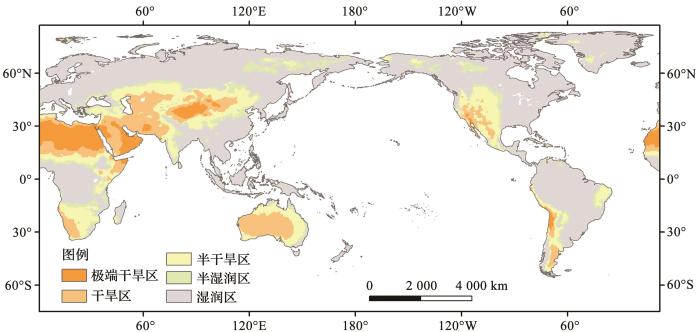
Drylands cover about 41% of the Earth's land area, support more than 38% of the world's population, and are home to most of the world's developing and poor populations. Drylands are one of the most sensitive areas to the impacts and responses to global climate change, and it is essential to study the changes in their climate, hydrology and ecological environment. There have been many studies in this area in recent decades, but the conclusions are fragmented and there are many inconsistencies. Based on the analysis of domestic and international literature, this paper summarizes and composes the changes in climate, hydrology, area and type of drylands under climate change and the impacts of these changes on ecosystems. The main results of the combing are as follows. CO2 emissions from dryland are only about 30% of those from humid areas, but the warming rate is 20%~40% higher than that of humid areas. In the past half century, the dryland area has increased by about 2.61×10⁶ km2, and by the end of this century, the global dryland area will continue to expand by about 5.8×10⁶ km2, which will occupy more than half of the total land area. Under the background of global warming, the water resources system based on precipitation and snow melt recharge in drylands will be more fragile, and hydrological elements such as ice and snow and water resources composition will change, hydrological fluctuations will increase, and water resources uncertainty will intensify. Along with the expansion of dryland area and the increase of aridity, the shortage of water resources, shrinkage of water bodies, degradation of ecosystems and desertification in dryland areas will also intensify, and the future socio-economic development and ecological security of dryland areas will face more severe challenges. Some comprehensive conclusions condensed from these inductive combs are of reference significance for governmental decision making and for proposing credible and clear scientific understanding in the future.
Key words: Climate change; Dryland; Water resources; Desertification; Ecological crisis
Yaning CHEN , Yupeng LI , Zhi LI , Yongchang LIU , Wenjing HUANG , Xigang LIU , Meiqing FENG . Analysis of the Impact of Global Climate Change on Dryland Areas[J]. Advances in Earth Science, 2022 , 37(2) : 111 -119 . DOI: 10.11867/j.issn.1001-8166.2022.006
| 1 | CHEN Yaning. An overview of arid region science[M]. Beijing: Science Press, 2021. |
| 1 | 陈亚宁. 干旱区科学概论[M]. 北京:科学出版社,2021. |
| 2 | HUANG J P, YU H P, DAI A G, et al. Drylands face potential threat under 2 ℃ global warming target[J]. Nature Climate Change, 2017, 7(6): 417-422. |
| 3 | ABBOTT B W, BISHOP K, ZARNETSKE J P, et al. Human domination of the global water cycle absent from depictions and perceptions[J]. Nature Geoscience, 2019, 12(7): 533-540. |
| 4 | HUANG J, GUAN X, JI F. Enhanced cold-season warming in semi-arid regions[J]. Atmospheric Chemistry and Physics, 2012, 12(12): 5 391-5 398. |
| 5 | DAI A G, LAMB P J, TRENBERTH K E, et al. The recent Sahel drought is real[J]. International Journal of Climatology, 2004, 24(11): 1 323-1 331. |
| 6 | FENG S, FU Q. Expansion of global drylands under a warming climate[J]. Atmospheric Chemistry and Physics, 2013, 13(19): 10 081-10 094. |
| 7 | HUANG J P, YU H P, GUAN X D, et al. Accelerated dryland expansion under climate change[J]. Nature Climate Change, 2016, 6(2): 166-171. |
| 8 | LI Xinzhou, LIU Xiaodong, MA Zhuguo, et al. Analysis on the drought characteristics in the main arid regions in the world since recent hundred-odd years[J]. Arid Zone Research, 2004, 21(2): 97-103. |
| 8 | 李新周, 刘晓东, 马柱国, 等. 近百年来全球主要干旱区的干旱化特征分析[J]. 干旱区研究, 2004, 21(2): 97-103. |
| 9 | FINLAYSON M, CRUZ R D, DAVIDSON N, et al. Millennium ecosystem assessment: ecosystems and human well-being: synthesis[M]. Washington, D.C.: Island Press, 2005. |
| 10 | YAN Xinyang, ZHANHG Qiang, YAN Xiaomin, et al. An overview characteristic and formation mechanisms in global arid areas[J]. Advances in Earth Science, 2019, 34(8): 826-841. |
| 10 | 闫昕旸, 张强, 闫晓敏, 等. 全球干旱区分布特征及成因机制研究进展[J]. 地球科学进展, 2019, 34(8): 826-841. |
| 11 | GUAN X D, MA J R, HUANG J P, et al. Impact of oceans on climate change in drylands[J]. Science China: Earth Sciences, 2019, 62(6): 891-908. |
| 12 | LI Y, CHEN Y, LI Z. Dry/wet pattern changes in global dryland areas over the past six decades[J]. Global and Planetary Change, 2019, 178: 184-192. |
| 13 | DARAMOLA M T, XU M. Recent changes in global dryland temperature and precipitation[J]. International Journal of Climatology, 2021. DOI:10.1002/joc.7301 . |
| 14 | CHEN Yaning, LI Zhi, FANG Gonghuan, et al. Impact of climate change on water resources in the Tianshan Mountains, Central Asia[J]. Acta Geographica Sinica, 2017, 72(1): 18-26. |
| 14 | 陈亚宁, 李稚, 方功焕, 等. 气候变化对中亚天山山区水资源影响研究[J]. 地理学报, 2017, 72(1): 18-26. |
| 15 | LI B F, CHEN Y N, SHI X, et al. Temperature and precipitation changes in different environments in the arid region of northwest China[J]. Theoretical and Applied Climatology, 2013, 112(3): 589-596. |
| 16 | HU Z Y, ZHANG C, HU Q, et al. Temperature changes in Central Asia from 1979 to 2011 based on multiple datasets[J]. Journal of Climate, 2014, 27(3): 1 143-1 167. |
| 17 | LI B F, CHEN Y N, SHI X. Why does the temperature rise faster in the arid region of northwest China?[J]. Journal of Geophysical Research: Atmospheres, 2012, 117(D16). DOI:10.1029/2012jd017953 . |
| 18 | CHEN Yaning, et al. Research on water resources in arid region of northwest China[M]. Beijing: Science Press, 2014. |
| 18 | 陈亚宁, 等. 中国西北干旱区水资源研究[M]. 北京:科学出版社,2014. |
| 19 | CHEN Y N, LI W H, DENG H J, et al. Changes in Central Asia's water tower: past, present and future[J]. Scientific Reports, 2016,6:35458. |
| 20 | KANG S C, GUO W Q, ZHONG X Y, et al. Changes in the mountain cryosphere and their impacts and adaptation measures[J]. Climate Change Research, 2020, 16(2): 143-152. |
| 21 | MOTE P W, LI S, LETTENMAIER D P, et al. Dramatic declines in snowpack in the western US[J]. Climate and Atmospheric Science, 2018, 1(1): 2. |
| 22 | HUNING L S, AGHAKOUCHAK A. Global snow drought hot spots and characteristics[J]. Proceedings of the National Academy of Sciences, 2020, 117(33): 201915921. |
| 23 | LI Y, CHEN Y, WANG F, et al. Evaluation and projection of snowfall changes in High Mountain Asia based on NASA's NEX-GDDP high-resolution daily downscaled dataset[J]. Environmental Research Letters, 2020, 15(10): 104040. |
| 24 | SMITH T, BOOKHAGEN B. Changes in seasonal snow water equivalent distribution in High Mountain Asia (1987 to 2009) [J]. Science Advances, 2018, 4(1): e1701550. |
| 25 | LI Z, CHEN Y N, LI Y P, et al. Declining snowfall fraction in the alpine regions, Central Asia[J]. Scientific Reports, 2020, 10: 3476. |
| 26 | GUO D, SUN J, LI H, et al. Attribution of historical near-surface permafrost degradation to anthropogenic greenhouse gas warming[J]. Environmental Research Letters, 2020, 15(8): 1-9. |
| 27 | FYFE J C, DERKSEN C, MUDRYK L, et al. Large near-term projected snowpack loss over the western United States[J]. Nature Communications, 2017, 8: 14996. |
| 28 | CHEN X, YANG Y, MA Y, et al. Distribution and attribution of terrestrial snow cover phenology changes over the Northern Hemisphere during 2001-2020[J]. Remote Sensing, 2021, 13(9):1843. |
| 29 | CHEN Y N, LI Z, FAN Y T, et al. Progress and prospects of climate change impacts on hydrology in the arid region of northwest China[J]. Environmental Research, 2015,139:11-19. |
| 30 | BARNETT T P, ADAM J C, LETTENMAIER D P. Potential impacts of a warming climate on water availability in snow-dominated regions[J]. Nature, 2005, 438(7 066): 303-309. |
| 31 | CHEN Yaning, LI Zhi, FAN Yuting, et al. Research progress on the impact of climate change on water resources in the arid region of northwest China[J]. Acta Geographica Sinica, 2014, 69(9): 1 295-1 304. |
| 31 | 陈亚宁, 李稚, 范煜婷,等. 西北干旱区气候变化对水文水资源影响研究进展[J]. 地理学报, 2014, 69(9):1 295-1 304. |
| 32 | CHEN Y N, LI B F, LI Z, et al. Water resource formation and conversion and water security in arid region of northwest China[J]. Journal of Geographical Sciences, 2016,26(7): 939-952. |
| 33 | SHEN Yongping, SU Hongchao, WANG Guoya, et al. The responses of glaciers and snow cover to climate change in Xinjiang (I): hydrological effects[J]. Journal of Glaciology and Geocryology, 2013, 35(3): 513-527. |
| 33 | 沈永平,苏宏超,王国亚,等.新疆冰川、积雪对气候变化的响应(I):水文效应[J].冰川冻土, 2013, 35(3): 513-527. |
| 34 | CHEN Y N, LI W H, FANG G H, et al. Hydrological modeling in glacierized catchments of Central Asia—status and challenges[J]. Hydrology and Earth System Sciences, 2017, 21(2): 669-684. |
| 35 | CHEN Yaning, YANG Qing, LUO Yi, et al. Ponder on the issues of water resources in the arid region of the northwest[J]. China Arid Land Geography,2012,35(1):1-9. |
| 35 | 陈亚宁,杨青,罗毅,等.西北干旱区水资源问题研究思考[J].干旱区地理,2012,35(1):1-9. |
| 36 | CHEN Yaning, WANG Huaijun, WANG Zhicheng,et al. Characteristics of extreme climatic/hydrological events in the arid region of northwestern China[J]. Arid Land Geography, 2017,40(1):1-9. |
| 36 | 陈亚宁,王怀军,王志成,等.西北干旱区极端气候水文事件特征分析[J].干旱区地理, 2017,40(1):1-9. |
| 37 | WANG H J, CHEN Y N, LI W H. Characteristics in streamflow and extremes in the Tarim River, China: trends, distribution and climate linkage[J]. International Journal of Climatology, 2015, 35(5): 761-776. |
| 38 | ZOU Z, XIAO X, DONG J, et al. Divergent trends of open-surface water body area in the contiguous United States from 1984 to 2016[J]. Proceedings of the National Academy of Sciences, 2018, 115(15): 3 810-3 815. |
| 39 | WANG X, XIAO X, ZOU Z, et al. Gainers and losers of surface and terrestrial water resources in China during 1989-2016[J]. Nature Communications, 2020,11(1): 3471. |
| 40 | HUANG W, DUAN W, CHEN Y. Rapidly declining surface and terrestrial water resources in Central Asia driven by socio-economic and climatic changes[J]. Science of the Total Environment, 2021, 784: 147193. |
| 41 | SAMY A R. A desertification impact on Siwa Oasis: present and future challenges[J]. Research Journal of Agriculture and Biological Sciences, 2010,6(6): 791-805. |
| 42 | GOLDEWIJK K K, BEUSEN A, DOELMAN J, et al. Anthropogenic land use estimates for the Holocene-HYDE 3.2[J]. Earth System Science Data, 2017, 9(2): 27-953. |
| 43 | AMIRASLANI F, DRAGOVICH D. Combating desertification in Iran over the last 50 years: an overview of changing approaches[J]. Journal of Environmental Management, 2011, 92(1): 1-13. |
| 44 | BESTELMEYER B T, OKIN G S, DUNIWAY M C, et al. Desertification, land use, and the transformation of global drylands[J]. Frontiers in Ecology and the Environment, 2015,13(1): 28-36. |
| 45 | YI C X, WEI S H, HENDREY G. Warming climate extends dryness-controlled areas of terrestrial carbon sequestration[J]. Scientific Reports, 2014, 4: 1-6. |
| 46 | EVAN A T. Surface winds and dust biases in climate models[J]. Geophysical Research Letters, 2018, 45(2): 1 079-1 085. |
| 47 | EVAN A T, FLAMANT C, FIEDLER S, et al. An analysis of aeolian dust in climate models[J]. Geophysical Research Letters, 2014, 41(16): 5 996-6 001. |
| 48 | LI Z, CHEN Y N, FANG G H, et al. Multivariate assessment and attribution of droughts in Central Asia[J]. Scientific Reports, 2017, 7(1): 1-12. |
| 49 | WANG L, ODORICO P D, EVANS J P, et al. Dryland ecohydrology and climate change: critical issues and technical advances[J]. Hydrology and Earth System Sciences, 2012, 16(8): 2 585-2 603. |
| 50 | ZHENG Yi, ZHANG Li, ZHOU Yu, et al. Vegetation chang and its driving factors in global drylands during the period of 1982-2012[J]. Arid Zone Research, 2017, 34(1): 59-66. |
| 50 | 郑艺, 张丽, 周宇, 等. 1982—2012年全球干旱区植被变化及驱动因子分析[J]. 干旱区研究, 2017, 34(1): 59-66. |
| 51 | YUAN W P, ZHENG Y, PIAO S L, et al. Increased atmospheric vapor pressure de?cit reduces global vegetation growth[J]. Science Advances, 2019, 5(8): 1396. |
| 52 | PAN N, FENG X, FU B, et al. Increasing global vegetation browning hidden in overall vegetation greening: insights from time-varying trends[J]. Remote Sensing of Environment, 2018, 214: 59-72. |
| 53 | CUNHA A, ALVALá R, NOBRE C, et al. Monitoring vegetative drought dynamics in the Brazilian semiarid region[J]. Agricultural and Forest Meteorology, 2015, 214: 494-505. |
| 54 | LI Z, CHEN Y, LI W, et al. Potential impacts of climate change on vegetation dynamics in Central Asia[J]. Journal of Geophysical Research Atmospheres, 2015,120(24): 1 234-1 236. |
| 55 | PARK T, GANGULI S, T?MMERVIK H, et al. Changes in growing season duration and productivity of northern vegetation inferred from long-term remote sensing data[J]. Environmental Research Letters, 2016, 11(8): 084001. |
| 56 | LI Z, CHEN Y N, ZHANG Q F, et al. Spatial patterns of vegetation carbon sinks and sources under water constraint in Central Asia[J]. Journal of Hydrology, 2020, 590: 125355. |
| 57 | CIAIS P, REICHSTEIN M, VIOVY N, et al. Europe-wide reduction in primary productivity caused by the heat and drought in 2003[J]. Nature, 2005, 437(7 058): 529-533. |
| 58 | COOK B I, PAU S. A global assessment of long-term greening and browning trends in pasture lands using the GIMMS LAI3g dataset[J]. Remote Sensing, 2013, 5(5): 2 492-2 512. |
| 59 | LI Y, CHEN Y, SUN F, et al. Recent vegetation browning and its drivers on Tianshan Mountain, Central Asia[J]. Ecological Indicators, 2021, 129(6 397): 107912. |
/
| 〈 |
|
〉 |
 甘公网安备62010202000687