
Response of China Climate to Vegetation Change Under Mid-Holocene Background Based on Dynamic Downscaling Simulation
Received date: 2021-05-13
Revised date: 2021-09-26
Online published: 2022-01-20
Supported by
the National Key Research and Development Program of China "Numerical simulation reconstruction of paleoclimate parameters and attribution analysis of climate change"(2016YFA0600504);The National Natural Science Foundation of China "Study on the mechanism of regionality of winter extreme low temperature affected by upper-tropospheric jet pattern in the Northern Hemisphere"(41775073)
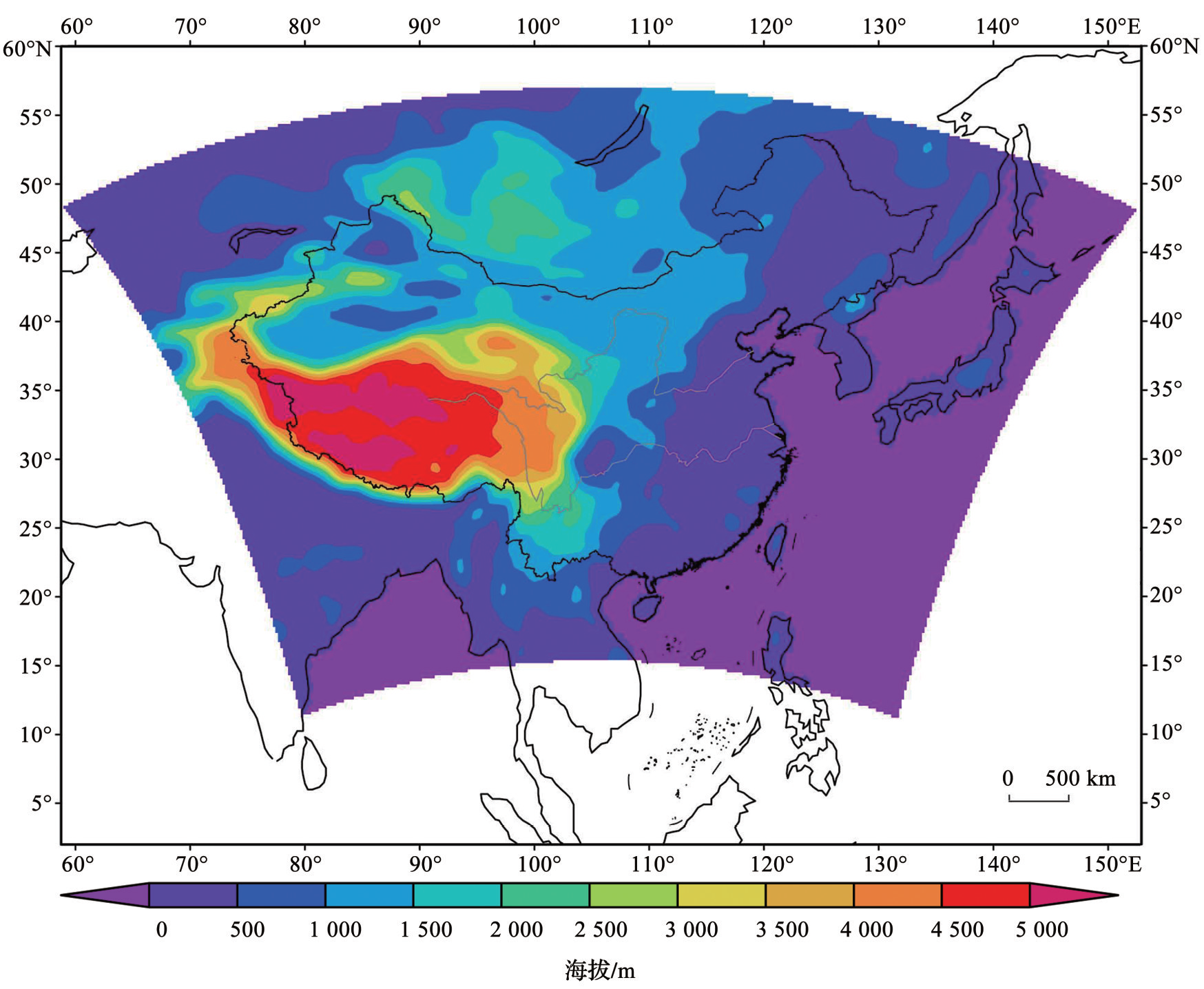
The mid-Holocene is the latest warm period on orbital scale with topography and coastline distribution similar to modern times. Therefore, it is of significance for climate prediction in the future to explore the causes of climate change in this period. In this study, the dynamic downscaling modeling on the climate of China in mid-Holocene were carried out by using the monthly mean atmospheric circulation data of the fully-forced transient experiment results (TraCE-21ka) as lateral boundary nested into the regional climate model (RegCM4). The dynamic downscaling results could more precisely capture the regional differences of climate in China than the TraCE-21ka simulation.Based on the dynamic downscaling simulation, the summer in the mid-Holocene was warmer while the winter was colder in most areas relative to modern times. Meanwhile, the precipitation difference distribution of "positive in north and negative in south" between mid-Holocene and modern era reveals that the East Asian summer monsoon in mid-Holocene was stronger and the rain belt was far northward than the modern times. To further differentiate contributions of the vegetation, sea surface temperature and greenhouse gases on summer precipitation of China in mid-Holocene, we designed three sensible experiments by replacing the relevant variables of mid-Holocene with modern situation. The results reveal that the vegetation is the most crucial one exerting significant influence on the summer precipitation. The vegetation change from mid-Holocene to modern era could cause significant response of the surface albedo, then absorbed solar radiation and atmospheric structure is differently distributed. Consequently, the meridional temperature gradient of the troposphere is altered accompanied with southward shift of the East Asian subtropical westerly jet, so the vertical flow south to the 35°N is strengthened while the north is weakened, comprehensively leading to the longitudinal displacement of the monsoon precipitation belt. Additionally, the evaporation and water vapor transport are also influenced by the vegetation distribution to large extent, which also contribute to the precipitation response to the vegetation change.
Key words: Mid-Holocene; Vegetation change; Summer precipitation; Down scaling
Xueyuan KUANG , Yuechao HAN . Response of China Climate to Vegetation Change Under Mid-Holocene Background Based on Dynamic Downscaling Simulation[J]. Advances in Earth Science, 2021 , 36(12) : 1301 -1312 . DOI: 10.11867/j.issn.1001-8166.2022.004
| 1 | HUANG Chunju, TIAN Xiaoli. Discussion on the driving mechanism of solar activity to interannual suborbital-scale climate change[J]. Quaternary Sciences, 2018, 38(5):1 255-1 267. |
| 1 | 黄春菊,田晓丽. 太阳活动对年代际—亚轨道尺度气候变化的驱动机制探讨[J]. 第四纪研究, 2018,38(5): 1 255-1 267. |
| 2 | WANG Zhiyuan, WANG Jianglin, ZHANG Shijia, et al. Impact of different timescales on the characteristics and mechanisms of the Northern Hemisphere Summer Monsoon: based on the CESM results[J]. Quaternary Sciences, 2018, 38(6):1 494-1 506. |
| 2 | 王志远, 王江林,张诗茄, 等. 不同时间尺度影响下的北半球夏季风空间特征及其可能影响机制[J].第四纪研究,2018,38(6):1 494-1 506. |
| 3 | BRACONNOTT P, OTTO-BLIESNER B, HARRISON S, et al. Results of PMIP2 coupled simulations of the mid-Holocene and Last Glacial Maximum—part 2: feedbacks with emphasis on the location of the ITCZ and mid- and high latitudes heat budget[J]. Climate of the Past, 2007, 3: 279-296. |
| 4 | WANNER H, Solomina O, GROSJEAN M, et al. Structure and origin of Holocene cold events[J]. Quaternary Science Reviews, 2011, 30: 1-15. |
| 5 | MCGEE D, DONOHOE A, MARSHALL J, et al. Changes in ITCZ location and cross-equatorial heat transport at the Last Glacial Maximum, Heinrich Stadial 1, and the mid-Holocene[J]. Earth and Planetary Science Letters, 2014, 390: 69-79. |
| 6 | MASSON V, CHEDDADI R, BRACONNOT P, et al. Mid-Holocene climate in Europe: what can we infer from PMIP model-data comparisons?[J]. Climate Dynamics, 1999, 15(3): 163-182. |
| 7 | WANG Y, CHENG H, EDWARDS R L, et al. The Holocene Asian monsoon: links to solar changes and North Atlantic climate[J]. Science, 2005, 308: 854-857. |
| 8 | MAHER B A. Holocene variability of the East Asian summer monsoon from Chinese cave records: a re-assessment[J]. The Holocene, 2008, 18(6): 861-866. |
| 9 | CHEN F, Yu Z, YANG M, et al. Holocene moisture evolution in arid Central Asia and its out-of-phase relationship with Asian monsoon history[J]. Quaternary Science Reviews, 2008, 27(3/4): 351-364. |
| 10 | HU C, HENDERSON G M, HUANG J, et al. Quantification of Holocene Asian monsoon rainfall from spatially separated cave records[J]. Earth and Planetary Science Letters, 2008, 266(3/4): 221-232. |
| 11 | JIANG D B, TIAN Z P, LANG X M. Mid-Holocene net precipitation changes over China: model-data comparison[J]. Quaternary Science Reviews, 2013, 82: 104-120. |
| 12 | JIANG D B, TIAN Z P, LANG X M. Mid-Holocene global monsoon area and precipitation from PMIP simulations[J]. Climate Dynamics, 2015, 44(9/10): 2 493-2 512. |
| 13 | TIAN Z P, JIANG D B. Revisiting mid-Holocene temperature over China using PMIP3 simulations[J]. Atmospheric and Oceanic Science Letters, 2015, 8(6): 358-364. |
| 14 | SHI Yafeng, KONG Zhaochen, WANG Sumin, et al. Basic feature of climate and environment during the Holocene Megathermal in China [J]. Science in China Series B: Chemistry, 1993, 23(8): 865-873. |
| 14 | 施雅风,孔昭宸,王苏民,等. 中国全新世大暖期鼎盛阶段的气候与环境[J]. 中国科学B辑:化学,1993,23(8):865-873. |
| 15 | HOU Guangliang, FANG Xiuqi. Characteristics of Holocene temperature change in China[J]. Progress in Geography,2011,30(9): 1 075-1 080. |
| 15 | 侯光良,方修琦. 中国全新世气温变化特征[J]. 地理科学进展, 2011, 30(9): 1 075-1 080. |
| 16 | YU E T, WANG T, GAO Y Q, et al. Precipitation pattern of the mid-Holocene simulated by a high-resolution regional climate model[J]. Advances in Atmospheric Sciences, 2014, 31(4): 962-971. |
| 17 | YU Ge, WANG Sumin. Studies of the climatic dynamics for the mid-Holocene vegetational changes in China[J]. Acta Micropalaeontologica Sinica, 2000, 17(2): 147-154. |
| 17 | 于革,王苏民. 中国中全新世植被带迁移的气候动力学机制探讨[J]. 微体古生物学报,2000,17(2):147-154. |
| 18 | LIU Jian, YU Ge, CHEN Xing, et al. Simulations of East Asian climate in mid-Holocene and LGM[J]. Progress in Natural Sciences, 2002,12(7):713-720. |
| 18 | 刘健,于革,陈星,等. 中全新世和末次盛冰期东亚古气候的模拟[J]. 自然科学进展, 2002,12(7):713-720. |
| 19 | Haibo Lü. A study on mid-Holocene climate and its different impact on some regions in China[J]. Journal of Weinan Teachers University, 2010,25(2):42-45. |
| 19 | 吕海波.中全新世气候及对中国区域差异性影响研究[J]. 渭南师范学院学报,2010,25(2):42-45. |
| 20 | MAYEWSKI P A, BENDER M. The GISP2 ice core record—paleoclimate highlights[J]. Reviews of Geophysics, 1995, 33: 1 287-1 296. |
| 21 | ALLEY R B, CLARK P U. The deglaciation of the northern hemisphere: a global perspective[J]. Annual Review of Earth and Planetary Sciences, 1999, 27: 149-182. |
| 22 | CLARK P U, SHAKUN J D, BAKER P A, et al. Global climate evolution during the last Deglaciation[J]. Proceedings of the National Academy of Sciences of the United States of America, 2012, 109(19): E1134-E1142. |
| 23 | CHEN F, XU Q, CHEN J, et al. East Asian summer monsoon precipitation variability since the last deglaciation[J]. Scientific Reports,2015, 5: 1-11. |
| 24 | RENSSEN H, MAIRESSE A, GOOSSE H, et al. Multiple causes of the Younger Dryas cold period[J]. Nature Geoscience, 2015, 8:946-949. |
| 25 | YU Fei, JIN Liya, ZHANG Xiaojian, et al. Central and east Asian climate variability in response to vegetation change at 6 ka BP[J]. Journal of Lanzhou University (Natural Sciences), 2011,47(2):24-31. |
| 25 | 俞飞,靳立亚,张肖剑,等. 6 ka BP中东亚气候对植被变化的响应[J]. 兰州大学学报:自然科学版,2011,47(2):24-31. |
| 26 | ZHENG Yiqun, YU Ge, XUE Bin, et al. Simulations of East Asian climate at 6 ka B.P.[J]. Quaternary Sciences, 2004,24(1):29-38. |
| 26 | 郑益群,于革,薛滨,等. 6 ka B.P.东亚区域气候模拟及其变化机制探讨[J].第四纪研究,2004,24(1):29-38. |
| 27 | LIU W, HE J H, LI W L, et al. MM5 simulations of the China regional climate during the mid-Holocene[J]. Acta Meteorologica Sinica, 2010, 24(4): 468-483. |
| 28 | ZHOU B T, ZHAO P. Modeling variations of summer upper tropospheric temperature and associated climate over the Asian Pacific region during the mid-Holocene[J]. Journal of Geophysical Research Atmospheres, 2010,115: D20109. |
| 29 | KUANG Xueyuan, HAN Yuechao, WANG Zhiyuan. Dynamic downscaling simulation of millennial climate in China since the Last Glacial Maximum—climate comparison of three typical periods [J]. Quaternary Sciences,2021,41(3):842-855. |
| 29 | 况雪源,韩跃超,王志远.末次冰盛期以来中国千年尺度气候的动力降尺度模拟——3个特征时期气候对比[J].第四纪研究,2021,41(3):842-855. |
| 30 | HE F. Simulating transient climate evolution of the last deglaciation with CCSM3[D]. Madison: University of Wisconsin, 2011. |
| 31 | HE F, SHAKUN J D, Clark P U, et al. Northern Hemisphere forcing of Southern Hemisphere climate during the last Deglaciation[J]. Nature, 2013, 494: 81-85. |
| 32 | GIORGI F, MARINUCCI M R, BATES G T. Development of a second-generation regional climate model (RegCM2).Part I: boundary-layer and radiative transfer processes[J]. Monthly Weather Review, 1993, 121(10): 2 794-2 813. |
| 33 | GIORGI F, MARINUCCI M R, BATES G T. Development of a second-generation regional climate model (RegCM2). part II: convective processes and assimilation of lateral boundary conditions[J]. Monthly Weather Review, 1993, 121(10): 2 814-2 832. |
| 34 | GIORGI F, COPPOLA F, SOLMON E, et al. RegCM4: model description and preliminary tests over multiple CORDEX domains[J]. Climate Research, 2012, 52: 7-29. |
| 35 | BROOK E J, SOWERS T, ORCHARDO J. Rapid variations in atmospheric methane concentration during the past 110,000 years[J]. Science, 1996, 273:1 087-1 091. |
| 36 | LI Q, WU H, YU Y, et al. Large-scale vegetation history in China and its response to climate change since the Last Glacial Maximum[J]. Quaternary International, 2019, 500:108-119. |
/
| 〈 |
|
〉 |
 甘公网安备62010202000687