
收稿日期: 2025-07-10
修回日期: 2025-10-14
网络出版日期: 2025-11-10
基金资助
国家重点研发计划项目(2022YFB3903502);湖北省自然科学基金创新群体项目(2024AFA032);华中师范大学优秀研究生教育创新资助项目(2024CXZZ002)
Investigation of Farmland Utilization in Naiman Banner Using Time-Series Remote Sensing Imagery and Deep Learning
Received date: 2025-07-10
Revised date: 2025-10-14
Online published: 2025-11-10
Supported by
the National Key Research and Development Program of China(2022YFB3903502);Hubei Provincial Natural Science Foundation of China(2024AFA032);The 2024 Excellent Graduate Education Innovation Funding Project of Central China Normal University(2024CXZZ002)
开展奈曼旗地区的农田利用现状分析,有助于推动农牧交错区的农业高质量发展,支撑国家粮食安全战略。基于2020—2024年Landsat 8时序数据,采用随机森林分类提取主要粮食作物种植信息,并利用吉林一号数据,结合多尺度分割算法与U-Net深度学习模型,提取农田地块与道路分布,系统评估区域的主要粮食作物种植格局与农田基础设施建设水平的关系。研究结果表明,近5年来,奈曼旗主要粮食作物种植面积稳步增长,累计净增22 673.46 hm2,增幅达12.9%,种植区域逐步由一般耕地向高标准农田转移。区域农田基础设施建设水平显著提升,高标准农田建设区的农田基础设施优于一般耕地区域。农田基础设施建设水平越高的区域,主要粮食作物种植面积越大,呈现出显著的空间一致性与正相关关系。
谢君洋 , 王轶 , 黎孟琦 , 余强毅 , 吴文斌 , 吴浩 . 基于时序遥感影像和深度学习的奈曼旗地区农田利用现状分析[J]. 地球科学进展, 2025 , 40(12) : 1307 -1322 . DOI: 10.11867/j.issn.1001-8166.2025.081
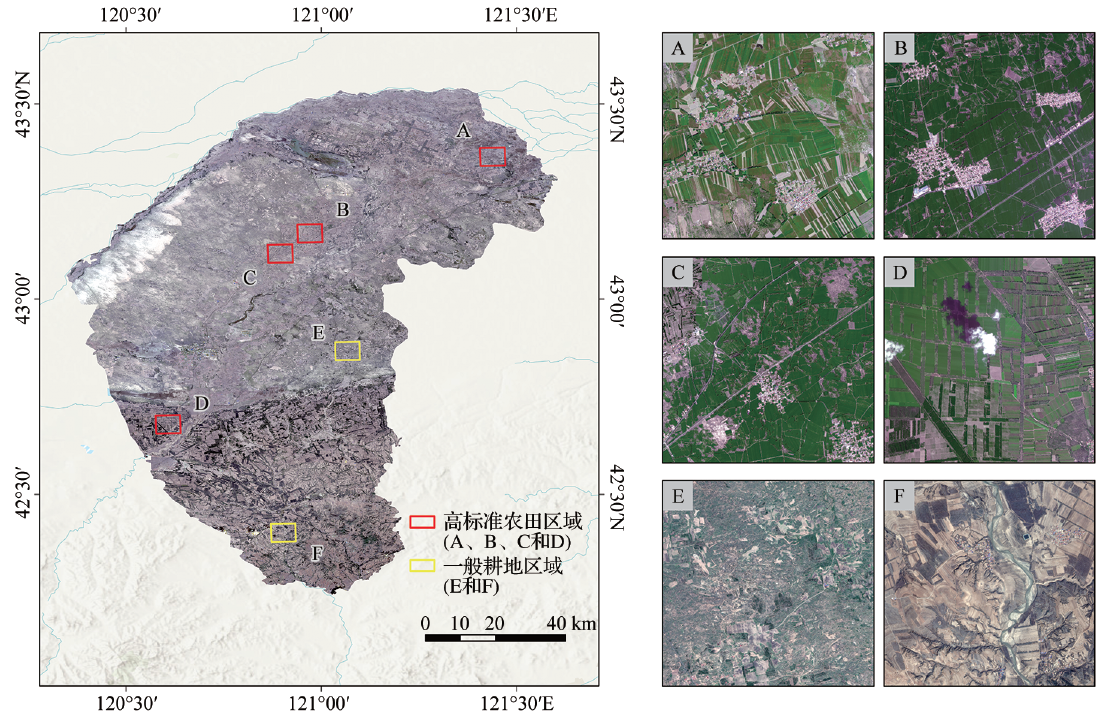
Naiman Banner is located in an arid and semi-arid region and represents a typical agro-pastoral ecotone. Agricultural production in this area has long been constrained by complex natural conditions and the fragmented spatial distribution of cropland, resulting in an unclear understanding of the current state of farmland utilization. This, in turn, limits the region’s capacity for agricultural resource management and targeted policy implementation. Conducting an analysis of farmland utilization in Naiman Banner is therefore crucial for promoting high-quality agricultural development in agro-pastoral transitional zones and supporting the national food security strategy. In this study, Naiman Banner was selected as the research area. Based on Landsat 8 time-series imagery, the spatial distribution of major grain crops from 2020 to 2024 was extracted using the random forest method. Additionally, Jilin-1 high-resolution remote sensing imagery was used in combination with a multi-scale segmentation algorithm and the U-Net model to obtain cropland field parcels and road data for 2020 and 2024, respectively. On this basis, an evaluation index system for assessing the level of farmland infrastructure construction in the region was established. By integrating the extracted spatial distribution of major grain crops, this study focuses on analyzing the spatiotemporal patterns of major grain crops, the level of farmland infrastructure construction, and their interrelationship in Naiman Banner. Results showed a steady increase in the planting area of major grain crops over the five-year period, with a cumulative net growth of 22 673.46 hm2, representing a 12.9% increase. Planting areas gradually shifted from general farmland to well-facilitated farmland. Meanwhile, agricultural infrastructure was continuously improved, with significantly higher development levels observed in well-facilitated farmland areas compared to general farmland. Further analysis revealed that regions with higher levels of agricultural infrastructure exhibited higher utilization rates of staple crops, demonstrating clear spatial consistency and a positive correlation. These findings provide provide technical support and decision-making references for regional agricultural resource management, optimization of infrastructure allocation, and food security assurance.
Key words: Remote sensing; Staple crops; Agricultural infrastructure; U-Net; Naiman Banner.
| [1] | LIU Lingcen, JIANG Zhihong, ZHANG Junyi, et al. Evaluating grain production security using cultivated land in China in thenew era [J]. Transactions of the Chinese Society of Agricultural Engineering (Transactions of the CSAE), 2025, 41(8): 250-260. |
| 刘泠岑, 姜志鸿, 张俊逸, 等. 新形势下中国耕地利用的粮食生产保障能力评价 [J]. 农业工程学报, 2025, 41(8): 250-260. | |
| [2] | YANG Bin, GUO Weihong, TAN Qingyuan, et al. Impacts of high-standard farmland construction policy on cultivated landsystem resilience [J]. Transactions of the Chinese Society of Agricultural Engineering (Transactions of the CSAE), 2025, 41(4): 269-278. |
| 杨斌, 郭维红, 谭青媛, 等. 高标准农田建设对耕地系统韧性的影响及其机制 [J]. 农业工程学报, 2025, 41(4): 269-278. | |
| [3] | XIE Junyang, LIN Anqi, WU Hao, et al. JAM-R-CNN deep learning network model forremote sensing recognition of terraced fields [J]. National Remote Sensing Bulletin, 2024, 28(12): 3 136-3 146. |
| 谢君洋, 林安琪, 吴浩, 等. 面向梯田遥感识别的JAM-R-CNN深度网络模型 [J]. 遥感学报, 2024, 28(12): 3 136-3 146. | |
| [4] | ZHANG Jie, LIU Yujie, ZHANG Ermei, et al. Dynamics and driving mechanisms of cultivated land at county level in China [J]. Acta Geographica Sinica, 2023, 78(9): 2 105-2 127. |
| 张婕, 刘玉洁, 张二梅, 等. 中国县域耕地动态演变及其驱动机制 [J]. 地理学报, 2023, 78(9): 2 105-2 127. | |
| [5] | CHENG Yuying, CHEN Wenbo, LAI Sasa. Research on precise identification and driving mechanisms of abandoned cultivated land in typical mountainous areas[J]. China Land Science, 2024, 38(12): 93-104. |
| 程钰颖, 陈文波, 来洒洒. 典型山区撂荒耕地精准识别及驱动机制研究 [J]. 中国土地科学, 2024, 38(12): 93-104. | |
| [6] | GE Yujuan, ZHAO Yuluan, REN Hongyu. The effect of farmland fragmentation on the intensity of farmland in differentutilization ways [J]. Advances in Earth Science, 2020, 35(2): 180-188. |
| 葛玉娟, 赵宇鸾, 任红玉. 山区耕地细碎化对不同利用方式农地集约度的影响 [J]. 地球科学进展, 2020, 35(2): 180-188. | |
| [7] | DONG Jinwei, CUI Yifeng, DI Yuanyuan, et al. Opportunities and challenges in monitoring cultivated land red line in big data era [J]. Bulletin of Chinese Academy of Sciences, 2023, 38(12): 1 781-1 792. |
| 董金玮, 崔屹峰, 邸媛媛, 等. 大数据时代耕地红线管控监测的机遇与挑战 [J]. 中国科学院院刊, 2023, 38(12): 1 781-1 792. | |
| [8] | LI X Y, LI J Y, JIANG J, et al. Spatio-temporal-text fusion for hierarchical multi-label crop classification based on time-series remote sensing imagery [J]. International Journal of Applied Earth Observation and Geoinformation, 2025, 139. DOI:10.1016/j.jag.2025.104471 . |
| [9] | NING An, REN Miaomiao, JIANG Shan,et al. Application and prospect of optical remote sensing technology in agricultural monitoring [J]. Journal of Chinese Agricultural Mechanization, 2025, 46(2): 2 199-2 206. |
| 宁岸, 任淼淼, 蒋杉, 等. 光学遥感技术在农情监测中的应用与展望 [J]. 中国农机化学报, 2025, 46(2): 2 199-2 206. | |
| [10] | XIE J Y, LI Y, WU H, et al. Integrating random forest with boundary enhancement for mapping crop planting structure at the parcel level from remote sensing images [J]. IEEE Journal of Selected Topics in Applied Earth Observations and Remote Sensing, 2025, 18: 9 934-9 953. |
| [11] | REHMAN A U, RAZIQ A, SHRESTHA B, et al. The role of spectro-temporal remote sensing in vegetation classification: a comprehensive review integrating machine learning and bibliometric analysis [J]. Computers and Electronics in Agriculture, 2025, 234. DOI:10.1016/j.compag.2025.110184 . |
| [12] | HU Qiong, WU Wenbin, SONG Qian, et al. Recent progresses in research of crop patterns mapping by using remote sensing [J]. Scientia Agricultura Sinica, 2015, 48(10): 1 900-1 914. |
| 胡琼, 吴文斌, 宋茜, 等. 农作物种植结构遥感提取研究进展 [J]. 中国农业科学, 2015, 48(10): 1 900-1 914. | |
| [13] | MATHUR A, FOODY G M. Crop classification by support vector machine with intelligently selected training data for an operational application [J]. International Journal of Remote Sensing, 2008, 29(8): 2 227-2 240. |
| [14] | JIA K, WU B F, LI Q Z. Crop classification using HJ satellite multispectral data in the North China Plain [J]. Journal of Applied Remote Sensing, 2013, 7(1). DOI:10.1117/1.JRS.7.073576 . |
| [15] | WANG Y M, FENG L W, SUN W W, et al. Exploring the potential of multi-source unsupervised domain adaptation in crop mapping using Sentinel-2 images [J]. GIScience & Remote Sensing, 2022, 59(1): 2 247-2 265. |
| [16] | ASGARIAN A, SOFFIANIAN A, POURMANAFI S. Crop type mapping in a highly fragmented and heterogeneous agricultural landscape: a case of central Iran using multi-temporal Landsat 8 imagery [J]. Computers and Electronics in Agriculture, 2016, 127: 531-540. |
| [17] | ASHOURLOO D, SHAHRABI H S, AZADBAKHT M, et al. A novel automatic method for Alfalfa mapping using time series of Landsat-8 OLI data [J]. IEEE Journal of Selected Topics in Applied Earth Observations and Remote Sensing, 2018, 11(11): 4 478-4 487. |
| [18] | HAO P Y, DI L P, ZHANG C, et al. Transfer learning for crop classification with Cropland Data Layer data (CDL) as training samples [J]. Science of The Total Environment, 2020, 733. DOI:10.1016/j.scitotenv.2020.138869 . |
| [19] | PE?A-BARRAGáN J M, NGUGI M K, PLANT R E, et al. Object-based crop identification using multiple vegetation indices, textural features and crop phenology [J]. Remote Sensing of Environment, 2011, 115(6): 1 301-1 316. |
| [20] | MENG Jihua, HE Rongpeng, LIN Zhenxin. Status and prospects of Google Earth Engine in agricultural management research [J]. Journal of Geo-Information Science, 2024,26(4): 1 002-1 018. |
| 蒙继华, 何荣鹏, 林圳鑫. Google Earth Engine在农业管理中的研究现状与展望 [J]. 地球信息科学学报, 2024, 26(4): 1 002-1 018. | |
| [21] | WOLDEMARIAM G W, GESSESSE A B, VARGAS M R. Remote sensing vegetation Indices-Driven models for sugarcane evapotranspiration estimation in the semiarid Ethiopian Rift Valley[J]. ISPRS Journal of Photogrammetry and Remote Sensing, 2024, 215: 136-156. |
| [22] | XU F, YAO X C, ZHANG K X, et al. Deep learning in cropland field identification: a review [J]. Computers and Electronics in Agriculture, 2024, 222. DOI:10.1016/j.compag.2024.109042 . |
| [23] | CAI Z W, HU Q, ZHANG X Y, et al. Improving agricultural field parcel delineation with a dual branch spatiotemporal fusion network by integrating multimodal satellite data [J]. ISPRS Journal of Photogrammetry and Remote Sensing, 2023, 205: 34-49. |
| [24] | ZHANG Xinchang, HUANG Jianfeng, NING Ting. Progress and prospect of cultivated land extraction from high-resolution remote sensing images [J]. Geomatics and Information Science of Wuhan University, 2023, 48(10): 1 582-1 590. |
| 张新长, 黄健锋, 宁婷. 高分辨率遥感影像耕地提取研究进展与展望 [J]. 武汉大学学报(信息科学版), 2023, 48(10): 1 582-1 590. | |
| [25] | HONG Liang, FENG Yafei, PENG Shuangyun, et al. Classification of high spatial resolution remote sensing imagery based on object-oriented multi-scale weighted sparse representation [J]. Acta Geodaetica et Cartographica Sinica, 2022, 51(2): 224-237. |
| 洪亮, 冯亚飞, 彭双云, 等. 面向对象的多尺度加权联合稀疏表示的高空间分辨率遥感影像分类 [J]. 测绘学报, 2022, 51(2): 224-237. | |
| [26] | MA L, LI M C, MA X X, et al. A review of supervised object-based land-cover image classification [J]. ISPRS Journal of Photogrammetry and Remote Sensing, 2017, 130: 277-293. |
| [27] | XU L, MING D P, ZHOU W, et al. Farmland extraction from high spatial resolution remote sensing images based on stratified scale pre-estimation [J]. Remote Sensing, 2019, 11(2). DOI:10.3390/rs11020108 . |
| [28] | LI Chaokui, ZENG Qiangguo, FANG Jun, et al. Road extraction in rural areas from high resolution remotesensing image using a improved full convolution network [J]. National Remote Sensing Bulletin, 2021, 25(9): 1 978-1 988. |
| 李朝奎, 曾强国, 方军, 等. 改进全卷积网络方法的高分二号影像农村道路提取 [J]. 遥感学报, 2021, 25(9): 1 978-1 988. | |
| [29] | SHI W Z, MIAO Z L, DEBAYLE J. An integrated method for urban main-road centerline extraction from optical remotely sensed imagery[J]. IEEE Transactions on Geoscience and Remote Sensing, 2014, 52(6): 3 359-3 372. |
| [30] | SHANMUGAM L, KALIAPERUMAL V. Junction-aware water flow approach for urban road network extraction [J]. IET Image Processing, 2016, 10(3): 227-234. |
| [31] | TENG Xinpeng, SONG Shunlin, ZHAN Yongzhao. An improved road extraction algorithm from high-resolution remote sensing images based on structure tensor [J]. Bulletin of Science and Technology, 2013, 29(2): 175-177. |
| 滕鑫鹏, 宋顺林, 詹永照. 一种改进的基于结构张量的高分辨率遥感图像道路提取算法 [J]. 科技通报, 2013, 29(2): 175-177. | |
| [32] | YU Z B, CHEN Z, LEI X Q, et al. SegRoadv2: a hybrid deformable self-attention and convolutional network for road extraction with connectivity structure[J]. International Journal of Digital Earth, 2025, 18. DOI:1 0.1080/17538947.2025.2480267 . |
| [33] | ZHU Q Q, ZHANG Y N, WANG L Z, et al. A global context-aware and Batch-independent network for road extraction from VHR satellite imagery [J]. ISPRS Journal of Photogrammetry and Remote Sensing, 2021, 175: 353-365. |
| [34] | LI X G, WANG Y B, ZHANG L Q, et al. Topology-enhanced urban road extraction via a geographic feature-enhanced network[J]. IEEE Transactions on Geoscience and Remote Sensing, 2020, 58(12): 8 819-8 830. |
| [35] | RONNEBERGER O, FISCHER P, BROX T. U-Net: convolutional networks for biomedical image segmentation[M]// Medical image computing and computer-assisted intervention-MICCAI 2015. Cham: Springer International Publishing, 2015: 234-241. |
| [36] | YANG M X, YUAN Y, LIU G C. SDUNet: road extraction via spatial enhanced and densely connected UNet [J]. Pattern Recognition, 2022, 126. DOI:10.1016/j.patcog.2022.108549 . |
| [37] | CHEN Z Y, WANG C, LI J, et al. Adaboost-like End-to-End multiple lightweight U-nets for road extraction from optical remote sensing images [J]. International Journal of Applied Earth Observation and Geoinformation, 2021, 100. DOI:10.1016/j.jag.2021.102341 . |
| [38] | YAN K, GAO S, YAN G, et al. A global systematic review of the remote sensing vegetation indices [J]. International Journal of Applied Earth Observation and Geoinformation, 2025, 139. DOI:10.1016/j.jag.2025.104560 . |
| [39] | ZHANG H Y, XIAO F F, HE W, et al. Multiyear automated mapping and price analysis of garlic in main planting areas of China using time-series remote sensing images[J]. IEEE Journal of Selected Topics in Applied Earth Observations and Remote Sensing, 2022, 15: 5 222-5 233. |
| [40] | GU L X, SHUAI Y M, SHAO C Y, et al. Angle effect on typical optical remote sensing indices in vegetation monitoring [J]. Remote Sensing, 2021, 13(9). DOI:10.3390/rs13091699 . |
| [41] | TASSI A, VIZZARI M. Object-oriented LULC classification in Google Earth Engine combining SNIC, GLCM, and machine learning algorithms [J]. Remote Sensing, 2020, 12(22). DOI:10.3390/rs12223776 . |
| [42] | BREIMAN L. Random forests [J]. Machine Learning, 2001, 45(1): 5-32. |
| [43] | WANG T, XU C, LIU B, et al. MCAT-UNet: convolutional and cross-shaped window attention enhanced UNet for efficient high-resolution remote sensing image segmentation [J]. IEEE Journal of Selected Topics in Applied Earth Observations and Remote Sensing, 2024, 17: 9 745-9 758. |
| [44] | HE X, ZHOU Y, ZHAO J Q, et al. Swin transformer embedding UNet for remote sensing image semantic segmentation[J]. IEEE Transactions on Geoscience and Remote Sensing, 2022, 60: 1-15. |
| [45] | DIAKOGIANNIS F I, WALDNER F, CACCETTA P, et al. ResUNet-a: a deep learning framework for semantic segmentation of remotely sensed data [J]. ISPRS Journal of Photogrammetry and Remote Sensing, 2020, 162: 94-114. |
| [46] | XV X, REN J, MING Y S. Impacts of mechanized farmland transformation on ecological landscape patterns in hilly regions of Zhong County, China[J]. Scientific Reports, 2025, 15. DOI:10.1038/s41598-025-05357-7 . |
/
| 〈 |
|
〉 |
 甘公网安备62010202000687