
收稿日期: 2025-07-01
修回日期: 2025-08-06
网络出版日期: 2025-08-31
基金资助
海南热带海洋学院校级人才科研启动项目(RHDRCZK202403);海南热带海洋学院崖州湾创新研究院重大科技计划项目(2022CXYZD003)
Distribution and Influencing Factors of Biogenic Silica in the Sediments of the Coastal Waters of China
Received date: 2025-07-01
Revised date: 2025-08-06
Online published: 2025-08-31
Supported by
Hainan Tropical Ocean University School-level Talent Research Start-up Project(RHDRCZK202403);Major Science and Technology Project of Yazhou Bay Innovation Institute, Hainan Tropical Ocean University(2022CXYZD003)
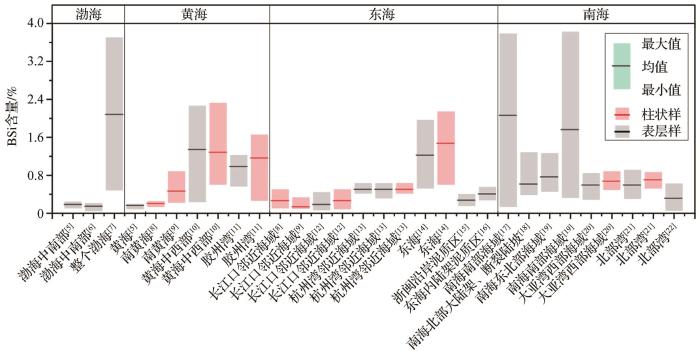
硅作为地壳中含量第二丰富的元素,其生物地球化学循环与全球碳循环密切相关,在调节大气二氧化碳浓度、海洋初级生产力及海岸带富营养化等过程中发挥关键作用。生物硅(BSi)作为由生物体代谢产生的含硅化合物,其在沉积物中的埋藏是海洋硅移除的主要途径。然而,中国近海沉积物中生物硅的测定缺乏统一标准,导致不同研究数据可比性差。整理评估了预处理方法、提取试剂浓度、温度及时间等关键参数对生物硅测定结果的影响。结果表明,采用0.5 mol/L的Na2CO3溶液,在85 ℃下不进行预处理直接提取8小时,是中国近海沉积物生物硅测定的最适宜方案。收集整理了中国近海(渤海、黄海、东海和南海)沉积物中生物硅的含量及分布数据,对不同预处理和提取条件下的数据进行校正,分析了生物硅的空间分布特征及影响因素。结果表明,中国近海沉积物中生物硅含量范围为0.05%~3.82%,自北向南呈现递增趋势,不同海域表现出独特的平面和垂直分布特征。影响因素方面,水体初级生产力(尤其是硅藻生产力)、沉积物溶解速率(受温度、pH值、比表面积及铝含量等调控)以及人类活动(如营养盐输入和水动力改变)是关键驱动因素。为中国近海生物硅的后续研究提供了数据参考和方法借鉴。
张科 , 韩玉 , 肖洲 . 中国近海沉积物中生物硅的分布及影响因素[J]. 地球科学进展, 2025 , 40(10) : 1003 -1012 . DOI: 10.11867/j.issn.1001-8166.2025.083
Silicon, the second most abundant element in Earth’s crust, is intricately linked to the global carbon cycle through its biogeochemical processes, playing a pivotal role in regulating atmospheric CO2 concentrations, marine primary productivity, and coastal eutrophication. Biogenic Silica (BSi), a silicon-containing compound produced by biological metabolism, serves as the primary pathway for silicon removal from the ocean via sedimentary burial. However, the lack of unified standards for BSi determination in China's offshore sediments has impeded data comparability across studies. An extensive evaluation was conducted to assess the effects of key parameters, including pretreatment methods, extractant concentration, temperature, and duration, on the measurement results of BSi. The findings demonstrate that the optimal analytical approach for determining BSi in China’s coastal marine sediments involves extraction with 0.5 mol/L Na2CO3 solution at 85 °C for 8 hours, without any preliminary chemical pretreatment. This research compiles BSi content and distribution data from sediments in the Bohai, Yellow, East China, and South China Seas. It calibrates data generated under different pretreatment and extraction conditions against the optimal methodology, and analyzes spatial distribution characteristics and influencing factors. Results indicate that BSi content in China’s offshore sediments ranges from 0.05% to 3.82%, with an increasing trend from north to south, alongside distinct planar and vertical distribution patterns in different sea regions. Key influencing factors include water column primary productivity (particularly diatom productivity), sediment dissolution rates (regulated by temperature, pH, specific surface area, and aluminum content), and human activities (such as nutrient input and hydrodynamic changes). This study provides an improved data foundation and methodological framework for subsequent high-precision marine silicon cycle research, carbon sink assessment, and predictive modeling of coastal ecological evolution in China’s offshore areas, while simultaneously highlighting the urgent necessity for establishing national BSi standard reference materials and standardized analytical protocols.
Key words: Offshore sediment; Biogenic silicon; Distribution; Dissolution; Influence factor
| [1] | ZHU Dongdong, SUTTON J N, LEYNAERT A, et al. The global marine silicon cycle and its major challenges[J]. Earth Science Frontiers,2022, 29(5): 47-48. |
| 朱东栋, SUTTON J N, LEYNAERT A, 等. 全球海洋硅循环及研究中面临的主要挑战[J]. 地学前缘,2022, 29(5): 47-48. | |
| [2] | TRéGUER P J, de la ROCHA C L. The world ocean silica cycle [J]. Annual Review of Marine Science, 2013, 5: 477-501. |
| [3] | TRéGUER P J, SUTTON J N, BRZEZINSKI M, et al. Reviews and syntheses: the biogeochemical cycle of silicon in the modern ocean[J]. Biogeosciences, 2021, 18(4): 1 269-1 289. |
| [4] | ZHU D D, SUTTON J N, LEYNAERT A, et al. Revisiting the biogenic silica burial flux determinations: a case study for the East China Seas [J]. Frontiers in Marine Science, 2023, 9. DOI: 10.3389/fmars.2022.1058730 . |
| [5] | LIU S M, YE X W, ZHANG J, et al. Problems with biogenic silica measurement in marginal seas[J]. Marine Geology, 2002, 192(4):383-392. |
| [6] | LI Lingwei, LIU Sumei, ZHOU Zhaoqian, et al. Distribution of biogenic elements in the southern and central Bohai Sea sediments[J]. Marine Sciences, 2010, 34(11): 59-68. |
| 李玲伟,刘素美,周召千,等. 渤海中南部沉积物中生源要素的分布特征[J]. 海洋科学,2010, 34(11): 59-68. | |
| [7] | DAI Zhenfei, XUE Yong, ZHANG Haibo, et al. Biogenic silica in the surface sediment of the Bohai Sea[J]. Marine Sciences, 2017, 41(5): 42-49. |
| 代振飞,薛勇,章海波,等. 渤海表层沉积物中的生物硅[J]. 海洋科学,2017, 41(5): 42-49. | |
| [8] | ZHAO Yingfei, LIU Sumei, YE Xiwen, et al. The analysis of biogenic silica in the sediments of the East China Sea and the Yellow Sea[J]. Periodical of Ocean University of China, 2005, 35(3): 423-428. |
| 赵颖翡,刘素美,叶曦雯,等. 黄、东海柱状沉积物中生物硅含量的分析[J]. 中国海洋大学学报(自然科学版),2005, 35(3): 423-428. | |
| [9] | YANG Qian, SUN Yao, WANG Didi, et al. Biogenic silica distributions in recent sediments of the East China Sea and the Yellow Sea and implications for productivity reconstructions[J]. Acta Oceanologica Sinica, 2010, 32(3): 51-59. |
| 杨茜,孙耀,王迪迪,等. 东海、黄海近代沉积物中生物硅含量的分布及其反演潜力[J]. 海洋学报,2010,32(3):51-59. | |
| [10] | WU Bin. Distribution, dissolution and influencing factors of biogenic silica in sediments of the Yellow Sea and the East China Sea[D]. Qingdao: Ocean University of China, 2015. |
| 吴彬. 黄、东海沉积物中生物硅的分布、溶解及影响因素研究[D]. 青岛:中国海洋大学,2015. | |
| [11] | WU B, LU C, LIU S M. Dynamics of biogenic silica dissolution in Jiaozhou Bay, western Yellow Sea[J]. Marine Chemistry, 2015, 174:58-66. |
| [12] | LI Huiju, LIU Shumin, JIAN Huimin, et al. The study of silica in sediment and pore water in the adjacent area of Changjiang Estuary[J]. Haiyang Xuebao, 2017, 39(4): 39-49. |
| 李慧菊,刘淑民,简慧敏,等. 长江口邻近海域沉积物和间隙水中硅的研究[J]. 海洋学报,2017,39(4):39-49. | |
| [13] | WANG L S, ZHANG C S, SHI X Y. The burial of biogenic silica, organic carbon and organic nitrogen in the sediments of the East China Sea[J]. Journal of Ocean University of China, 2015, 14(3): 464-470. |
| [14] | WU B, LIU S M. Dissolution kinetics of biogenic silica and the recalculated silicon balance of the East China Sea[J]. Science of the Total Environment, 2020, 743. DOI: 10.1016/j.scitotenv.2020.140552 . |
| [15] | LI Y H, WANG L, FAN D J, et al. Distribution of biogenic silica in seafloor sediments on the East China Sea inner shelf: seasonal variations and typhoon impact[J]. Estuarine, Coastal and Shelf Science, 2018, 212: 353-364. |
| [16] | LIU Shengfa, LIU Yanguang, YU Yonggui, et al. Distribution of sedimentary biogenic silica in the muddy area of inner continental shelf of the East China Sea and its influence factors[J]. Advances in Marine Science, 2014, 32(1): 50-58. |
| 刘升发,刘焱光,于永贵,等. 东海内陆架泥质区沉积物生物硅分布及其影响因素[J].海洋科学进展,2014,32(1):50-58. | |
| [17] | ZHANG L L, CHEN M H, XIANG R, et al. Distribution of biogenic silica content in surface sediments from the southern South China Sea and its environmental dignificance[J]. Marine Science Bulletin, 2009, 11(1):43-52. |
| [18] | MA Y W, YANG B, ZHOU N, et al. Distribution and dissolution kinetics of biogenic silica in sediments of the northern South China Sea[J]. Frontiers in Marine Science, 2023, 10. DOI: 10.3389/fmars.2023.1083233 . |
| [19] | ZHOU Peng, LI Dongmei, LIU Guangshan, et al. Biogenic silica in surface sediments of the northeastern and southern South China Sea[J]. Journal of Tropical Oceanography, 2010, 29(4): 40-47. |
| 周鹏,李冬梅,刘广山,等. 南海东北部和南部海域表层沉积物生物硅研究[J]. 热带海洋学报,2010,29(4):40-47. | |
| [20] | ZHOU Peng, LI Dongmei, LI Haitao, et al. Biogenic silica contents and its distribution in the sediments of the west Daya Bay[J]. Journal of Applied Oceanography,2019,38(1): 109-117. |
| 周鹏,李冬梅,李海涛,等. 大亚湾西部海域沉积物中生物硅的含量及其分布特征[J]. 应用海洋学学报,2019,38(1):109-117. | |
| [21] | LIU Fang. The study on BSi in the water column and sediment of Tonkin Gulf[D]. Xiamen:Xiamen University, 2008. |
| 刘芳. 北部湾水体及沉积物中生物硅的研究[D].厦门:厦门大学,2008. | |
| [22] | LIN Peimei. Study on distribution and speciation of silica in Tonkin Gulf[D]. Xiamen: Xiamen University, 2008. |
| 林培梅. 北部湾海域硅的分布与赋存形态研究[D]. 厦门:厦门大学,2008. | |
| [23] | SCHLüTER M, RICKERT D. Effect of pH on the measurement of biogenic silica[J]. Marine Chemistry, 1998, 63: 81-92. |
| [24] | CONLEY D J. An interlaboratory comparison for the measurement of biogenic silica in sediments[J]. Marine Chemistry, 1998, 63: 39-48. |
| [25] | ZHAO Libo, HUANG Lingfeng, PAN Ke, et al. A preliminary study on the determination of biogenic silica in innerbay sediments and its application in Xiamen western waters[J]. Journal of Xiamen University(Natural Science), 2004, 43(): 153-158. |
| 赵立波,黄凌风,潘科,等. 内湾沉积物中生物硅的测定方法及其应用初探[J].厦门大学学报(自然科学版),2004,43():153-158. | |
| [26] | MORTLOCK R A, FROELICH P N. A simple method for the rapid determination of biogenic opal in pelagic marine sediments[J]. Deep Sea Research Part A: Oceanographic Research Papers, 1989, 36(9): 1 415-1 426. |
| [27] | NELSON D M, TRéGUER P J, BRZEZINSKI M A, et al. Production and dissolution of biogenic silica in the ocean: revised global estimates, comparison with regional data and relationship to biogenic sedimentation[J]. Global Biogeochemical Cycles, 1995, 9(3): 359-372. |
| [28] | LIU Sumei, TRéGUER P J, BEUCHER C,et al. A study on the rate of production and dissolution of Bio-silica: Jiaozhou Bay as an example[J]. Periodical of Ocean University of China,2008,38(5):781-785. |
| 刘素美, TRéGUER P J, BEUCHER C,等. 生物硅的生成与溶解速率的研究——以胶州湾为例[J]. 中国海洋大学学报,2008,38(5):781-785. | |
| [29] | ZHANG Zhaoyi. Preliminary study on biological silicon production in diatom[D]. Tianjin: Tianjin University of Science and Technology, 2018. |
| 张昭怡. 硅藻生物硅生产速率研究[D]. 天津:天津科技大学,2018. | |
| [30] | GIESBRECHT K E, VARELA D E. Summertime biogenic silica production and silicon limitation in the Pacific Arctic Region from 2006 to 2016[J]. Global Biogeochemical Cycles, 2021, 35. DOI: 10.1029/2020GB00629 . |
| [31] | HAO Qiang. The distribution of chlorophyllα and primary production and the environmental control mechanism in the China Sea: ship-measured and satellite study[D]. Qingdao: Ocean University of China, 2010. |
| 郝锵. 中国近海叶绿素和初级生产力的时空分布特征和环境调控机制研究[D].青岛:中国海洋大学,2010. | |
| [32] | Ministry of Water Resources of the People’s Republic of China. China river sediment bulletin[R]. Beijing, 2020. |
| 中华人民共和国水利部. 2020 年中国河流泥沙公报[R]. 北京, 2020. | |
| [33] | YANG Haifei, ZHANG Zhilin, LI Bochang. Study of the spatial pattern of suspended sediment concentration in the Yangtze Estuary and Hangzhou Bay[J]. Shanghai Land & Resources, 2019, 40(2): 70-74. |
| 杨海飞, 张志林, 李伯昌. 长江口—杭州湾悬沙浓度的空间分布特征研究[J]. 上海国土资源, 2019, 40(2): 70-74. | |
| [34] | BIGGS T E G, ROZEMAP D, EVANS C, et al. Control of Antarctic phytoplankton community composition and standing stock by light availability[J]. Polar Biology, 2022, 45(11): 1 635-1 653. |
| [35] | van CAPPELLEN P, QIU L Q. Biogenic silica dissolution in sediments of the Southern Ocean. II. kinetics[J]. Deep Sea Research Part II: Topical Studies in Oceanography, 1997, 44(5): 1 129-1 149. |
| [36] | SUN Chengzhi, ZHENG Chongwei, CHEN Xuan. Seasonal characteristics and long-term trend analysis of SST in the global ocean[J]. Marine Environmental Science,2015,34(5):713-717. |
| 孙成志,郑崇伟,陈璇. 全球SST的季节特征及长期变化趋势分析[J]. 海洋环境科,2015,34(5): 713-717. | |
| [37] | JIANG Z T, SONG Z G, BAI Y, et al. Remote sensing of global sea surface pH based on massive underway data and machine learning[J]. Remote Sensing, 2022, 14(10). DOI: 10.3390/rs14102366 . |
| [38] | MEI Xi, LI Xuejie, MI Beibei, et al. Distribution regularity and sedimentary differentiation patterns of China seas surface sediments [J]. Geology in China, 2020, 47(5): 1 447-1 462. |
| 梅西,李学杰,密蓓蓓,等. 中国海域表层沉积物分布规律及沉积分异模式[J]. 中国地质,2020,47(5):1 447-1 462. | |
| [39] | MENZEL B J L, SAMANTA S, ACHTERBERG E P, et al. A first global oceanic compilation of observational dissolved aluminum data with regional statistical data treatment[J]. Frontiers in Marine Science, 2020, 7. DOI: 10.3389/fmars.2020.00468 . |
| [40] | LI Faming. Online Fie preconcentration flow injection analysis method for the determination of dissolved aluminum and its application in the marginal seas of China[D]. Qingdao: Ocean University of China, 2015. |
| 李发明. 在线富集—流动注射测定溶解态铝的方法及其在中国陆架边缘海中的应用[D]. 青岛:中国海洋大学,2015. | |
| [41] | LU Chao. A study on the dissolution behavior of biogenic silica in coastal sea: Jiaozhou Bay as an example[D]. Qingdao: Ocean University of China, 2010. |
| 鲁超. 近海生物硅溶解行为的研究[D]. 青岛:中国海洋大学,2010. | |
| [42] | JIANG Wenfei, YU Lanlan, YU Qingxi, et al. Spatio-temporal analysis of the sea surface temperature in the Bohai and Yellow Seas under the background of climate change[J]. Journal of Guangxi Academy of Sciences, 2018, 34(3): 216-221. |
| 姜雯斐,虞兰兰,于清溪,等. 气候变化背景下渤黄海海温时空特征分析[J]. 广西科学院学报,2018,34(3): 216-221. | |
| [43] | RAN Xiangbin, WEI Qinsheng, YU Zhigang. Stoichiometric imbalance in the rates of nutrient and phosphorus depletion in coastal China with implications for the ecological environment [J]. Marine Sciences, 2023, 47(8): 75-89. |
| 冉祥滨, 韦钦胜, 于志刚. 中国近海营养盐结构失衡与磷消耗问题及其生态环境效应的研究进展[J]. 海洋科学,2023,47(8): 75-89. | |
| [44] | ZHANG M, LU Q Y, WANG D W, et al. Spatiotemporal evolution of nutrients and the influencing factors in Laizhou Bay over the past 40 years[J]. Marine Pollution Bulletin, 2022, 184. DOI: 10.1016/j.marpolbul.2022.114186 . |
| [45] | ZHANG Guicheng, SUN Jun. State of environmental pollution in the Bohai Sea, China: a review[J]. Environmental Chemistry, 2023, 42(3): 918-930. |
| 张桂成, 孙军. 渤海环境污染现状及研究进展[J]. 环境化学, 2023, 42(3): 918-930. | |
| [46] | WANG Hao, RAN Xiangbin, ZANG Jiaye, et al. Transport and variation of reactive silica in the Changjiang River and the Yellow River [J]. Journal of Lake Sciences, 2018, 30(5): 1 246-1 259. |
| 王昊,冉祥滨,臧家业,等. 长江与黄河入海活性硅输送规律及变化趋势[J]. 湖泊科学 2018,30(5):1 246-1 259. | |
| [47] | HUANG Jiangchan. Distributions and changes of nutrient concentration in the East China Sea in late 50 years[D]. Qingdao: Ocean University of China, 2011. |
| 黄江婵. 近50年东海海水中营养盐时空分布特征[D]. 青岛:中国海洋大学,2011. | |
| [48] | YUAN Zijie, HUANG Enqing, JIANG Xiaoying, et al. Seasonal changes of upper ocean water structure in the South China Sea since the Last Glacial Maximum: insights from carbon isotope of individual planktonic foraminifera [J]. Quaternary Sciences, 2025, 45(2): 505-515. |
| 袁子杰,黄恩清,江小英,等. 末次冰盛期以来南海单壳体浮游有孔虫碳同位素反映的上层海水结构季节性演变[J]. 第四纪研究,2025,45(2):505-515. | |
| [49] | SONG Jinming, YUAN Huamao, LI Xuegang, et al. Ecological environment evolution and nutrient variations in Jiaozhou Bay[J]. Marine Sciences, 2020, 44(8): 106-117. |
| 宋金明, 袁华茂, 李学刚, 等. 胶州湾的生态环境演变与营养盐变化的关系[J]. 海洋科学, 2020, 44(8): 106-117. | |
| [50] | GOU Yimeng, LIU Dongyan, DONG Xiaowei, et al. Sedimentary geochemical records and their indications for environmental variations in Bohai Bay[J]. Haiyang Xuebao, 2024, 46(9):14-28. |
| 勾艺萌,刘东艳,董晓伟,等. 渤海湾沉积地球化学记录及其对环境变迁的指示[J]. 海洋学报,2024,46(9):14-28. | |
| [51] | GUO Yuxuan. Numerical simulation of suspended sediment transport process and its mechanism of the Bohai Sea, Yellow Sea and East China Sea[D]. Qingdao: First Institute of Oceanography, MNR, 2019. |
| 郭瑜璇. 渤、黄、东海悬浮物传输过程和机制的数值模拟[D]. 青岛:自然资源部第一海洋研究所,2019. | |
| [52] | WANG Yongzhi. A numerical simulation of the seasonal variation of transport of suspended particles in East China Sea[D]. Qingdao: Ocean University of China, 2006. |
| 王勇智. 渤、黄、东海悬浮物浓度及输运季节变化的数值模拟[D]. 青岛:中国海洋大学,2006. | |
| [53] | SHI Xuefa, WU Bin, QIAO Shuqing, et al. Distribution, burial, and carbon sink effect of sedimentary organic carbon in the eastern coast of China [J]. Science China: Earth Science, 2024, 54(10): 3 113-3 133. |
| 石学法,吴斌,乔淑卿,等. 中国东部近海沉积有机碳的分布、埋藏及碳汇效应[J]. 中国科学:地球科学,2024,54(10):3 113-3 133. | |
| [54] | LIU Jingjing, LIU Zhifei, JIAN Zhimin,et al. Characteristics of the spatial and temporal variations in the composition of deep-water sediments and their accumulation rates since the Last Glacial Maximum in the northern South China Sea [J]. Science China: Earth Science, 2017, 47(8): 958-971. |
| 刘晶晶,刘志飞,翦知湣,等. 南海北部末次冰期以来深水沉积物组成及其堆积速率的时空变化特征[J]. 中国科学:地球科学,2017,47(8):958-971. |
/
| 〈 |
|
〉 |
 甘公网安备62010202000687