
基于孔缝差异充填的岩溶水流动路径反演——以大牛地气田马家沟组为例
收稿日期: 2025-04-11
修回日期: 2025-08-21
网络出版日期: 2025-08-31
基金资助
中国石化股份有限公司华北油气分公司项目(34550008-22-ZC0611-0014)
Recovery Method of Karst Water Flow Path Based on Differential Filling of Pores and Fractures: A Case Study of Majiagou Formation in Daniudi Gas Field
Received date: 2025-04-11
Revised date: 2025-08-21
Online published: 2025-08-31
Supported by
the North China Oil and Gas Branch, SINOPEC Corporation(34550008-22-ZC0611-0014)
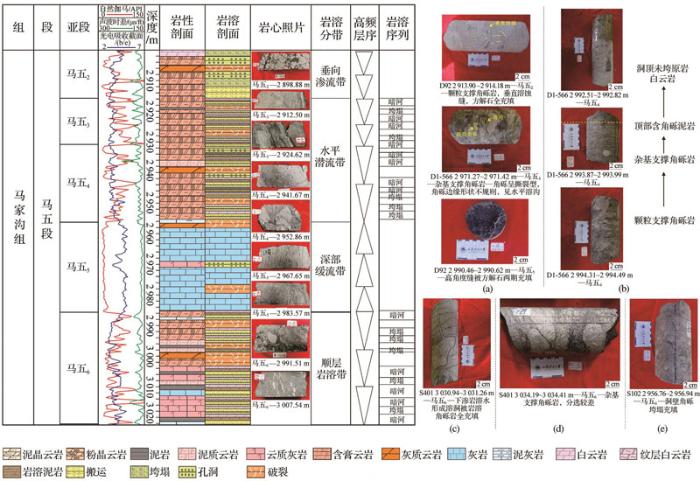
岩溶储层的孔缝差异充填特征对岩溶水系统具有重要的指示意义。岩溶水的流动性与滞留程度会造成碳酸盐岩储层溶蚀和充填程度的差异,从而影响储层物性。基于鄂尔多斯盆地大牛地气田奥陶系马家沟组构造与沉积背景,综合岩心观察、铸体薄片鉴定以及元素和同位素分析等手段,系统剖析了马家沟组纵向岩溶分带特征及孔缝充填规律,探讨了孔缝差异充填及其对岩溶水流动路径的指示。结果表明:①马家沟组纵向发育风化壳岩溶带(马五1~5亚段)和顺层岩溶带(马五6亚段)。风化壳岩溶带以垂向渗流溶缝和水平潜流溶孔为特征,受古地貌控制显著;顺层岩溶带以下渗岩溶水溶蚀作用为主,形成溶洞与角砾岩。②岩溶储层中溶孔与溶缝耦合发育,识别出孔缝均被充填、孔未充缝全充、孔全充缝未充及孔缝均未充4种差异充填类型,反映岩溶水饱和程度和流体沉淀作用的差异性。③岩相分析显示,研究区岩溶地质体的断裂通道是岩溶水流动路径之一;地球化学参数(如Fe/Mn值、碳氧同位素及锶同位素)显示,风化壳岩溶带Fe/Mn值较高(平均51.30),碳氧同位素显著偏负,指示氧化环境下强烈的溶蚀作用;顺层岩溶带Fe/Mn值分布不均(20.78~92.47),锶同位素比值(0.711 034)高于同期海水,顺层流动过程中岩溶水滞留程度较高,溶蚀作用相对减弱。④孔缝充填特征与古地貌具有耦合关系,岩溶高地与斜坡过渡带(如S401井)因垂向渗流受限,孔缝呈全充填特征,导致储层有效性降低;斜坡与沟槽过渡带(如D126井)保留半开放流体环境,溶蚀物质沉淀较弱,有效储集空间更发育。研究表明,孔缝差异充填特征可结合岩溶古地貌、断裂分布和元素变化等手段综合揭示岩溶水流动路径及滞留状态,为岩溶储层评价及油气勘探提供重要依据。
范云杰 , 伏美燕 , 邓虎成 , 朱俊阳 , 兰浩翔 , 吴冬 . 基于孔缝差异充填的岩溶水流动路径反演——以大牛地气田马家沟组为例[J]. 地球科学进展, 2025 , 40(9) : 945 -960 . DOI: 10.11867/j.issn.1001-8166.2025.072
Differential filling characteristics of pores and fractures in karst reservoirs serve as critical indicators for the reconstruction of paleokarst hydrogeological systems. The mobility and retention degree of karst water control the dissolution and filling processes in carbonate reservoirs, ultimately governing reservoir quality. Based on the tectonic and sedimentary background of the Ordovician Majiagou Formation in the Daniudi gas field, Ordos Basin, this study integrated core observations, cast thin-section analyses, geochemical data (including elemental and isotopic compositions), and petrographic techniques to systematically investigate the vertical zonation of karst features and pore-fracture filling patterns. The implications of differential filling for tracing paleo-karst water flow pathways are discussed. Key findings are summarized as follows: First, the Majiagou Formation is divided into two vertical karst zones: a weathering crust karst zone (sub-members Ma 51~5) and a stratabound karst zone (sub-member Ma 56). Weathering crust karst zones are characterized by vertical seepage fractures and horizontal subsurface flow dissolution pores, which are strongly influenced by paleotopography. In contrast, the stratabound karst zone is dominated by downward-infiltrating karst water, forming dissolution caves and breccias. Second, the coupling between dissolution pores and fractures in the karst reservoir is evident. Four distinct filling patterns were identified:
| [1] | GU Yifan, WANG Yansong, ZHOU Gang, et al. Diagenetic sequence and reservoir-formation & hydrocarbon accumulation effects of paleokarst reservoirs in the Dengying Formation, central Sichuan[J]. Acta Sedimentologica Sinica, 2024, 42(6): 2 088-2 101. |
| 谷一凡,王岩松,周刚,等. 川中灯影组古岩溶储层成岩序列及成储—成藏效应[J].沉积学报,2024,42(6): 2 088-2 101. | |
| [2] | SUN Zhen, ZHANG Zhenghong, GUO Zhi, et al. Geochemical characteristics of formation water in karst reservoirs and gas-water distribution law—southern area of Sulige gas field, submember 5 of the 5th member of Majiaogou Formation[J/OL]. Acta Sedimentologica Sinica(2024-12-02)[2024-12-30]. . |
| 孙振, 张正红, 郭智, 等. 岩溶储层地层水地球化学特征及气水分布规律——苏里格气田南区马家沟组马五5亚段[J/OL]. 沉积学报(2024-12-02)[2024-12-30]. . | |
| [3] | LI Yuan. Study on the relationship between karst reservoir development of the Ordovician system in the Tahe oilfield and hydrogeomorphological response in the early hercynian[D]. Wuhan: China University of Geosciences (Wuhan), 2016. |
| 李源. 塔河油田奥陶系岩溶储层发育与海西早期水文地貌响应关系研究[D].武汉:中国地质大学(武汉),2016. | |
| [4] | LIANG Yongping, WANG Weitai. Classification and characteristics of karst water systems in northern China[J]. Acta Geoscientica Sinica, 2010, 31(6): 860-868. |
| 梁永平,王维泰.中国北方岩溶水系统划分与系统特征[J].地球学报, 2010,31(6): 860-868. | |
| [5] | LIU Yongli. Study on the development characteristics and formation mechanism of Paleokarst Fracture-cave reservoirs in the middle-deep formation of the Ordovician System in the southwestern part of the Tahe oilfield[D]. Wuhan: China University of Geosciences (Wuhan), 2023. |
| 刘永立. 塔河油田西南部奥陶系中深层古岩溶缝洞储层发育特征与形成机制[D].武汉: 中国地质大学(武汉),2023. | |
| [6] | LEI Tao, TANG Mingyuan, REN Guanglei, et al. Fault-controlled reservoir formation model of dolomite under non-permeable layers: a case study of the middle and lower combinations of the Majiagou Formation in the Daniudi gas field[J]. Bulletin of Geological Science and Technology, 2024, 43(5): 18-30. |
| 雷涛,唐明远,任广磊,等.非渗透层下白云岩断控成藏模式:以大牛地气田马家沟组中下组合为例[J].地质科技通报,2024,43(5):18-30. | |
| [7] | XIA Qinyu, MA Xinhua, GUO Zhenhua, et al. Characteristics of paleokarst zones and internal reservoir distribution in the fourth member of the Dengying Formation in the Gaoshiti Block, central Sichuan Basin[J]. Acta Petrolei Sinica, 2023, 44(8): 1 299-1 312,1 332. |
| 夏钦禹,马新华,郭振华,等. 川中高石梯区块灯影组四段古岩溶带及内部储层分布特征[J].石油学报,2023,44(8):1 299-1 312,1 332. | |
| [8] | ZHU Dancheng. Development model and controlling factors of karst reservoirs in the Maokou Formation of the Sichuan Basin[D]. Beijing: China University of Petroleum (Beijing), 2023. |
| 诸丹诚.四川盆地茅口组岩溶储层发育模式及其控制因素[D]. 北京:中国石油大学(北京),2023. | |
| [9] | SHU Pengcheng, FENG Qianghan, XU Shumei, et al. Weathering crust karstification model of the Ordovician in the western Ordos Basin[J]. Acta Sedimentologica Sinica, 2021, 39(6): 1 565-1 579. |
| 舒鹏程,冯强汉,许淑梅,等. 鄂尔多斯盆地西部奥陶系风化壳岩溶作用模式[J].沉积学报,2021,39(6):1 565-1 579. | |
| [10] | DING Xiaoqi, TIAN Yinyu, LEI Tao, et al. Control of the Luliang Paleo-uplift on the sedimentation of the Majiagou Formation in the Ordos Basin: based on the Fugu section in Shaanxi[J]. Journal of Palaeogeography, 2024, 26(3): 671-682. |
| 丁晓琪,田胤瑜,雷涛,等.吕梁古隆起对鄂尔多斯盆地马家沟组沉积的控制作用:基于陕西府谷剖面[J].古地理学报,2024,26(3):671-682. | |
| [11] | LEI Tao, DENG Hucheng, WU Dong, et al. Sedimentary model of the middle and lower combinations of the Majiagou Formation in the Daniudi gas field, Ordos Basin[J]. Journal of Palaeogeography, 2020, 22(3): 523-538. |
| 雷涛,邓虎成,吴冬,等.鄂尔多斯盆地大牛地气田奥陶系马家沟组中下组合沉积模式[J].古地理学报,2020,22(3): 523-538. | |
| [12] | LAN Haoxiang, FU Meiyan, DENG Hucheng, et al. Genetic types and main controlling factors of reservoirs in the Majiagou Formation of the Daniudi gas field, Ordos Basin[J]. Acta Sedimentologica Sinica, 2021, 39(6): 1 609-1 621. |
| 兰浩翔,伏美燕,邓虎成,等.鄂尔多斯盆地大牛地气田马家沟组储层类型成因及其主控因素[J].沉积学报,2021,39(6): 1 609-1 621. | |
| [13] | XU Wang, DENG Hucheng, LEI Tao, et al. Control of different types of faults on epigenetic karstification in the Majiagou Formation of the Daniudi gas field, northeastern Ordos Basin[J]. Natural Gas Geoscience, 2023, 34(3): 431-444. |
| 胥旺,邓虎成,雷涛,等. 鄂尔多斯盆地东北部大牛地气田马家沟组不同性质断裂对表生岩溶的控制作用[J].天然气地球科学,2023,34(3): 431-444. | |
| [14] | HE Yun, LEI Tao, XU Wang, et al. Study on the development mechanism of polygenetic karst in the lower-middle assemblage of Majiaogou Formation in Daniudi gas field[J]. Petroleum Geology and Engineering, 2022, 36(4): 26-33. |
| 何云,雷涛,胥旺,等.大牛地气田马家沟组中下组合多成因岩溶发育机制[J].石油地质与工程,2022,36(4):26-33. | |
| [15] | TANG Mingyuan. Study on reservoir characteristics of member 5~5 sub-member of weathering crust of ordovician system in Daniudi gas field[D]. Chengdu: Southwest Petroleum University, 2017. |
| 唐明远.大牛地气田奥陶系风化壳马五5亚段储层特征研究[D]. 成都:西南石油大学, 2017. | |
| [16] | WANG Zeji, CHEN Anqing, LI Huiyong, et al. Study on the fracture-karst combined reservoir-controlling mechanism of carbonate buried hills in the Bohai Bay Basin[J]. Acta Oceanologica Sinica, 2024, 46(12): 66-78. |
| 王泽霁,陈安清,李慧勇,等. 渤海湾盆地碳酸盐岩潜山裂缝—岩溶联合控储机制[J]. 海洋学报, 2024, 46(12):66-78. | |
| [17] | ZHONG Jiayi, WANG Wei, LIU Ran, et al. Reservoir characteristics and main controlling factors of the Maokou Formation in the eastern Sichuan Basin[J]. Fault-Block Oil & Gas Field, 2024, 31(2): 308-318. |
| 钟佳倚,王尉,刘冉,等. 川东地区茅口组储层特征及主控因素[J].断块油气田,2024,31(2):308-318. | |
| [18] | ZHANG Zili, QIAO Yanping, DOU Shuang, et al. Paleogeomorphology and reservoir control model of the second member of the Dengying Formation in the Penglai gas area, Sichuan Basin[J]. Oil & Gas Geology, 2024, 45(1): 200-214. |
| 张自力,乔艳萍,豆霜,等. 四川盆地蓬莱气区震旦系灯影组二段岩溶古地貌与控储模式[J].石油与天然气地质,2024,45(1): 200-214. | |
| [19] | YANG Lihua, LIU Chiyang, DAI Shuanghe, et al. Fault characteristics and petroleum geological significance of the Gufengzhuang area in the Ordos Basin[J]. Advances in Earth Science, 2021, 36(10): 1 039-1 051. |
| 杨丽华,刘池洋,代双和,等. 鄂尔多斯盆地古峰庄地区断裂特征及油气地质意义[J].地球科学进展,2021,36(10):1 039-1 051. | |
| [20] | SHI Ji’an, SHAO Yi, ZHANG Shuncun, et al. Sedimentary environment and lithofacies paleogeography of the Ordovician Majiagou Formation in the eastern Ordos Basin[J]. Natural Gas Geoscience, 2009, 20(3): 316-324. |
| 史基安,邵毅,张顺存,等. 鄂尔多斯盆地东部地区奥陶系马家沟组沉积环境与岩相古地理研究[J].天然气地球科学,2009,20(3): 316-324. | |
| [21] | XIAO Gaojian, LUO Yang, LIU Hongping. Analysis of deep-water gravity flow sedimentary characteristics of the Chang 6-Chang 7 members of the Yanchang Formation in the Binchang Block, southern Ordos Basin[J]. Bulletin of Geological Science and Technology, 2023, 42(2): 69-82. |
| 萧高健,骆杨,刘洪平. 鄂尔多斯盆地南部彬长区块延长组长6-长7段深水重力流沉积特征分析[J].地质科技通报,2023,42(2):69-82. | |
| [22] | HUANG Zhengliang, WU Chunying, MA Zhanrong, et al. Sedimentary sequences of the Majiagou Formation in the central and eastern Ordos Basin and their control on reservoir development[J]. China Petroleum Exploration, 2015, 20(5): 20-29. |
| 黄正良,武春英,马占荣,等.鄂尔多斯盆地中东部奥陶系马家沟组沉积层序及其对储层发育的控制作用[J].中国石油勘探,2015,20(5):20-29. | |
| [23] | SUN Xiao, WANG Jie, TAO Cheng, et al. Geochemical characteristics and source identification of natural gas in the Lower Paleozoic of the Daniudi area, Ordos Basin[J]. Petroleum Geology & Experiment, 2021, 43(2): 307-314. |
| 孙晓,王杰,陶成,等.鄂尔多斯盆地大牛地下古生界天然气地球化学特征及其来源综合判识[J].石油实验地质,2021,43(2): 307-314. | |
| [24] | ZHANG Wei. Diagenetic evolution and tight mechanism of the Chang 7 oil layer in the central-southern part of the Yishan slope, Ordos Basin[D]. Daqing: Northeast Petroleum University, 2019. |
| 张伟.鄂尔多斯盆地伊陕斜坡中南部地区长7油层成岩演化与致密机理[D].大庆:东北石油大学,2019. | |
| [25] | NI Chunhua, WU Xiaoqi, WANG Ping, et al. Light hydrocarbon geochemical characteristics of tight gas in the Upper Paleozoic of the Daniudi gas field, Ordos Basin[J]. Petroleum Geology & Experiment, 2024, 46(2): 366-379. |
| 倪春华,吴小奇,王萍,等.鄂尔多斯盆地大牛地气田上古生界致密气轻烃地球化学特征[J].石油实验地质,2024,46(2): 366-379. | |
| [26] | GAO Shumin, FAN Yunjie, ZHU Junyang, et al. Logging response characteristics and main controlling factors of distribution law of gas-water layers in the 6th-7th submembers of Ma 5 Member, Majiagou Formation in Daniudi Gasfield[J]. Sino-Global Energy, 2025, 30(2):50-56. |
| 高淑敏,范云杰,朱俊阳,等.大牛地气田马家沟组马五6-7亚段气水层测井响应特征及分布规律主控因素[J].中外能源,2025,30(2):50-56. | |
| [27] | JIN Xiaohui, ZHANG Juntao, SUN Dongsheng, et al. Discovery and significance of paleokarst caves in the Upper Ordovician Pingliang Formation in shallow drilling in the southern margin of the Ordos Basin[J]. Oil & Gas Geology, 2021, 42(3): 595-603. |
| 金晓辉,张军涛,孙冬胜,等.鄂尔多斯盆地南缘上奥陶统平凉组浅钻中古岩溶洞穴的发现及其意义[J].石油与天然气地质,2021,42(3): 595-603. | |
| [28] | WANG Lixin, ZHANG Ru, WANG Han, et al. New insights into the characteristics of karst reservoirs in the Kelimoli Formation of the Tianhuan Depression, Ordos Basin[J]. Fault-Block Oil & Gas Field, 2023, 30(1): 70-78. |
| 王立新,张茹,王菡,等.鄂尔多斯盆地天环坳陷克里摩里组岩溶型储层特征新认识[J].断块油气田,2023,30(1):70-78. | |
| [29] | LI Zhenhong, HU Jianmin. Tectonic evolution and distribution of paleokarst reservoirs in the Ordos Basin[J]. Oil & Gas Geology, 2010, 31(5): 640-647,655. |
| 李振宏,胡健民.鄂尔多斯盆地构造演化与古岩溶储层分布[J].石油与天然气地质,2010,31(5): 640-647,655. | |
| [30] | LEI Tao, LIU Xugang, YAN Shuhong. Study on the paleogeomorphological characteristics of the Ordovician in the Daniudi gas field[J]. Natural Gas Technology and Economy, 2014, 8(1): 8-11,77. |
| 雷涛,刘绪钢,闫淑红.大牛地气田奥陶系古地貌特征研究[J].天然气技术与经济,2014,8(1):8-11,77. | |
| [31] | TANG Mingyuan. Study on reservoir characteristics of the fifth sub-member of the Majiagou Formation weathering crust in the Ordovician of the Daniudi gas field[D]. Chengdu: Southwest Petroleum University, 2017. |
| 唐明远.大牛地气田奥陶系风化壳马五5亚段储层特征研究[D].成都:西南石油大学,2017. | |
| [32] | SHEN Yang, WU Xingning, WANG Shaoyi, et al. Pore filling characteristics of weathering crust karst reservoirs in the Ordovician of the eastern Ordos Basin[J]. Marine Origin Petroleum Geology, 2018, 23(3): 21-31. |
| 沈扬,吴兴宁,王少依,等.鄂尔多斯盆地东部奥陶系风化壳岩溶储层孔隙充填特征[J].海相油气地质,2018,23(3):21-31. | |
| [33] | BAI Xiaoliang, ZHANG Shaonan, DING Xiaoqi, et al. Characteristics and pore genesis of low-porosity and low-permeability karst dolomite reservoirs in the fifth member of the Majiagou Formation, Ordos Basin[J]. Sedimentary Geology and Tethyan Geology, 2018, 38(3): 32-40. |
| 白晓亮,张哨楠,丁晓琪,等.鄂尔多斯盆地奥陶系马五段低孔低渗岩溶白云岩储层特征及孔隙成因[J].沉积与特提斯地质,2018,38(3):32-40. | |
| [34] | QIAO Zhanfeng, SHEN Anjiang, ZHANG Lijuan, et al. Characteristics and genesis of bedding karst reservoirs in the Middle Ordovician of the southern margin of the Tabei Uplift[J]. Marine Origin Petroleum Geology, 2012, 17(4): 27-33. |
| 乔占峰, 沈安江, 张丽娟, 等. 塔北南缘中奥陶统顺层岩溶储层特征及成因[J]. 海相油气地质, 2012, 17(4): 27-33. | |
| [35] | ZHU Mao, SHEN Anjiang, ZENG Hongliu, et al. Application of paleogeomorphology restoration in the study of karst weathering crust reservoirs—taking member 4 of Dengying Formation in Moxi area of central Sichuan as an example[J]. Marine Origin Petroleum Geology, 2018, 23(4): 87-95. |
| 朱茂,沈安江,曾洪流,等.古地貌恢复在岩溶风化壳储层研究中的应用——以川中磨溪地区灯影组四段为例[J].海相油气地质,2018,23(4):87-95. | |
| [36] | HU Zuowei, LI Yun, LI Beikang, et al. Review and progress of studies on seawater strontium isotope composition since the Phanerozoic[J]. Advances in Earth Science, 2015, 30(1): 37-49. |
| 胡作维,李云,李北康,等.显生宙以来海水锶同位素组成研究的回顾与进展[J].地球科学进展,2015,30(1):37-49. | |
| [37] | ZHAO Weiwei, WANG Baoqing. Geochemical characteristics of dolomite in the fifth member of the Majiagou Formation in the Sulige area, Ordos Basin[J]. Acta Geoscientica Sinica, 2011, 32(6): 681-690. |
| 赵卫卫, 王宝清. 鄂尔多斯盆地苏里格地区奥陶系马家沟组马五段白云岩的地球化学特征[J]. 地球学报, 2011, 32(6):681-690. | |
| [38] | WANG Huanling. Carbon and oxygen isotopic characteristics of carbonate rocks in the Majiagou Formation of the Ordos Basin and their paleoenvironmental significance[D]. Beijing: China University of Geosciences (Beijing), 2021. |
| 王换玲. 鄂尔多斯盆地马家沟组碳酸盐岩碳氧同位素特征及古环境意义[D]. 北京:中国地质大学(北京), 2021. | |
| [39] | WENYAN H, LIHUA Y, MIN C, et al. Varied sediment archive of Fe and Mn contents under changing reservoir mixing patterns,oxygenation regimes, and runoff inputs[J]. Ecological Indicators,2023,147. DOI: 10.1016/j.ecolind.2023.109967 . |
| [40] | PENG G R, CHEN W T, JIA P M, et al. Middle-Late Eocene climate in the Pearl River Mouth Basin: evidence from a palynological and geological element record in the Xijiang Main Subsag[J]. Minerals,2023,13(3). DOI:10.3390/min13030374 . |
| [41] | CHEN Y X, LU W N, HE Y S, et al. Tracking Fe mobility and Fe speciation in subduction zone fluids at the slab-mantle interface in a subduction channel: a tale of whiteschist from the western Alps[J].Geochimica et Cosmochimica Acta,2019,267: 1-16. |
| [42] | LIU Mei, DING Xiaoqi, WAN Youli, et al. Characteristics and distribution of weathering crust reservoirs in the Ordovician of the Daniudi gas field, Ordos Basin[J]. Marine Origin Petroleum Geology, 2014, 19(1): 35-42. |
| 刘梅,丁晓琪,万友利,等.鄂尔多斯盆地大牛地气田奥陶系风化壳储层特征及分布[J].海相油气地质,2014,19(1):35-42. |
/
| 〈 |
|
〉 |
 甘公网安备62010202000687