
收稿日期: 2025-07-14
修回日期: 2025-09-19
网络出版日期: 2025-09-21
基金资助
中国地质调查局水文地质调查项目(DD20242500-1);中国地质科学院基本科研业务费专项(SK202411)
Formation Mechanism and Exploitation Potential of Strontium and Metasilicic Acid -Rich Groundwater in the Southern Mountainous Area of Naiman Banner
Received date: 2025-07-14
Revised date: 2025-09-19
Online published: 2025-09-21
Supported by
the Hydrogeological Survey Project of China Geological Survey(DD20242500-1);Chinese Academy of Geological Science Basal Research Fund(SK202411)
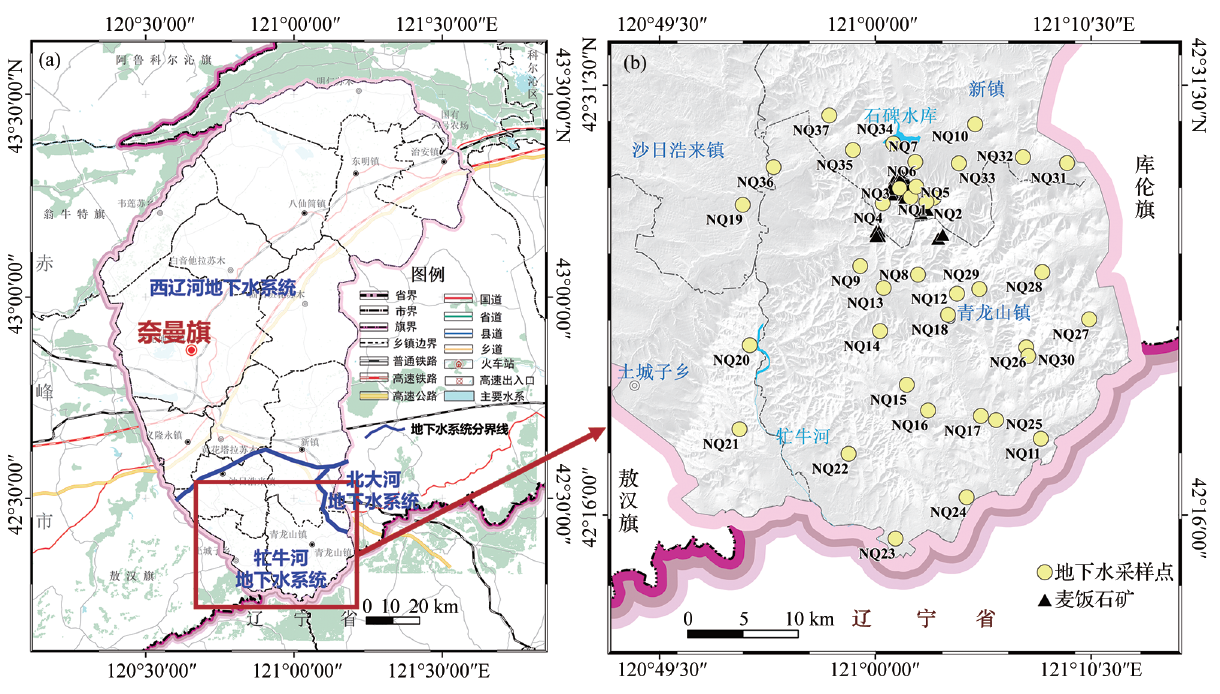
奈曼旗作为科尔沁农牧交错带水源涵养区,区内发现的富锶—偏硅酸地下水可为地下水健康研究和矿泉水开发提供契机。以内蒙古奈曼旗南部山区为靶区,基于水文地质调查与37组地下水样品测试数据,采用水文地球化学分析方法,揭示了富锶—偏硅酸地下水空间分异规律与成因机制。结果表明,研究区地下水呈中性—弱碱性,水化学类型以HCO3-Ca型为主,锶含量介于0.24~1.83 mg/L,偏硅酸含量介于14.9~29.9 mg/L,富锶—偏硅酸复合型地下水分布在区内麦饭石矿区周边;碳酸盐岩与硅酸盐岩风化溶解以及阳离子交替吸附促进了地下水中锶的富集,室内实验表明,麦饭石的溶滤有利于偏硅酸地下水的形成;研究也指明了区内孔隙—裂隙含水层具备富锶—偏硅酸地下水矿泉水开发潜力,为乡村振兴与地质资源协同利用提供了科学依据。
曹文庚 , 鲁重生 , 庄海艳 , 丛日辉 , 仝艳龙 , 任宇 , 李祥志 , 卢瑶 , 王妍妍 . 奈曼旗南部山区富锶—偏硅酸地下水形成机制与开发潜力[J]. 地球科学进展, 2025 , 40(12) : 1283 -1296 . DOI: 10.11867/j.issn.1001-8166.2025.062
As a water conservation area in the Horqin agro-pastoral ecotone, Naiman Banner boasts strontium and metasilicic acid-rich groundwater, which provides opportunities for groundwater health research and mineral water development. This study selected the southern mountainous area of Naiman Banner, Inner Mongolia, as the target area. Based on hydrogeological surveys and test data from 37 groups of groundwater samples, hydrogeochemical analysis methods were employed to reveal the spatial differentiation patterns and formation mechanisms of strontium-rich and metasilicic acid groundwater. Results indicated that the groundwater in the study area is neutral weak alkaline, with HCO3-Ca as the main hydrochemical type. The strontium content ranges from 0.24 to 1.83 mg/L, and the metasilicic acid content ranges from 14.9 to 29.9 mg/L. The strontium rich metasilicic acid composite groundwater is distributed around the Maifanshi mining area in the area. The weathering and dissolution of carbonate rocks and silicate rocks, as well as the alternating adsorption of cations, promote the enrichment of strontium in groundwater. Indoor experiments have shown that the leaching of vermiculite is beneficial for the formation of metasilicic groundwater. The study also indicates that the pore fissure aquifer in the area has the potential for industrialized development of strontium and metasilicic acid-rich mineral water, providing scientific basis for rural revitalization and coordinated utilization of geological resources.
| [1] | MUSGROVE M. The occurrence and distribution of strontium in U.S. groundwater[J]. Applied Geochemistry, 2021, 126. DOI: /10.1016/j.apgeochem.2020.104867 . |
| [2] | XU Changqian, HE Zhongqiang, DIAO Yushan, et al. Tracing the origins of strontium in strontium-rich mineral water using strontium, hydrogen and oxygen isotope analysis[J]. Earth and Environment, 2025, 53(4): 1-12. |
| 徐昌乾, 何钟强, 刁玉山, 等. 基于锶和氢氧同位素方法解析富锶矿泉水中锶的来源[J]. 地球与环境, 2025, 53(4): 1-12. | |
| [3] | WEI Xiuli, ZHANG Xiuqin, ZHOU Yide. Relationship between strontium and human health[J]. Studies of Trace Elements and Health, 2020, 37(5): 70-72. |
| 位秀丽, 张秀琴, 周毅德. 锶与人体健康关系[J]. 微量元素与健康研究, 2020, 37(5): 70-72. | |
| [4] | ZHU Xueqin, LIU Wenbo, LI Zhiming, et al. Distribution and characterization analyses of strontium-bearing mineral spring water in the Chengde region[J]. Hydrogeology & Engineering Geology, 2020, 47(6): 65-73. |
| 朱雪芹, 刘文波, 李志明, 等. 承德地区天然含锶矿泉水空间分布及特征分析[J]. 水文地质工程地质, 2020, 47(6): 65-73. | |
| [5] | GONG Lei, WANG Xinfeng, SONG Mian, et al. Hydrochemical characteristics and water quality health function evaluation of potential metasilicate mineral water in Xingguo County, Jiangxi Province[J]. Rock and Mineral Analysis, 2021, 40(6): 894-906. |
| 龚磊, 王新峰, 宋绵, 等. 江西兴国县潜在偏硅酸矿泉水水化学特征及水质健康功能评价[J]. 岩矿测试, 2021, 40(6): 894-906. | |
| [6] | LIANG Shuang, TIAN Xizhao, ZHANG Ruiqiang, et al. Primary discussion of geochemistry characteristic and formation of potable natural mineral water in Tangshan City[J]. Journal of Water Resources & Water Engineering, 2008, 19(6): 102-107. |
| 梁爽, 田西昭, 张瑞强, 等. 唐山市饮用天然矿泉水地球化学特征与成因探讨[J]. 水资源与水工程学报, 2008, 19(6): 102-107. | |
| [7] | SUN Houyun, WEI Xiaofeng, GAN Fengwei, et al. Genetic type and formation mechanism of strontium-rich groundwater in the upper and middle reaches of Luanhe River Basin[J]. Acta Geoscientica Sinica, 2020, 41(1): 65-79. |
| 孙厚云, 卫晓锋, 甘凤伟, 等. 滦河流域中上游富锶地下水成因类型与形成机制[J]. 地球学报, 2020, 41(1): 65-79. | |
| [8] | SUN Houyun, WEI Xiaofeng, SUN Xiaoming, et al. Formation mechanism and geological construction constraints of metasilicate mineral water in Yudaokou, Hannuoba Basalt area[J]. Earth Science, 2020, 45(11): 4 236-4 253. |
| 孙厚云, 卫晓锋, 孙晓明, 等. 御道口汉诺坝玄武岩偏硅酸矿泉水形成机制及其地质建造制约[J]. 地球科学, 2020, 45(11): 4 236-4 253. | |
| [9] | DENG Jianjun, XU Fen, BAI Ximin, et al. Study on the distribution patterns and formation mechanism of natural drinking mineral water in Jiangxi Province[J]. Jiangxi Science, 2024, 42(6): 1 190-1 197. |
| 邓建军, 徐芬, 白细民, 等. 江西省饮用天然矿泉水分布规律及形成机制研究[J]. 江西科学, 2024, 42(6): 1 190-1 197. | |
| [10] | WANG Panxi, CAO Yuanbing, FENG Naiqi, et al. Discovery and development suggestion of strontium-rich and metasilicate mineral water in the northern Pingxiang City, Jiangxi Province[J]. Geology in China, 2022, 49(2): 677-678. |
| 王盘喜, 曹员兵, 冯乃琦, 等. 江西省萍乡市北部区域发现富锶和偏硅酸矿泉水与开发建议[J]. 中国地质, 2022, 49(2): 677-678. | |
| [11] | SU Chuntian. Formation mechanism of strontium-rich groundwater in Xintian County, Hunan Province[D]. Wuhan: China University of Geosciences (Wuhan), 2021. |
| 苏春田. 湖南新田县富锶地下水形成机理研究[D]. 武汉: 中国地质大学(武汉), 2021. | |
| [12] | ZHANG Yanlin, LI Jiyu, LI Chunliang, et al. Hydrochemical characteristics and migration rules of strontium-rich groundwater in the middle and lower reaches of Liyuan River Plain[J]. Gansu Geology, 2024, 33(3): 38-44. |
| 张彦林, 李积玉, 李春亮, 等. 梨园河中下游平原富锶地下水水化学特征及运移规律探讨[J]. 甘肃地质, 2024, 33(3): 38-44. | |
| [13] | LIU Yonglin, LUO Kunli, NI Runxiang, et al. High quality natural Li-rich and Sr-rich drinking-water in Yutian County, Xinjiang and its development prospect[J]. Journal of Natural Resources, 2013, 28(12): 2 150-2 158. |
| 刘永林, 雒昆利, 倪润祥, 等. 新疆于田县优质富锂富锶天然饮用矿泉水及其开发前景[J]. 自然资源学报, 2013, 28(12): 2 150-2 158. | |
| [14] | LI Dong. Genesis of metasilicate mineral water in the basalt area, Changbai Mountain: an experimental study on the kinetics of the water-rock interactions[D]. Changchun: Jilin University, 2022. |
| 李栋. 长白山玄武岩区偏硅酸型矿泉水成因:水岩反应动力学实验研究 [D]. 长春: 吉林大学, 2022. | |
| [15] | SUN Qifa, SUN Zhuoan, JIA Lingang, et al. Formation mechanism of strontium and metasilicic acid groundwater in the Lianhuashan area, Changchun, Jilin Province[J]. Geology in China, 2023, 50(1): 181-191. |
| 孙岐发, 孙茁桉, 贾林刚, 等. 吉林省长春莲花山地区地下水中锶及偏硅酸的形成机理研究[J]. 中国地质, 2023, 50(1): 181-191. | |
| [16] | FAN Wei, YANG Yuesuo, YE Xueyan, et al. Hydrogeochemical and environmental characteristics of strontium enrichment in groundwater and its genesis in Qingken Lake area [J]. Journal of Jilin University (Earth Science Edition), 2010, 40(2): 349-367. |
| 范伟, 杨悦锁, 冶雪艳, 等. 青肯泡地区地下水中锶富集的水文地球化学环境特征及成因分析 [J]. 吉林大学学报(地球科学版), 2010, 40(2): 349-367. | |
| [17] | SU Chuntian, NIE Fayun, ZOU Shengzhang, et al. Hydrochemical characteristics and formation mechanism of Strontium-rich groundwater in Xintian County, Hunan Province[J]. Geoscience, 2018, 32(3): 554-564. |
| 苏春田, 聂发运, 邹胜章, 等. 湖南新田富锶地下水水化学特征与成因分析[J]. 现代地质, 2018, 32(3): 554-564. | |
| [18] | SU Chuntian, ZHANG Fawang, XIA Riyuan, et al. A study of the water-rock interaction of large rich Sr mineral spring in Xintian, Hunan Province[J]. Geology in China, 2017, 44(5): 1 029-1 030. |
| 苏春田, 张发旺, 夏日元, 等. 湖南新田发现大型富锶矿泉水及机理研究[J]. 中国地质, 2017, 44(5): 1 029-1 030. | |
| [19] | LI Hui, ZHAI Xing, LIU Shuo, et al. Analysis on the migration of strontium and occurrence characteristics of the strontium mineral water in Dushan area, eastern Hebei Provinc[J]. Science Technology and Engineering, 2021, 21(2): 458-464. |
| 李辉, 翟星, 刘硕, 等. 冀东都山地区富锶矿泉水锶的运移与赋存特征分析[J]. 科学技术与工程, 2021, 21(2): 458-464. | |
| [20] | HU Jinwu, WANG Zengyin, ZHOU Lian, et al. Hydrogeochemical characteristics of the strontitum in karst water [J]. Carsologica Sinica, 2004, 23(1): 38-43. |
| 胡进武, 王增银, 周炼, 等. 岩溶水锶元素水文地球化学特征 [J]. 中国岩溶, 2004, 23(1): 38-43. | |
| [21] | LIU Qingxuan, WANG Guiling, ZHANG Fawang. Geological geochemical environment for the enrichment of trace component H2SiO3 in groundwater[J]. Acta Geoscientica Sinica, 2004, 25(5): 575-578. |
| 刘庆宣, 王贵玲, 张发旺. 地下水中微量组份H2SiO3富集的地质地球化学环境[J]. 地球学报, 2004, 25(5): 575-578. | |
| [22] | HE Jin, MA Xuemei, DENG Qijun, et al. Hydrochemical characteristics and formation mechanism of metasilicate mineral water in a Cenozoic basaltic aquifer in Zhangbei County, Hebei Province[J]. Geology in China, 2023, 50(6): 1 887-1 902. |
| 何锦, 马雪梅, 邓启军, 等. 河北省张北县新生代玄武岩偏硅酸矿泉水化学特征及成因[J]. 中国地质, 2023, 50(6): 1 887-1 902. | |
| [23] | LI D, GAN S, LI J, et al. Hydrochemical characteristics and formation mechanism of strontium-rich groundwater in Shijiazhuang, North China Plain [J]. Journal of Chemistry, 2021, 2021(1). DOI: 10.1155/2021/5547924 . |
| [24] | YANG N, SU C L, LIU W B, et al. Occurrences and mechanisms of strontium-rich groundwater in Xinglong County, northern China: insight from hydrogeological and hydrogeochemical evidence[J]. Hydrogeology Journal, 2022, 30(7): 2 043-2 057. |
| [25] | LIU Qingxuan, WANG Guiling, ZHANG Fawang. Geochemical environment of trace element strontium (Sr) enriched in mineral waters[J]. Hydrogeology & Engineering Geology, 2004(6): 19-23. |
| [刘庆宣, 王贵玲, 张发旺. 矿泉水中微量元素锶富集的地球化学环境[J]. 水文地质工程地质, 2004(6): 19-23. | |
| [26] | TU Chunlin, HE Chengzhong, TAO Lanchu, et al. Characteristics and genesis of strontium enrichment in groundwater of typical karst basins in eastern Yunnan and western Guizhou[J]. Environmental Chemistry, 2023, 42(2): 456-468. |
| 涂春霖, 和成忠, 陶兰初, 等. 滇东黔西典型岩溶流域地下水中锶富集特征及成因分析[J]. 环境化学, 2023, 42(2): 456-468. | |
| [27] | ZHANG S T, HAN G L, GAO X, et al. Megacity river as a critical anthropogenic source of strontium release in global Sr cycle: insights from Bayesian mixing model and Sr isotope[J]. Water Research, 2025, 278. DOI: 10.1016/j.watres.2025.123402 . |
| [28] | WANG Bo, ZHAO Li, CHEN Xiaomei, et al. Characteristics and prospective evaluation of natural mineral water resources in the Erhai Lake basin [J]. Carsologica Sinica, 2024, 43(6): 1 275-1 286. |
| 王波, 赵莉, 陈晓梅, 等. 洱海流域天然出露矿泉水资源特征及远景评价 [J]. 中国岩溶, 2024, 43(6): 1 275-1 286. | |
| [29] | LU Chongsheng, CAO Wenggeng, ZHUANG Haiyan, et al. Study on the formation mechanism and background values of groundwater hydrochemistry in farming-pastoral zone, Naiman Banner [J]. Advances in Earth Science, 2025: 1-17. [2025-11-28]. . |
| 鲁重生,曹文庚,庄海艳,等.奈曼旗农牧交错带地下水水化学形成机制与背景值研究[J/OL].地球科学进展,2025: 1-17. [2025-11-28]. . | |
| [30] | LU Chongsheng, LIU Wenbo, LI Zhiming, et al. Hydrochemical environment in a typical conservation area in the Beijing-Tianjin-Hebei region: a case study in Xinglong County of Chengde[J]. Hydrogeology & Engineering Geology, 2020, 47(6): 132-141. |
| 鲁重生, 刘文波, 李志明, 等. 京津冀水源涵养区水化学环境分析——以承德市兴隆县为例 [J]. 水文地质工程地质, 2020, 47(6): 132-141. | |
| [31] | KALEEM M, NASEEM S, BASHIR E, et al. Discrete geochemical behavior of Sr and Ba in the groundwater of southern Mor Range, Balochistan, a tracer for igneous and sedimentary rocks weathering and related environmental issues[J]. Applied Geochemistry, 2021, 130. DOI: 10.1016/j.apgeochem.2021.104996 . |
| [32] | YANG N, GUO L, WANG G, et al. Application of major ions and Sr isotopes to indicate the evolution of river water and shallow groundwater chemistry in a typical endorheic watershed, northwestern China[J]. Applied Geochemistry, 2024, 175. DOI: 10.1016/j.apgeochem.2024.106182 . |
| [33] | XU Panpan, QIAN Hui, ZHANG Qiying, et al. Hydrogeochemical genesis mechanism and secondary environmental challenges of groundwater in southern Jingyang, Shaanxi Province[J]. Geological Bulletin of China, 2025, 44(5): 1-17. |
| 徐盼盼, 钱会, 张奇莹, 等. 陕西泾阳南部地下水水文地球化学成因机制及次生环境挑战[J]. 地质通报, 2025, 44(5): 1-17. | |
| [34] | ZHOU Xin, WANG Can, ZHENG Pengfei, et al. Metallogenic regularity of strontium-rich drinking natural mineral water in Devonian carbonate area in southern Hunan: taking strontium-rich drinking mineral water in Xinxu Town, Xintian County as an example[J]. Carsologica Sinica, 2022, 41(2): 197-209. |
| 周鑫, 王璨, 郑鹏飞, 等. 湘南泥盆系碳酸盐岩区富锶饮用天然矿泉水成矿规律——以新田县新圩矿泉水为例[J]. 中国岩溶, 2022, 41(2): 197-209. | |
| [35] | ZHANG Rong, SONG Le, MA Cuiyan, et al. Research on the prevention and control mechanism of characteristic heavy metals in soil-groundwater by Naiman Banner Maifanite[J]. Advances in Earth Science, 2025: 1-13. [2025-11-28]. . |
| 张荣,宋乐,马翠艳,等.奈曼旗麦饭石对土壤—地下水中特征重金属的防控机制研究[J/OL].地球科学进展,2025: 1-13. [2025-11-28]. . | |
| [36] | ZHANG Yanlin, DING Hongwei, FU Donglin, et al. A study of enrichment environment and formation mechanism of strontium mineral water in Gansu Province[J]. Geology in China, 2020, 47(6): 1 688-1 701. |
| 张彦林, 丁宏伟, 付东林, 等. 甘肃省锶矿泉水的富集环境及其形成机理研究[J]. 中国地质, 2020, 47(6): 1 688-1 701. | |
| [37] | PLECHACEK A, SCOTT S R, GOTKOWITZ M B, et al. Strontium and radium occurrence at the boundary of a confined aquifer system[J]. Applied Geochemistry, 2022, 142. DOI: 10.1016/j.apgeochem.2022.105332 . |
| [38] | LI Xiaofei, ZHANG Mingjun, MA Qian, et al. Characteristics of stable isotopes in precipitation over northeast China and its water vapor sources[J]. Environmental Science, 2012, 33(9): 2 924-2 931. |
| 李小飞, 张明军, 马潜, 等. 我国东北地区大气降水稳定同位素特征及其水汽来源[J]. 环境科学, 2012, 33(9): 2 924-2 931. | |
| [39] | YANG Nan, SU Chunli, ZENG Hanbin, et al. Evolutional processes of groundwater in Xinglong County based on hydrochemistry and hydrogen and oxygen isotopes[J]. Hydrogeology & Engineering Geology, 2020, 47(6): 154-162. |
| 杨楠, 苏春利, 曾邯斌, 等. 基于水化学和氢氧同位素的兴隆县地下水演化过程研究[J]. 水文地质工程地质, 2020, 47(6): 154-162. | |
| [40] | YANG Wenliang, PU Xiuchao, CAO Zhendong. Origin analysis and mining quantity calculation of strontium-rich mineral water of Xiamu Village, Shabao Town, Nayong County, Guizhou[J]. Mineral Resources and Geology, 2023, 37(4): 823-830. |
| 杨文亮, 蒲秀超, 曹振东. 贵州纳雍县沙包镇下木村富锶矿泉水成因分析及开采量计算[J]. 矿产与地质, 2023, 37(4): 823-830. |
/
| 〈 |
|
〉 |
 甘公网安备62010202000687