
研究论文

北极陆地环境新型有机污染物的传输及其影响

  • 陈心怡 , 1, 3 ,
  • 崔腾飞 2, 3 ,
  • 潘忆遥 1, 3 ,
  • 陈一帆 1, 3 ,
  • 李紫函 2, 3 ,
  • 伏钱琛 2, 3 ,
  • 杨瑞强 , 1, 3
展开
  • 1. 中国科学院生态环境研究中心 环境化学与环境毒理全国重点实验室,北京 100085
  • 2. 国科大杭州 高等研究院环境学院,浙江 杭州 310024
  • 3. 中国科学院大学 资源与环境学院,北京 100049
杨瑞强,主要从事持久性有机污染物长距离迁移及环境影响研究. E-mail:

陈心怡,主要从事持久性有机污染物长距离迁移及环境影响研究. E-mail:

CHEN Xinyi, research areas include long-range transport and environmental impacts of persistent organic pollutants. E-mail:

收稿日期: 2025-05-26

  修回日期: 2025-07-07

  网络出版日期: 2025-07-10

基金资助

国家重点研发计划项目(2020YFA0608503)

Emerging Organic Contaminants in the Arctic Terrestrial Environments: Occurrence, Sources and Associated Risks

  • Xinyi CHEN , 1, 3 ,
  • Tengfei CUI 2, 3 ,
  • Yiyao PAN 1, 3 ,
  • Yifan CHEN 1, 3 ,
  • Zihan LI 2, 3 ,
  • Qianchen FU 2, 3 ,
  • Ruiqiang YANG , 1, 3
Expand
  • 1. State Key Laboratory of Environmental Chemistry and Ecotoxicology, Research Center for Eco-Environmental Sciences, Chinese Academy of Sciences, Beijing 100085, China
  • 2. School of Environment, Hangzhou Institute for Advanced Study, University of Chinese Academy of Sciences, Hangzhou 310024, China
  • 3. College of Resource and Environment, University of Chinese Academy of Sciences, Beijing 100049, China
YANG Ruiqiang, research areas include long-range transport and environmental impacts of persistent organic pollutants. E-mail:

Received date: 2025-05-26

  Revised date: 2025-07-07

  Online published: 2025-07-10

Supported by

the National Key Research and Development Program of China(2020YFA0608503)

摘要

新型有机污染物或被大量应用于各种消费品中并持续释放,或在工业生产过程中作为副产物被无意排放,因其具有持久性和长距离传输的特性,已在北极环境中被广泛检出。目前已有综述总结了北极环境中新型有机污染物的赋存特征、环境行为和生态风险,但其主要针对海洋环境,而对陆地环境中新型有机污染物的总结与讨论有限。与海洋环境相比,陆地环境中的新型有机污染物主要来源于大气长距离传输,二次释放的来源贡献大,污染物在其中的赋存特征、传输和来源及环境影响方面存在差异。首先综述了当前高度关注的新型有机污染物(如OPEs、PFASs、NBFRs和PCNs)在北极陆地环境的赋存特征、变化趋势及其来源解析。研究表明,北极陆地环境中新型有机污染物总体浓度水平较低,其时间变化趋势与物质生产使用直接相关;人类活动排放与气候变化影响下的污染物二次释放,共同加剧了北极陆地环境新型有机污染物来源的复杂性。在此基础上,通过分析新型有机污染物在陆地植被、淡水鱼类和陆地动物中的富集情况,并结合人体暴露评估结果,综合评估其对生态环境和人体健康的潜在风险。最后,针对北极陆地环境新型有机污染物研究现存的问题与挑战展望了未来的研究重点:目前研究仍局限于单一介质的浓度赋存,报道的有机污染物种类仍然有限,缺乏对气候驱动再释放过程及环境效应的系统认识;未来需要加强多介质迁移归趋,结合非靶向筛查技术识别北极高风险污染物,重点关注气候变暖背景下污染物的再释放及其生态与健康风险。

本文引用格式

陈心怡 , 崔腾飞 , 潘忆遥 , 陈一帆 , 李紫函 , 伏钱琛 , 杨瑞强 . 北极陆地环境新型有机污染物的传输及其影响[J]. 地球科学进展, 2025 , 40(8) : 831 -846 . DOI: 10.11867/j.issn.1001-8166.2025.064

Abstract

Emerging Organic Contaminants (EOCs) are used extensively in a wide range of consumer products, and are continuously released into the environment or inadvertently emitted as by-products during industrial processes. Owing to their environmental persistence and long-range environmental transport characteristics, EOCs have become ubiquitous and have been widely detected, even in remote regions of the Arctic. Although previous reviews have addressed the occurrence, environmental behavior, and ecological risks of EOCs in the Arctic, they have largely concentrated on marine ecosystems, leaving terrestrial environments comparatively understudied. Compared with the marine environment, the predominant input pathway of EOCs is attributed to long-range atmospheric transport, with significant contributions from secondary emissions. These differences lead to distinct patterns in the occurrence, transport pathways, sources, and environmental impacts of EOCs in terrestrial systems. This review summarizes the occurrence characteristics, temporal trends, and sources of high-concern EOCs, including OPEs, PFASs, NBFRs, and PCNs, in the Arctic terrestrial environment. EOC concentrations in terrestrial compartments of the Arctic remain relatively low, and their temporal dynamics closely reflect historical and ongoing production and usage patterns, emphasizing the complex interplay between local anthropogenic emissions and secondary releases driven by climate change. Through comprehensive analysis across multiple trophic levels—including terrestrial vegetation, freshwater fish, and terrestrial wildlife, as well as human exposure pathways—this review evaluates the profound ecological and health implications of EOC bioaccumulation. Finally, this review outlines future research priorities in light of the current problems and challenges involved in studying EOCs in the Arctic terrestrial environment. Existing studies remain limited to concentration profiles in single media, with only a narrow range of contaminants reported, and lack a systematic understanding of climate-driven re-emission processes and their environmental effects. Future research should therefore strengthen multimedia investigations of contaminant transport and fate, apply non-target screening techniques to identify high-risk contaminants in the Arctic, and place particular emphasis on climate warming-induced re-emissions and their associated ecological and health risks.

1 引 言

新型有机污染物是指《关于持久性有机污染物的斯德哥尔摩公约》(简称《斯德哥尔摩公约》,Stockholm Convention,SC)新增列或拟增列的有机污染物,以及国际学术界高度关注的有机污染物,主要包括全氟和多氟烷基物质(Perfluoroalkyl and Polyfluoroalkyl Substances,PFASs)、有机磷酸酯(Organophosphate Esters,OPEs)、新型溴代阻燃剂(Novel Brominated Flame Retardants,NBFRs)、多氯萘(Polychlorinated Naphthalenes,PCNs)和短链氯化石蜡(Short-Chain Chlorinated Paraffins,SCCPs)等。该类污染物具有目前仍大量生产使用、环境存量高的特点,且其生态风险和健康风险的数据积累尚不能满足风险管理。目前,新型有机污染物已在全球水体、土壤和大气等环境介质以及生物体内被普遍检出1-2,其在环境中表现出持久性、生物富集与放大效应及毒性作用3-4,符合持久性有机污染物的特点。
北极因其独特的地理环境和气候条件,人为活动较少,是全球重要的背景区。但新型有机污染物仍可通过大气长距离传输5、动物迁徙6、洋流7和沿极地河流输入8等途径到达北极。北极地区的低温环境在一定程度上抑制了污染物的再挥发和生物、化学降解9-10,增强其在水体、土壤和冰雪等环境介质中的积累和储存911。目前已在北极的淡水鱼类中检出PFASs12,在海鸟中检出PFASs13-14、OPEs15、NBFRs16和PCNs17,在驯鹿和狼等哺乳动物中检出PFASs18和NBFRs19,表明这些污染物已经进入北极陆地生态系统。虽然已有综述总结了北极环境中新型有机污染物的赋存、传输、归趋和生态风险2-3,但聚焦于陆地环境的系统性研究仍有限。
北极陆地与海洋在环境条件和污染物的传输路径等方面存在显著差异,进而影响新型有机污染物的赋存和迁移转化。陆地环境以土壤和冰川等固态介质为主,海洋环境则以动态流动的水体为主,因此污染物在陆地生态系统中更易通过冷捕集效应被吸附储存。已有研究表明,北极陆地环境的冰川和冻土中储存了大量的PFASs和PCNs等新型有机污染物20。同样,受环境介质差异的影响,海洋环境因海水高比热容的调节作用,温度变化相对缓慢,而陆地环境则表现出显著的季节性温差。这种温度及水文条件的差异,一方面使得PFASs等新型有机污染物的浓度呈现季节性差异21-22,另一方面也导致冰川融水成为PFASs和OPEs等污染物重要的二次来源23-24。北极陆地和海洋环境在污染物的传输和来源方面也有显著不同,大多数半挥发性有机污染物如OPEs和SCCPs等主要通过大气长距离传输沉降到北极,而主要以离子型存在的全氟羧酸(Perfluorocarboxylic Acids,PFCAs)和全氟磺酸(Perfluoroalkyl Sulfonates,PFSAs)等PFASs污染物,还可通过洋流传输到达北极地区,或由环境中的前体物转化生成25。这种传输途径和来源的差异,直接导致污染物在陆地和海洋环境中的组成和分布特征存在显著差异。
本文系统梳理了北极陆地环境中OPEs、PFASs、NBFRs和PCNs等新型有机污染物的赋存特征、传输来源和生态影响,旨在为北极地区污染物的区域风险评估和管控策略的制定提供科学依据。

2 北极陆地环境新型有机污染物赋存特征

2.1 OPEs

OPEs是一类以磷酸基团为中心的人工合成化学品,根据其分子结构是否含氯原子,可分为氯代OPEs和非氯代OPEs。作为传统溴代阻燃剂多溴二苯醚(Polybrominated Diphenyl Ethers,PBDEs)等的替代品及增塑剂被广泛用于消费品中,年消费量从2001年的18.6万t增长至2023年的86万t26。由于OPEs与消费品非共价结合,在使用过程中易释放至环境中27。已在北极陆地环境的水体、大气、土壤和沉积物中广泛检出OPEs28-43表1总结了北极陆地环境和其他典型区域各环境介质中OPEs的浓度水平。
表1 北极陆地环境与其他典型区域各环境介质中OPEs的浓度比较

Table 1 Concentration comparison of OPEs in various environmental media in Arctic terrestrial environments compared with other typical regions

介质 北极陆地 北极海洋 南极 其他偏远地区 人口密集区
地区 浓度 地区 浓度 地区 浓度 地区 浓度 地区 浓度

土壤/

(ng/g dw)

斯瓦尔巴(n=10) 1.12~44.728

菲尔德斯半岛

n=10)

0.87~15.729 喜马拉雅山脉(n=10) ND~84.8030 世界范围 0.1~10 000(中位数范围)31
大气/(pg/m3

斯瓦尔巴

n=8)

34032-33

北大西洋—北冰洋

n=7)

36334

菲尔德斯半岛

n=7)

57~644(pg/da35 比利牛斯山脉(n=5) 5.3~10036

上海

n=13)

58037

努纳武特

n=14)

29138

水体/

(ng/L)

哈森湖

n=14)

12.2±0.923

北大西洋—北冰洋

n=7)

0.35~8.40(2.94)34 菲尔德斯半岛湖泊(n=11) 12.23~79.14(19.21)39

比利牛斯山高山湖泊

n=5)

0.14~2.8540 世界范围 25~3 67141

斯瓦尔巴

n=12)

6.81~19.342

沉积物/

(ng/g dw)

斯瓦尔巴

n=12)

0.01~7.4142

白令海峡—北冰洋中部

n=7)

0.16~4.6743 马里亚纳海沟(n=10) 42226

中国长江流域

n=16)

84.335

注: n为OPEs单体数量;dw:干重(dry weight);a:不同于大气统一单位,单独标注;ND:未检出(Not Detected);“—”表示未找到对应内容或数据。

OPEs在北极陆地环境中浓度较低:水体中Σ14OPEs为(12.2±0.9) ng/L23,Σ12OPEs为14.5 ng/L41;土壤中Σ10OPEs为1.12~44.7 ng/g dw(dw为干重)2833;沉积物中Σ12OPEs为0.01~7.41 ng/g dw41,Σ14OPEs为0.114~1.185 ng/g dw43,显著低于全球受人为活动影响较大的区域314042,与北极海洋环境3442、南极2945以及其他高山和海沟等偏远地区263039相比,浓度水平在相同数量级但表现出区域性差异,可能因为OPEs在偏远地区主要来源于长距离传输,但不同地区受人为活动影响的程度存在差异。OPEs在北极陆地大气中的浓度(291~426 pg/m3[32-3346-47)与北极海洋34、南极洲菲尔德斯半岛35、比利牛斯山脉36以及人口密集区上海大气中的OPEs浓度37近似。但需要注意的是,不同研究在大气采样过程中使用的滤膜吸附性存在差异,可能影响污染物的气/粒相分配48,进而影响数据的可比性。
北极陆地环境中OPEs的赋存特征在不同环境、区域和介质间表现出显著差异。北极陆地环境OPEs中的非氯代OPEs占比较高,如在挪威斯瓦尔巴群岛(下文简称斯瓦尔巴地区)的土壤中为54%~60.8%2833、大气中为56%±13%33,在加拿大努纳武特地区(下文简称努纳武特地区)哈森湖水体中非氯代OPEs占比亦较高;且这一特征与北美五大湖的大气49和南极洲菲尔德斯半岛的土壤(76%)29等其他陆地偏远地区的OPEs的特征相似。但在极地海洋环境中,OPEs则以氯代OPEs为主(78%~88%)3438,产生这种差异的原因可能在于:北极陆地环境中的OPEs主要来源于大气长距离传输,而非氯代OPEs更易进入大气并与颗粒物结合。但在海洋环境中,氯代OPEs长距离传输潜力更强,在横跨白令海峡到北冰洋中部的研究中发现,其占比随纬度增加而增加42。OPEs在北极陆地环境中的单体组成也表现出显著的空间差异,可能是长距离传输和本地人类活动的共同作用。如斯瓦尔巴地区的新奥尔松土壤中,优势单体三(2-氯乙基)磷酸酯[tris(2-chloroethyl) phosphate,TCEP]的浓度(198.7 ng/L)较其周边地区或其他单体均高出1个数量级30,而哈森湖水体及周边河流水体中的优势单体则为三(2-丁氧基乙基)磷酸酯[tris(2-butoxyethyl) phosphate,TBOEP]23。OPEs在北极陆地环境不同环境介质中的赋存也有一定差异。如哈森湖沉积物中检出的非氯代OPEs单体种类比水体中更多23,斯瓦尔巴地区土壤中氯代OPEs的占比高于大气33。这些研究结果凸显了北极陆地环境中OPEs赋存特征的复杂性,需对其传输路径和本地源进行系统解析。
北极环境中污染物的时间变化趋势能反映其环境持久性和全球排放动态,为环境治理决策提供科学依据。自PBDEs列入SC管控清单后,OPEs产量剧增,北极陆地环境逐渐成为OPEs在全球环境循环中的重要汇。研究表明,斯瓦尔巴地区大气中的Σ7OPEs浓度在2011—2019年呈上升趋势,浓度倍增时间估计为6.3年,其中TCEP和磷酸三丁酯(tri-n-butyl phosphate,TnBP)的浓度倍增时间更短,估计为2.9年和4.2年。在其他偏远地区,如2014—2018年南极大气中的Σ8OPEs浓度50和2007—2013年加拿大哈德逊湾海洋上空大气中的Σ14OPEs浓度38均呈上升趋势。逸度模型分析进一步证实,斯瓦尔巴地区Σ8OPEs以大气向土壤中的净沉降为主33,表明北极陆地环境中的土壤正成为OPEs的储存库。

2.2 PFASs

PFASs是烷基碳链上氢原子全部或部分被氟原子取代的一类化合物,具有疏水、疏油特性和极强的化学稳定性,被广泛应用于工业生产和消费品领域。因PFASs的环境持久性、长距离迁移能力、生物累积性和生物蓄积性,已在全球范围内限制使用。根据其碳链末端官能团能否在环境中离子化,可将PFASs分为离子型PFASs(含PFCAs、PFSAs)和中性PFASs[包括全氟烷基磺酰胺类(Perfluoroalkyl Sulfonamides,PFOSAs)和氟调聚醇类(Fluorotelomer Alcohols,FTOHs)]。离子型PFASs在水体中的溶解度为mg/L水平,甚至可达g/L,而中性PFASs在水体中的溶解度低,有一定的挥发性。PFASs在北极陆地环境中的赋存特征和归趋行为已成为研究热点,现有证据表明其广泛分布于土壤、大气、水体、积雪和冰芯等多种环境介质中,表2总结了北极陆地环境和其他典型区域土壤、大气、水体和沉积物中PFASs的浓度。
表2 北极陆地环境与其他典型区域各环境介质中PFASs的浓度比较

Table 2 Concentrations comparison of PFASs in various environmental media in Arctic terrestrial environments compared with other typical regions

介质 北极陆地 北极海洋 南极 其他偏远地区 人口密集区
地区 浓度 地区 浓度 地区 浓度 地区 浓度 地区 浓度
土壤/(ng/g dw)

斯瓦尔巴

n=20)

0.12~4.84(1.08±1.38)51 南极(n=32) 0.19852 纳木错盆地(n=13) 0.130~1.50753 长江流域(n=26) 0.991~29.454
加拿大北极群岛(n=16) 0.20~9.52(1.18)55
大气/(pg/m3)(中性PFASs) 努纳武特(n=11) 2856 日本—北冰洋(n=13) 61~35857 南极半岛西部(n=10) 17.358 阿尔卑斯山(n=3) <LOD~72.459

中国

n=14)

11~41060
格陵兰岛(n=7) 1.82~32.161
水体/(ng/L) 哈森湖(n=19) 0.3~1024 格陵兰海—北冰洋(n=29) 140~8507 菲尔德斯半岛(n=13) 2.6762 纳木错(n=13) 0.98~1.28(平均值范围)63 中国呼伦湖(n=30) 1.2164
努纳武特(n=19) 1.1~2.45665
加拿大北极机场下游(n=19) 112~15365
朗伊尔城(n=17) 1.5~3.566
沉积物/(ng/g dw) 加拿大北极地区(n=19) 0.001~0.7365 挪威峡湾(n=1) 0.14~6.5467 多伦多湖机场下游(n=8) 1368

长江

n=15)

0.058~0.8969
加拿大北极机场下游(n=19) 11~2464

注: n表示PFASs单体数量;LOD:检出限(Limit of Detection);dw:干重(dry weight);“—”表示未找到对应内容或数据。

PFASs在北极陆地的整体浓度水平较低(土壤中为0.12~9.52 ng/g dw5155,大气中<0.17~30 pg/m3[566170,水体中为0.3~10 ng/L245665-66,沉积物中为0.001~0.73 ng/g dw64-65),显著低于人为活动密集区域54606469,略高于南极地区5257-58,略低于其他偏远地区53596368。且其浓度较北极海洋环境的大气(61~358 pg/m357、水体(140~850 ng/L)7和沉积物(0.14~6.58 ng/g dw)67低1~2个数量级,这可能因离子型PFASs主要经洋流传输达到北极,而陆地环境中的PFASs主要来源于占比较小的中性PFASs的转化。在加拿大北极机场下游地区的湖泊和沉积物中PFASs浓度比周边其他湖泊高1~2个数量级65,表明PFASs也易受到人为活动的影响。除常规环境介质外,北极陆地环境的积雪和冰芯中的PFASs也受到广泛关注。在1967—2016年努纳武特Mt.oxford冰场的冰芯71、2006—2019年斯瓦尔巴地区的冰芯72、1993—2007年73和1977—2015年74加拿大努纳武特地区的德文冰盖(下文简称德文冰盖)的冰芯样品和斯瓦尔巴朗伊尔城的积雪中21,可检出的PFSAs浓度范围为<LOD~4.16 ng/L(LOD为检出限),PFCAs浓度范围为<LOD~2 023 pg/L,低于阿尔卑斯山冰芯中的Σ18PFASs(650~4 060 pg/L)75,高于南极表层雪中的Σ16PFASs(940 pg/L)76
北极陆地环境中PFASs的赋存特征在不同介质和地区间表现出显著差异。大气中以中性PFASs为主,其他环境介质则以离子型为主54-56。在单体组成上,可检出C1~C12的PFCAs,主要为全氟丁酸(perfluorobutanonic acid,PFBA)、PFOA和全氟壬酸(perfluorononanoic acid,PFNA);C13~C18的PFCAs检出率极低(仅C13和C14以较低频率被检出),这是因为碳链较长的PFASs不易通过大气长距离传输72。可检出的PFSAs包括全氟丁基磺酸(perfluorobutane sulfonate,PFBS)和PFOS等,其浓度水平在水体65-66、土壤55、沉积物65、积雪2177和冰芯2472中通常比PFCAs单体低1~3个数量级。因离子型PFASs主要来源于其中性前体物的长距离传输和转化,而PFCAs的前体物FTOHs在北极陆地大气中的浓度通常比其他中性PFASs高1个数量级5661。但在受人为活动影响较大的努纳武特地区机场下游的水体和沉积物中,PFOS浓度则高于PFCAs或与其浓度相似65。PFBA是努纳武特地区的土壤55和水体24以及朗伊尔城的积雪66和冰芯66中的优势单体,其浓度甚至高于PFOA,但其浓度仅与少数PFCAs单体相关,表明PFBA在北极陆地环境中除前体物转化外还有其他来源,如C4F9等氢氟碳化物(hydrofluorocarbons,HFCs)和氢氟氧化物(hydrofluoro oxygens,HFOs)的转化73
PFASs的时间变化趋势与全球对其的生产使用密切相关。环境介质中PFASs浓度的时间变化趋势能够反映其生产使用与排放的特征,偏远地区冰芯和沉积物具有较高分辨率,可反映污染物在环境中的时间变化趋势。1950年后PFASs开始大规模生产78,2000年后欧美地区开始禁用从而引发产地转移,但部分单体在环境中的浓度仍呈上升趋势79-80。文献报道的PFASs浓度变化的时间趋势与排放量变化趋势大体一致,如哈森湖(1923—2011年)和B35湖(1940—2009年)的沉积柱81、德文冰盖的冰芯73以及努纳武特地区冰川冰芯71中的PFASs在1950—2012年的一定时间区段内呈上升趋势。但其沉积通量峰值出现的时间可能有偏差,如德文冰盖中PFASs的沉积通量峰值出现在2013年74,加拿大Alert地区大气中的PFBA、PFOA和PFOS等单体在2010—2014年仍呈上升趋势70,而斯瓦尔巴Zeppelin气象站2006—2014年的PFOS以及挪威Andøya地区2010—2014年的PFOS和PFOA浓度均呈下降趋势70,这可能是因为PFASs的产业转移和二次释放。近年来,PFASs的组成呈现明显的短链代替长链的趋势,短链PFBA、PFSA和三氟乙酸(trifluoroacetic acid,TFA)等单体的沉积通量显著上升。如2006—2019年斯瓦尔巴地区冰芯72和德文冰盖冰芯记录显示82,三氟乙酸和PFBS等短链PFASs单体的沉积通量呈上升趋势。然而,受气候变暖污染物二次释放的影响,冰芯记录的PFASs沉积通量无法完全反映其排放趋势。因夏季冰川融化时,PFASs的年沉积通量会发生变化,在重新冻结时又重新分配进入积雪中83。因此后续研究可对多介质(大气、积雪、冰芯和冰川融水等)进行同步观测,以更准确地重建短链PFASs的历史排放趋势。

2.3 NBFRs

NBFRs是传统溴代阻燃剂的替代品,因其高热稳定性和低生产成本,自20世纪末开始广泛应用于电气、纺织、化工和建筑材料等领域。中国五溴甲苯(pentabromotoluen,PBT)、五溴乙苯(pentabromoethylbenzene,PBEB)和六溴苯(hexabromobenzene,HBB)等NBFRs单体的年产量在数百吨到数千吨84。NBFRs主要通过物理吸附与消费品结合,在生产、使用和处置过程中易释放进入环境。目前关于北极陆地环境中NBFRs的研究相对有限,但已在土壤、大气和积雪等环境介质中普遍检出NBFRs。
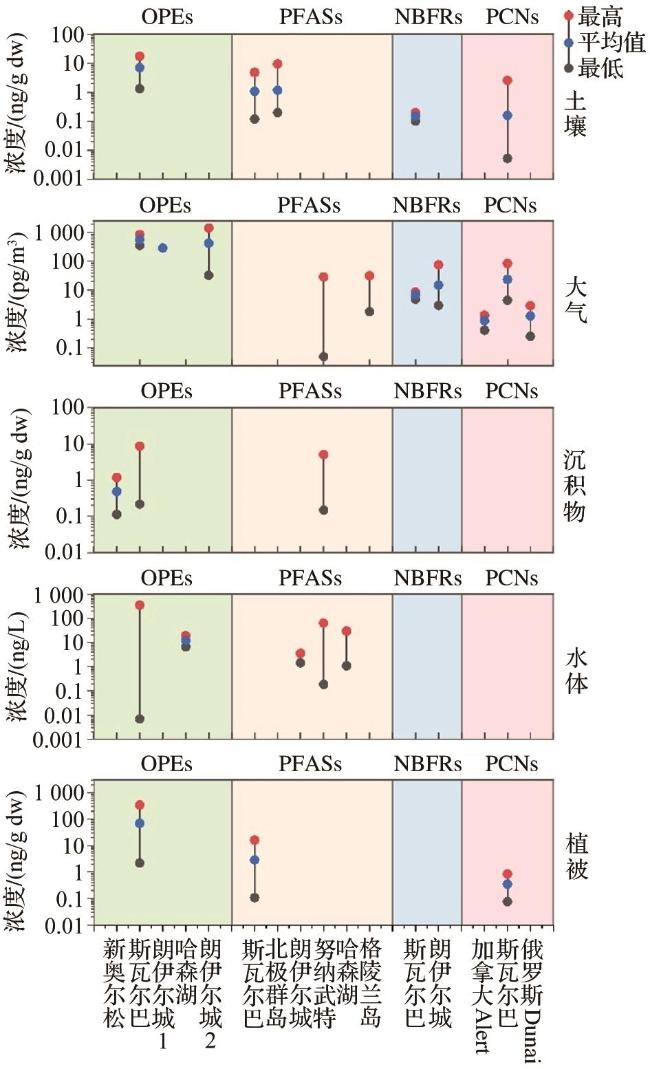
北极陆地环境中NBFRs的总体浓度水平较低(图1),呈现明显的区域差异。斯瓦尔巴地区土壤中的Σ9NBFRs浓度为0.15 ng/g dw(0.101~0.210 ng/g dw)85,高于Σ12PBDEs(0.042 ng/g dw)86,与南极地区的Σ9NBFRs(0.061~0.212 ng/g dw)87、中国青藏高原东部贡嘎山区域的Σ6NBFRs(0.065~3.33 ng/g dw)88和东南地区的Σ7NBFRs(0.342~0.879 ng/g dw)89浓度水平相当,与人为污染严重的区域(如电子垃圾拆解地)相比,北极陆地环境中的NBFRs至少低2个数量级90-91。2005—2008年在德文冰盖的雪坑中也检出1,2-双(2,4,6-三溴苯氧基)乙烷[1,2-bis(2,4,6-tribromophenoxy)ethane,BTBPE]、DBDPE、PBEB和PBT等单体,其中BTBPE浓度最高,浓度范围为ND~83 pg/L,比该雪坑中检出的Σ26PBDEs低1~2个数量级92。关于大气中NBFRs的研究相对较多,例如,斯瓦尔巴地区的气相中Σ9NBFRs浓度为4.9~8.7 pg/m3(平均值:6.8 pg/m385,斯瓦尔巴朗伊尔城的颗粒相中Σ8NBFRs浓度为15 pg/m3[47,高于PBDEs(5.6 pg/m3),与东海到高纬度北极地区的海洋大气中检出的五溴苯(pentabromobenzene,PBBz;0.09~2 pg/m3)、PBT(0.1~4.5 pg/m3)、(2,3-二溴丙基;2,4,6-三溴丙基)醚(2,3-dibromopropyl;2,4,6-tribromophenyl ether,DPTE;0.1~2.5 pg/m3)和HBB(0.1~5.9 pg/m3)等单体浓度近似93。加拿大Alert地区大气中的BTBPE浓度(0.16~1.9 pg/m394高于朗伊尔城和美国阿拉斯加Toolik Field Station颗粒相中的BTBPE(分别为0.04 pg/m3[47和0.02~0.15 pg/m3[95)。
图1 新型有机污染物在北极陆地环境中的浓度水平

朗伊尔城1:指该地区大气样品的气相;朗伊尔城2:指该地区大气样品的颗粒相。

Fig. 1 Concentration levels of emerging organic contaminants in Arctic terrestrial environments

Longyearbyen 1 refers to the gas phase of atmospheric samples in this region; Longyearbyen 2 refers to the particle phase of atmospheric samples in this region.

时间变化趋势显示,在斯瓦尔巴地区的大气中,PBBz、PBT和DPTE等单体浓度在2011—2019年显著增加,其浓度倍增时间分别为(3.0±0.8)年、(3.3±0.6)年和(2.8±0.5)年。但浓度最高的DBDPE和BTBPE可能因其半衰期较短而略有下降趋势94。Hao等85根据逸度模型计算了斯瓦尔巴地区土壤和大气中的平衡状态,结果表明该地区NBFRs以大气向土壤中的净沉降占主导,北极陆地环境中的土壤是NBFRs重要的汇。

2.4 PCNs

PCNs是萘环上氢原子被氯原子取代的一系列化合物的总称,根据氯原子的取代数和取代位置可分为8种同族物。PCNs在20世纪初用于工业生产,全球累计产量15万t,除工业生产外也可来源于工业热过程的无意排放。PCNs的商业化生产和使用在20世纪后期就已被大部分国家和地区禁止,在2015年被列入SC附件A和C,以明确禁止PCNs的工业生产,并减少无意排放或消除排放源。
PCNs在北极陆地环境中的浓度水平较低(图1),具有显著的区域和年际差异。Gebru等96在斯瓦尔巴地区2011—2019年大气中检出的Σ75PCNs浓度为4.56~85.2 pg/m3(23.5 pg/m3),低于该地区2001年大气中Σ75PCNs的浓度(35.0 pg/m397,但高于1994—1995年加拿大Alert地区(0.43~0.88 pg/m3)、俄罗斯Dunai地区(0.031~1.29 pg/m3)和加拿大Tagish(0.21~0.53 pg/m3)等地区的浓度98-99。在斯瓦尔巴地区的土壤和积雪中,Σ75PCNs的浓度范围分别为5.3~230 pg/g dw(扣除离群值)100和60~1 100 pg/L97,低于青藏高原东南部土壤(Σ75PCNs:25.5~530 pg/g;平均值为212 pg/g)101和波兰地区的土壤(350~1 100 pg/g)102。在斯瓦尔巴地区的大气中,Σ75PCNs浓度水平无显著的空间差异96,但在受人为活动较多的朗伊尔城土壤中的浓度(0.083~0.230 ng/g dw)高于伦敦岛(0.011~0.110 ng/g dw)和新奥尔松地区(5.3~91 ng/g dw)100,朗伊尔城历史上有较多采矿工业,表明PCNs受当地遗留污染物的影响,北极陆地土壤中储存了大量的PCNs20。PCNs在各环境介质中都以低氯代取代的同族物为主,其中斯瓦尔巴地区土壤中1-3氯取代PCNs的占比达91%100,大气中达97%96,与青藏高原土壤和大气中单体组成一致101,低氯代PCNs通常与燃烧源相关103。因此,北极陆地环境中PCNs的赋存与历史遗留和燃烧排放源相关。
PCNs的环境浓度在时间趋势上表现出复杂的动态变化特征:受政策法规限制,PCNs的环境浓度总体呈下降趋势,如斯瓦尔巴地区大气中的PCNs浓度在2013—2019年呈现下降趋势96。但由于PCNs的持久性,加之其在生产过程及频发的森林野火中仍被无意排放20,在气候变化情况下,作为持久性有机污染物汇的北极,可能会释放PCNs进而造成其环境浓度的升高或波动。

2.5 不同新型有机污染物的赋存特征比较

北极陆地环境中新型有机污染物的浓度低于大部分人为活动较多的地区,总体上略高于南极。从时间变化趋势看,不同新型有机污染物呈现显著不同的规律:OPEs和NBFRs作为传统溴代阻燃剂的替代品,生产量持续增长,部分单体浓度呈上升趋势,但由于其在环境中较易降解(如OPEs可代谢为毒性更强的磷酸二酯),整体环境浓度未呈现显著上升趋势;PCNs和PFASs已在较长时间内大规模使用,近年来受到管控,其环境浓度整体呈下降趋势,但仍存在阶段性波动。这种波动可能与3个方面的因素相关:一是气候变化导致的污染物二次释放,二是北极本地污染源(如历史采矿活动残留)的持续排放,三是森林火灾等的排放。污染物的环境浓度与生产排放量直接相关,但污染物的持久性和环境行为对其浓度变化趋势的影响日益显著。未来研究应重点关注污染物的环境转化途径、气候变化对污染物归趋的影响以及区域特异性暴露风险,为完善北极环境管控政策提供科学依据。

3 北极陆地环境新型有机污染物的传输和来源

3.1 大气长距离传输

大气长距离传输是北极陆地环境一些半挥发性有机污染物的主要来源,该观点可通过污染物在北极陆地环境中空间分布的一致性及其持久性得到证明。如在加拿大Alert地区和Tagish地区以及俄罗斯Dunai地区等受人为活动影响较少的区域检出的PCNs浓度近似98-99,NBFRs在斯瓦尔巴地区大气和土壤中的空间分布无显著差异87,在斯瓦尔巴地区和努纳武特等地区冰芯中检出的PFASs具有相似的单体组成等现象517477,均表明其主要来源于长距离传输。SC中化学品长距离迁移的大气半衰期的最低阈值通常为2天,PCNs在大气中的半衰期为2~343天104,中性PFASs如FTOHs(半衰期:13~14天105)在降解成PFCAs等稳定化合物之前会迁移相当长的距离106,因此具有长距离传输潜力。
在大气中半衰期较短的新型有机污染物,与大气颗粒相结合可增加其持久性。大气颗粒物对污染物与羟基自由基反应的抑制作用可延长其环境寿命,如OPEs在大气中的半衰期低于2天107,但颗粒相中OPEs的半衰期可增长至3.5~14天107。OPEs在大气颗粒相中富集可增强其长距离传输的潜力,在北大西洋到北冰洋的大气样品中,颗粒相中OPEs的浓度占比随纬度增加而增加,但在中国和日本沿海等源区OPEs主要以气相形式存在108。OPEs也可与大气中的水蒸汽相互作用延长其在大气中的保留时间,水蒸气通过形成氢键改变原先反应中的络合物和过渡态的稳定性,从而减缓污染物与羟基自由基的反应。Li等109的研究表明,三(2-氯异丙基)磷酸酯[tris(2-chloroisopropyl) phosphate,TCIPP]在大气中的半衰期约为1.7 h,但考虑大气中水蒸气系数重新估算后得到的半衰期为0.5~20.2天。氯代OPEs通过洋流长距离传输再重新分配达到动态平衡后,由于水蒸气可延长大气中OPEs的保留时间,海洋上空大气气相中氯代OPEs的浓度比非氯代OPEs高25,甚至可高1~2个数量级108

3.2 转化生成

北极陆地环境中的新型有机污染物可通过挥发性前体物的长距离大气传输并进行环境转化,这一过程主导了PFASs的分布特征。
目前北极陆地环境中的离子型PFASs,主要通过中性PFASs(如FTOHs)转化形成77110-111。PFCAs和PFSAs为离子型化合物且水溶性较高(可达mg/L水平)112,很难通过大气长距离传输。研究表明,FTOHs可通过大气长距离传输,其中n∶2 FTOH会降解生成摩尔比1∶1的奇数碳链(n+1)和偶数碳链(n)的PFCAs5661。北极陆地环境中已广泛检出PFCAs和PFSAs。值得注意的是,关于PFNA生产的报道很少,但该物质在北极陆地环境中分布广泛65-66,如北极的格陵兰岛、努纳武特地区和斯瓦尔巴地区的土壤、湖泊、冰川融水和冰芯等环境介质中以及驯鹿和鸟类等生物体中均检出PFNA,甚至成为努纳武特地区和斯瓦尔巴地区土壤中PFCAs的优势单体,在斯瓦尔巴群岛的土壤中51、加拿大北极地区内陆湖泊的水体和沉积物中56、斯瓦尔巴地区66和努纳武特地区的冰芯中7173,PFNA和PFOA的浓度水平近似,表明PFNA主要在环境中转化生成,且与PFOA具有相似的来源。同时,在斯瓦尔巴地区的土壤和德文冰盖冰芯中,全氟癸酸(perfluorodecanoic acid,PFDA)和全氟十一酸(perfluoroundecanoic acid,PFUnDA)、全氟十二酸(perfluorododecanoic acid,PFDoDA)和全氟十三酸(perfluorotridecanoic acid,PFTrDA)之间的浓度水平也相似,表明可能有相似的来源5174。FTOHs是北极大气中主要的中性PFASs5661,其中8∶2 FTOH含量最高,可解释在其他环境介质中PFOA和PFNA浓度较高,且具有相似的浓度及占比,因此,FTOHs可能是北极陆地环境中PFCAs的来源77110-111。相比较,PFBA除FTOHs外还有更多的前体物,如HFC-329113,导致PFBA在北极的水体、冰芯和积雪等环境介质以及生物体中的浓度(其他样品未检测PFBA)比PFASs其他单体浓度高1~2个数量级。

3.3 气候变化背景下的二次释放

北极地区是典型的气候敏感区,1979—2021年北极地区平均气温变化率高达0.75 ℃/10a,约是全球平均增温水平的4倍114。北极陆地环境的变暖效应比海洋环境更显著,使长期储存在冰川和冻土中的新型有机污染物重新释放。因此,二次释放已成为北极陆地环境新型有机污染物的重要来源。
冰川融化和冻土退化释放的新型有机污染物会重新进入环境,呈现多介质扩散特征,影响冰川前沿土壤和大气中污染物的浓度。研究表明,在斯瓦尔巴地区朗伊尔城的冰川融水和冰川前沿沉积物,以及哈森湖的冰川径流中,都检出浓度与周边环境浓度相近或更高的PFASs和OPEs23-244166,这表明冰川融水将成为北极陆地水体环境重要的二次来源。永久冻土融水同样贡献显著,在哈森湖流域因永久冻土融化形成的河流中,上游PFASs浓度是下游区域的2倍以上24,OPEs浓度也比冰川融水形成的河流的OPEs浓度更高23。冰川融水也是冰川前沿的土壤或沉积物和大气等环境介质的源。如北极斯瓦尔巴地区冰川前沿土壤和大气中检出的OPEs浓度高于该地区OPEs的平均水平2832,冰川前沿沉积物中的NBFRs浓度随与冰川距离的增加而减少85115。冰川融水的通量计算数据显示,哈森湖通过冰川融水输入的Σ19PFASs量为1.60 kg/a,占总输入量的78%24,远超青藏高原纳木错冰川融水释放的Σ13PFASs的占比(0.49 kg/a,占比27%)63。哈森湖Σ14OPEs的输入量也与冰川径流量的变化直接相关,2015年的输入量为(7.0±3.2) kg,但2018年随着融水量的减少导致不同单体输入量下降22%~87%23。冰川融水导致的二次释放同样也是传统POPs的重要来源116。因此,随着新型有机污染物的生产使用时间延长,北极陆地环境的二次释放的贡献不容忽视,亟须建立多介质长期监测网络并量化其释放通量以评估环境风险。

3.4 人为活动导致的本地源排放

北极地区人类活动的增加导致污染物的使用和排放也随之增加。研究表明,2020—2030年阿拉斯加和加拿大北极地区的人口将增加约20%,冰岛、芬兰和格陵兰岛等国家和地区的人口也会有不同程度的增长20。人口增长伴随着工业活动(如石油和天然气的开采、挖矿、航运、渔业和水产养殖等)的发展,以及基础设施如海港、机场、公路和铁路等的扩建,使得人为活动排放成为北极陆地环境中新型有机污染物越来越重要的本地来源。
室内环境是新型有机污染物在北极陆地环境中的一个重要来源。北极的Zeppelin气象站、新奥尔松和朗伊尔城地区室内大气中Σ7OPEs的浓度比室外高2~350倍32。此外,北极地区的科考、旅游和人群定居点等在基础设施建设以及固废处理等过程中会释放污染物。如北极科考站和机场附近大气中的Σ8OPEs浓度均高于其他站点33,斯瓦尔巴地区朗伊尔城的土壤和植被中的Σ75PCNs、Σ10OPEs和Σ9NBFRs等污染物浓度均高于周边新奥尔松和伦敦岛地区28100,斯瓦尔巴地区冰川下游水体中PFASs的浓度比冰川融水浓度更高66。在人为污染严重的区域,部分污染物单体浓度可能异常升高。加拿大雷索卢特湾和Meretta Lake附近的军用机场运营65和船舶运输117、美国阿拉斯加曾用的防御站点的建筑和设备使用118以及孔斯峡湾中的船舶运输119都会释放污染物,导致部分污染物单体在特定区域的浓度高于周边地区。如在机场附近大气中TnBP的浓度比其他点位高1~2个数量级3238,格陵兰岛Kanger地区的驯鹿肝脏中全氟己基磺酸(perfluorohexane sulfonate,PFHxS)浓度远高于其邻近区域Akia120,加拿大Meretta湖和Resolute湖的水体和沉积物中Σ9PFASs浓度比其他湖泊高1~2个数量级,全氟乙基环己烷磺酸盐(perfluoro-4-ethylcyclohexanesulfonate,PFECHS)高出40~1 000倍65,斯瓦尔巴地区地表雪中检出PFHxS的支链异构体21,其沉积物中可检出PFECHS(其他湖泊未检出)65。以上研究可为新型有机污染物人为源的判定提供线索。

3.5 海洋—陆地的迁移

北极生物(通过海洋摄食和迁徙等活动)和海洋气溶胶可从海洋向陆地生态系统转移有机污染物。斯瓦尔巴地区越冬后返回的三趾鸥血浆中,PFASs的浓度随停留时间每天减少0.2 ng/g ww(ww为湿重),且越冬的时长与三趾鸥体内PFASs的浓度呈负相关(时间范围:36~81天),表明鸟类在低纬度地区富集PFASs,返回斯瓦尔巴地区之后开始向环境中释放13。斯瓦尔巴群岛北极狐中TBOEP浓度比鸟类等其他生物高2~3个数量级121,可能由于北极狐主要摄食海洋生物122,将海洋中的OPEs转移到陆地生态系统中。此外,海洋气溶胶能够将海域环境污染物传输到沿海陆地环境中123。因斯瓦尔巴地区和Akia地区更接近开阔海域,斯瓦尔巴地区大气中Σ13PFCAs的浓度比加拿大Alert地区高3~30倍,格陵兰岛Akia地区驯鹿肝脏中的PFHxS浓度远高于其邻近Kanger地区,可能是受到海洋气溶胶传输的影响70
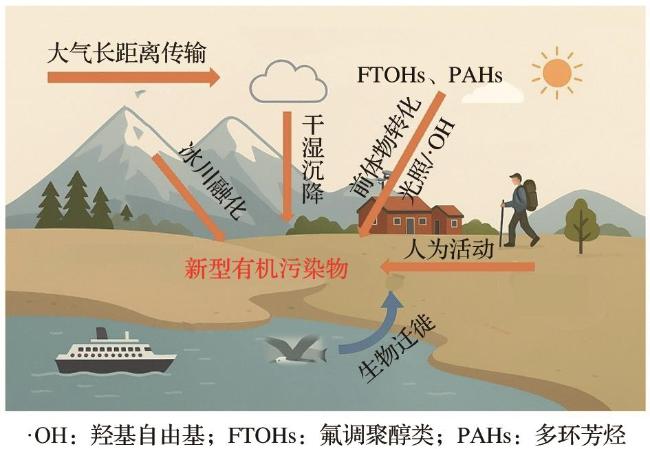
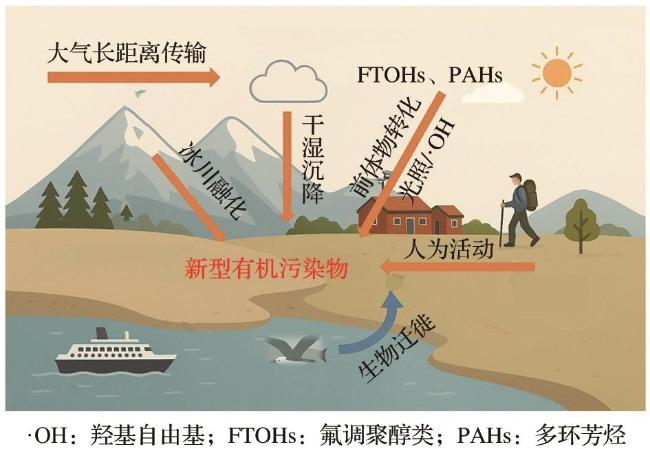
综上所述,大气长距离传输是北极陆地环境中OPEs、NBFRs和PCNs等新型有机污染物的主要传输途径,离子型PFASs因水溶性较强,主要通过洋流传输到达北极;而具有挥发性的中性PFASs(如FTOHs等)可通过大气长距离迁移至北极陆地环境。季节性生物的迁徙也可携带污染物进入北极陆地环境。同时,人为活动的增加使本地源贡献增加,全球变暖背景下二次释放对北极陆地环境新型有机污染物的贡献不容忽视。不同污染物的传输路径与污染物的物理化学性质密切相关。北极陆地环境中新型有机污染物的传输和来源如图2所示。
图2 北极陆地环境新型有机污染物的传输和来源示意图

Fig. 2 Schematic diagram of emerging organic pollutant transport and sources in Arctic terrestrial environments

4 环境影响

新型有机污染物在北极陆地环境介质中整体浓度较低,但生物富集或放大可能使其在高营养级生物或北极原住民体内浓度升高并产生潜在风险。以下主要从新型有机污染物在植被中的富集规律、生物体中的富集和放大以及原住民的暴露水平等方面出发,评估其生态风险和健康影响,为北极陆地环境的污染防控提供科学依据。

4.1 植被富集

北极斯瓦尔巴地区的地衣、北极柳和石楠等植被中Σ20PFASs、Σ10OPEs和Σ75PCNs的浓度分别为0.11~16.3 ng/g dw(2.93±4.64 ng/g dw)51、6.86~236 ng/g dw(70.0 ng/g dw)28和0.077~0.87 ng/g dw100。加拿大育空地区和努纳武特地区植被中Σ16PFASs的浓度为0.02~0.26 ng/g ww55。3个地区不同植被中PFASs的浓度有1个数量级的差别,其中地衣中浓度都相对更高,可能是因为地衣没有根,污染物的主要来源为大气直接输入。PFOA是3个地区的优势单体,PFCAs更是占北极斯瓦尔巴地区PFASs的95.6%51。在加拿大Bathurst地区的地衣、苔藓和北极柳等植被中可检出的NBFRs的主要单体为2,4,6-三溴苯基烯丙基醚(2-Allyloxy-1,3,5-tribromobenzene,TBP-AE)(10 ng/g lw)(lw为脂重)和PBBz(0.72 ng/g lw),浓度高于PBDEs浓度(0.82~5.5 ng/g lw)19。新型有机污染物在植被中的赋存特征反映了多种环境过程的综合影响,与大气长距离传输和本地来源密切相关,也受到污染物长距离传输的组分分馏和植被选择性吸收的影响。
目前,已在北极地区检测到OPEs28、PFASs51和PCNs100等多种新型有机污染物在植被中积累,其生物富集系数(Bioconcentration Factors,BCF)存在显著差异。在北极斯瓦尔巴地区OPEs、PCNs和PFASs的BCF分别为2.08~21.30、2.10~8.60和0.22~12.00。新型有机污染物从土壤到植被的富集主要与其log K OW和log K OA相关。Dong等100研究发现,在斯瓦尔巴地区PCNs(log K OW:3.93~6.68)在植被中的log BCF与log K OW呈正相关关系,而对于OPEs(log K OW:0.8~9.5)二者呈抛物线关系,在log K OW约为6时达到峰值28,SCCPs和PFASs的log K OW随碳链增长而增加,因此其从土壤到植被中的富集与碳链长度显著相关124。植被中的污染物除了从土壤中富集,也可从大气中吸收,因此植被的BCF也与污染物的log K OA相关。基于北极地区植被对土壤中污染物较高的富集系数,植被富集可能是北极陆地生态系统中新型有机污染物重要的迁移和归趋途径。

4.2 生物富集与放大

新型有机污染物在北极陆地环境生物体中的浓度水平和单体组成与环境介质中的浓度存在一定差异,在不同地区、物种和组织之间也存在差异。PFASs在北极陆地包括斯瓦尔巴地区、格陵兰岛、法罗群岛和努纳武特等地区的淡水鱼类、鸟类、驯鹿和狼等生物中的浓度为几到几百ng/g ww12-14,主要单体为碳链数>8的PFCAs和PFOS。通常环境中PFOA和PFOS占比更大,但生物体中则以碳链数>8的PFCAs为主,又因PFSAs比PFCAs具有更高的生物可利用性,PFOS在生物中的浓度相较PFOA更高。同样的,碳链数>8的PFCAs在生物体中具有更高的生物放大效应,如努纳武特地区的地衣—驯鹿—狼食物链中C9~C12的PFCAs和PFOS具有显著的生物放大效应18。区域对比研究发现,法罗群岛鳟鱼肝脏中PFASs的浓度比北极红点鲑肝脏的高1~3倍12,比努纳武特机场下游区域2个湖泊的北极红点鲑的浓度高1~2个数量级65,表明局部人为活动对PFASs在生物体中的浓度水平具有显著影响。值得注意的是,斯瓦尔巴群岛北极狐肝脏中其他OPEs的单体浓度与鸟类的浓度相似,但TBOEP浓度较其他单体高2个数量级(955.09 ng/g lw)121,可能是因TBOEP受本地源影响较大。NBFRs在格陵兰岛16、加拿大北极地区15和挪威熊岛125等地的鸟类和驯鹿等生物体中的浓度一般为几个ng/g lw(或ww),其中TBP-AE和PBBz的K OW与一些生物积累性更强的PBDEs相近,但根据不同饮食结构计算的生物放大系数(Biomagnification Factors,BMF)较小(0.072~3.7)19,这可能是因为其可在生物体内脱溴代谢126-127。新型有机污染物在生物体中的浓度水平和单体组成受污染物在环境中的浓度水平、污染物的生物可利用性和生物体对其代谢的共同影响,需综合考虑来评估污染物的生态风险。
新型有机污染物的生物放大与物种、组织和污染物类型相关。努纳武特地区红点鲑中PFASs浓度与δ15N呈负相关,表明PFASs没有随营养级增大而发生生物放大65,可能是因为PFASs可通过鱼鳃排出体外51。在加拿大育空地区和努纳武特地区植被—驯鹿的PFASs中65,驯鹿肝脏和肌肉组织中不同单体的BMF分别为11~110和0.9~5.2,驯鹿到狼的BMF为2.1~5.4,这种组织间差异可能是因为肝脏作为主要的代谢器官具有更高的蛋白质结合能力。但该地区的TBP-AE和PBBz的BMF(0.34~5.2)在统计上并不显著,可能是因为其在生物体中的脱溴反应导致了代谢程度的差异18。以上研究表明,新型有机污染物在北极陆地环境中的生物放大需结合污染物的特性、代谢途径以及食物网类型综合评估。
新型有机污染物在生物体中的富集可能导致多种环境风险。研究报道PFDoDA和PFTrDA等PFASs单体与海鸟体内的甲状腺激素正相关128,可能会干扰海鸟的内分泌功能。新型有机污染物还可通过母体转移,北极斯瓦尔巴地区的海鸟蛋中PFASs的浓度是母体血浆中浓度的2~3倍,且母体转移率随碳链长度增加而增加14,北美波罗的海的鲱鱼和海鸠之间的母体转移也表现出相似的规律129-130。在北极陆地环境的典型食物链植被—驯鹿—狼中,PFCAs和PFOS的营养级放大因子(Trophic Magnification Factors,TMF)分别为2.2~2.9和2.3~2.6,具有明显的食物链放大效应18。已在北极原住民体中检出新型有机污染物,如努纳武特地区因纽特人血浆中可检出较高浓度的PFASs,其中PFOS浓度范围为0.480~470 ng/mL131-132,高于中国济南健康老年人全血中Σ18PFASs的浓度(5.0~135.9 ng/mL)133。此外,该地区原住民尿液中OPEs的浓度与加拿大普通人群相似或略低,并检出了OPEs的代谢物134。这表明北极陆地环境中的新型有机污染物已进入人体,并可能代谢为毒性更强的污染物。以上研究表明,新型有机污染物已在北极陆地生态系统中形成完整的暴露链条,其通过生物放大和母体转移的积累效应,不仅威胁野生动物种群健康,更对北极原住民构成潜在风险。

5 总结与展望

本文综述了OPEs、PFASs、NBFRs和PCNs等新型有机污染物在北极陆地环境中的赋存、来源以及生态环境和健康影响。研究表明,上述新型有机污染物在北极陆地环境介质和生物体中广泛存在,主要来源于大气长距离传输、前体物的转化、人为活动和动物迁徙产生的局部来源,气候变化导致的二次释放也使得污染物来源更加复杂。新型有机污染物在北极陆地环境通过生物富集、营养级放大效应以及人体暴露等多种途径对生态环境和人体健康带来潜在风险。
尽管相关研究已取得了长足进展,但有关北极陆地环境中新型有机污染物的研究仍存在不足。现有研究多局限于单介质或单污染物,缺乏对多种污染物协同作用下生态风险的系统评估;研究覆盖的新型有机污染物种类有限,部分潜在高毒性或浓度水平更高的污染物数据缺乏;气候变化背景下新型有机污染物的动态归趋研究亟待加强;对生物体间的传递、代谢产物毒性及原住民健康影响的系统研究仍显不足。基于上述不足,提出以下展望:
(1)开展新型有机污染物在多介质环境中的迁移转化和归趋研究,结合食物网结构解析其在生物体中的营养级转移和多种污染物影响下的复合生态风险。
(2)扩展污染物筛查与分析范围,结合非靶向筛查与高分辨质谱等先进分析技术,识别与分析北极陆地环境中浓度水平更高或毒性更强的污染物(如PHCZs和OPEs的代谢物、更短链的PFASs和更长链的石蜡等替代物)。
(3)结合逸度模型和通量估算等方法量化冰川融水和冻土退化等引发的新型有机污染物的二次释放,模拟不同增温情景下新型有机污染物的再迁移规律及生态风险。
(4)构建新型有机污染物在生物体内的全链条评估体系,通过不同暴露方式追踪污染物从环境介质到生物体的传递路径,开展污染物在生物体及人体内的代谢转化规律研究,结合流行病学调查,评估其对原住民的健康影响。
[1]
LIANG C ZENG M X YUAN X Z, et al. An overview of current knowledge on organophosphate di-esters in environment: analytical methods, sources, occurrence, and behavior[J]. Science of the Total Environment2024, 906. DOI:10.1016/j.scitotenv.2023.167656 .

[2]
XIE Z Y ZHANG P WU Z L, et al. Legacy and emerging organic contaminants in the polar regions[J]. Science of the Total Environment2022, 835. DOI:10.1016/j.scitotenv.2022.155376 .

[3]
FU J FU K H CHEN Y, et al. Long-range transport, trophic transfer, and ecological risks of organophosphate esters in remote areas[J]. Environmental Science & Technology202155(15): 10 192-10 209.

[4]
XIONG P YAN X T ZHU Q Q, et al. A review of environmental occurrence, fate, and toxicity of novel brominated flame retardants[J]. Environmental Science & Technology201953(23): 13 551-13 569.

[5]
MACDONALD R W HARNER T FYFE J. Recent climate change in the Arctic and its impact on contaminant pathways and interpretation of temporal trend data[J]. Science of the Total Environment2005342(1/2/3): 5-86.

[6]
EWALD G LARSSON P LINGE H, et al. Biotransport of organic pollutants to an inland Alaska Lake by migrating sockeye salmon (Oncorhynchus nerka)[J]. Arctic199851(1): 40-47.

[7]
JOERSS H XIE Z Y WAGNER C C, et al. Transport of legacy perfluoroalkyl substances and the replacement compound HFPO-DA through the Atlantic gateway to the Arctic Ocean—Is the Arctic a sink or a source?[J]. Environmental Science & Technology202054(16): 9 958-9 967.

[8]
MA Y X XIE Z Y HALSALL C, et al. The spatial distribution of organochlorine pesticides and halogenated flame retardants in the surface sediments of an Arctic fjord: the influence of ocean currents vs. glacial runoff[J]. Chemosphere2015119: 953-960.

[9]
CASAL P CASAS G VILA-COSTA M, et al. Snow amplification of persistent organic pollutants at coastal Antarctica[J]. Environmental Science & Technology201953(15): 8 872-8 882.

[10]
WANIA F MACKAY D. Peer reviewed: tracking the distribution of persistent organic pollutants[J]. Environmental Science & Technology199630(9): 390A-396A.

[11]
GALBÁN-MALAGÓN C BERROJALBIZ N OJEDA M J, et al. The oceanic biological pump modulates the atmospheric transport of persistent organic pollutants to the Arctic[J]. Nature Communications2012, 3. DOI: 10.1038/ncomms1858 .

[12]
BOSSI R, DAM M, RIGÉT F F. Perfluorinated Alkyl Substances (PFAS) in terrestrial environments in Greenland and Faroe Islands[J]. Chemosphere2015129: 164-169.

[13]
LÉANDRI-BRETON D J JOUANNEAU W LEGAGNEUX P, et al. Winter tracking data suggest that migratory seabirds transport per- and polyfluoroalkyl substances to their Arctic nesting site[J]. Environmental Science & Technology202458(29): 12 909-12 920.

[14]
JOUANNEAU W LÉANDRI-BRETON D J CORBEAU A, et al. A bad start in life?Maternal transfer of legacy and emerging poly- and perfluoroalkyl substances to eggs in an Arctic seabird[J]. Environmental Science & Technology202256(10): 6 091-6 102.

[15]
VERREAULT J LETCHER R J GENTES M L, et al. Unusually high Deca-BDE concentrations and new flame retardants in a Canadian Arctic top predator, the glaucous gull[J]. Science of the Total Environment2018639: 977-987.

[16]
VORKAMP K BOSSI R RIGÉT F F, et al. Novel brominated flame retardants and dechlorane plus in Greenland air and biota[J]. Environmental Pollution2015196: 284-291.

[17]
BRAUNE B M MUIR D C G. Declining trends of polychlorinated naphthalenes in seabird eggs from the Canadian Arctic, 1975-2014[J]. Environmental Science & Technology201751(7): 3 802-3 808.

[18]
MÜLLER C E de SILVA A O SMALL J, et al. Biomagnification of perfluorinated compounds in a remote terrestrial food chain: lichen-caribou-wolf[J]. Environmental Science & Technology201145(20): 8 665-8 673.

[19]
MORRIS A D MUIR D C G SOLOMON K R, et al. Bioaccumulation of polybrominated diphenyl ethers and alternative halogenated flame retardants in a vegetation-caribou-wolf food chain of the Canadian Arctic[J]. Environmental Science & Technology201852(5): 3 136-3 145.

[20]
MUIR D GUNNARSDÓTTIR M J KOZIOL K, et al. Local sources versus long-range transport of organic contaminants in the Arctic: future developments related to climate change[J]. Environmental Science: Advances20254(3): 355-408.

[21]
HARTZ W F BJÖRNSDOTTER M K YEUNG L W Y, et al. Sources and seasonal variations of per- and Polyfluoroalkyl Substances (PFAS) in surface snow in the Arctic[J]. Environmental Science & Technology202458(49): 21 817-21 828.

[22]
BJÖRNSDOTTER M K HARTZ W F KALLENBORN R, et al. Levels and seasonal trends of C1-C4 perfluoroalkyl acids and the discovery of trifluoromethane sulfonic acid in surface snow in the Arctic[J]. Environmental Science & Technology202155(23): 15 853-15 861.

[23]
SUN Y X de SILVA A O PIERRE K A ST, et al. Glacial melt inputs of organophosphate ester flame retardants to the largest high Arctic Lake[J]. Environmental Science & Technology202054(5): 2 734-2 743.

[24]
MACINNIS J de SILVA A O LEHNHERR I, et al. Investigation of perfluoroalkyl substances in proglacial rivers and permafrost seep in a high Arctic watershed[J]. Environmental Science Processes & Impacts202224(1): 42-51.

[25]
MCDONOUGH C A de SILVA A O SUN C X, et al. Dissolved organophosphate esters and polybrominated diphenyl ethers in remote marine environments: Arctic surface water distributions and net transport through fram strait[J]. Environmental Science & Technology201852(11): 6 208-6 216.

[26]
XIE J Q ZHANG G X CHEN C C, et al. Tracing organophosphate ester pollutants in hadal Trenches—distribution, possible origins, and transport mechanisms[J]. Environmental Science & Technology202458(9): 4 392-4 403.

[27]
HAN X LI W H ZHAO Y J, et al. Organophosphate esters in building materials from China: levels, sources, emissions, and preliminary assessment of human exposure[J]. Environmental Science & Technology202458(5): 2 434-2 445.

[28]
DONG C DAI S Y WU Y T, et al. Bioaccumulation and trophic transfer of Organophosphate Esters (OPEs) in Arctic terrestrial and benthic marine ecosystems[J]. Environmental Science & Technology202559(17): 8 703-8 713.

[29]
DONG C ZHANG G X PEI Z G, et al. Organophosphate esters in terrestrial environments of fildes peninsula, Antarctica: occurrence, potential sources, and bioaccumulation[J]. Journal of Hazardous Materials2024, 478. DOI:10.1016/j.jhazmat.2024.135519 .

[30]
CHEN Y XIAN H ZHU C C, et al. The transport and distribution of Novel Brominated Flame Retardants (NBFRs) and Organophosphate Esters (OPEs) in soils and moss along mountain valleys in the Himalayas[J]. Journal of Hazardous Materials2024, 465. DOI:10.1016/j.jhazmat.2023.133044 .

[31]
ZHANG Q Y WANG Y ZHANG C, et al. A review of organophosphate esters in soil: implications for the potential source, transfer, and transformation mechanism[J]. Environmental Research2022, 204. DOI:10.1016/j.envres.2021.112122 .

[32]
LI Y M XIONG S Y HAO Y F, et al. Organophosphate esters in Arctic air from 2011 to 2019: concentrations, temporal trends, and potential sources[J]. Journal of Hazardous Materials2022, 434. DOI:10.1016/j.jhazmat.2022.128872 .

[33]
HAN X HAO Y F LI Y M, et al. Occurrence and distribution of organophosphate esters in the air and soils of Ny-Ålesund and London Island, Svalbard, Arctic[J]. Environmental Pollution2020, 263. DOI:10.1016/j.envpol.2020.114495 .

[34]
LI J XIE Z Y MI W Y, et al. Organophosphate esters in air, snow, and seawater in the north Atlantic and the Arctic[J]. Environmental Science & Technology201751(12): 6 887-6 896.

[35]
FAN Q Y HUANG S E GUO J X, et al. Spatiotemporal distribution and transport flux of organophosphate esters in the sediment of the Yangtze River[J]. Journal of Hazardous Materials2024, 477. DOI:10.1016/j.jhazmat.2024.135312 .

[36]
PRATS R M van DROOGE B L FERNÁNDEZ P, et al. Occurrence and temperature dependence of atmospheric gas-phase organophosphate esters in high-mountain areas (Pyrenees)[J]. Chemosphere2022, 292. DOI:10.1016/j.chemosphere.2021.133467 .

[37]
MA Y X XIE Z Y LOHMANN R, et al. Organophosphate ester flame retardants and plasticizers in ocean sediments from the north Pacific to the Arctic Ocean[J]. Environmental Science & Technology201751(7): 3 809-3 815.

[38]
SÜHRING R DIAMOND M L SCHERINGER M, et al. Organophosphate esters in Canadian Arctic air: occurrence, levels and trends[J]. Environmental Science & Technology201650(14): 7 409-7 415.

[39]
LI R J GAO H HOU C, et al. Occurrence, source, and transfer fluxes of organophosphate esters in the South Pacific and Fildes Peninsula, Antarctic[J]. Science of the Total Environment2023, 894. DOI:10.1016/j.scitotenv.2023.164263 .

[40]
PRATS R M van DROOGE B L FERNÁNDEZ P, et al. Passive water sampling and air-water diffusive exchange of long-range transported semi-volatile organic pollutants in high-mountain lakes[J]. The Science of the Total Environment2023, 860. DOI:10.1016/j.scitotenv.2022.160509 .

[41]
WANG Y S ZHAO Y J HAN X, et al. A review of organophosphate esters in aquatic environments: levels, distribution, and human exposure[J]. Water202315(9). DOI:10.3390/w15091790 .

[42]
GAO X Z XU Y P MA M, et al. Distribution, sources and transport of organophosphorus flame retardants in the water and sediment of Ny-Ålesund, Svalbard, the Arctic[J]. Environmental Pollution2020, 264. DOI:10.1016/j.envpol.2020.114792 .

[43]
MA Y X LUO Y C ZHU J C, et al. Seasonal variation and deposition of atmospheric organophosphate esters in the coastal region of Shanghai, China[J]. Environmental Pollution2022, 300. DOI:10.1016/j.envpol.2022.118930 .

[44]
HAO Y F XIONG S Y WANG P, et al. Novel brominated and organophosphate flame retardants in the atmosphere of Fildes Peninsula, West Antarctica: continuous observations from 2011 to 2020[J]. Journal of Hazardous Materials2022, 440. DOI:10.1016/j.jhazmat.2022.129776 .

[45]
FU J FU K H HU B Y, et al. Source identification of organophosphate esters through the profiles in proglacial and ocean sediments from Ny-Ålesund, the Arctic[J]. Environmental Science & Technology202357(5): 1 919-1 929.

[46]
HE J H LI J F MA L Y, et al. Large-scale distribution of organophosphate esters (flame retardants and plasticizers) in soil from residential area across China: implications for current level[J]. Science of the Total Environment2019, 697. DOI:10.1016/j.scitotenv.2019.133997 .

[47]
SALAMOVA A HERMANSON M H HITES R A. Organophosphate and halogenated flame retardants in atmospheric particles from a European Arctic site[J]. Environmental Science & Technology201448(11): 6 133-6 140.

[48]
OKEME J O RODGERS T F M JANTUNEN L M, et al. Examining the gas-particle partitioning of organophosphate esters: how reliable are air measurements?[J]. Environmental Science & Technology201852(23): 13 834-13 844.

[49]
SALAMOVA A MA Y N VENIER M, et al. High levels of organophosphate flame retardants in the great lakes atmosphere[J]. Environmental Science & Technology Letters20141(1): 8-14.

[50]
WANG C WANG P ZHAO J P, et al. Atmospheric organophosphate esters in the western Antarctic Peninsula over 2014-2018: occurrence, temporal trend and source implication[J]. Environmental Pollution2020, 267. DOI:10.1016/j.envpol.2020.115428 .

[51]
DAI S Y ZHANG G X DONG C, et al. Occurrence, bioaccumulation and trophodynamics of per- and Polyfluoroalkyl Substances (PFAS) in terrestrial and marine ecosystems of Svalbard, Arctic[J]. Water Research2025, 271. DOI:10.1016/j.watres.2024.122979 .

[52]
RANKIN K MABURY S A JENKINS T M, et al. A North American and global survey of perfluoroalkyl substances in surface soils: distribution patterns and mode of occurrence[J]. Chemosphere2016161: 333-341.

[53]
HUANG K LI Y L BU D, et al. Trophic magnification of short-chain per- and polyfluoroalkyl substances in a terrestrial food chain from the Tibetan Plateau[J]. Environmental Science & Technology Letters20229(2): 147-152.

[54]
XU C Y XU C M ZHOU Q, et al. Spatial distribution, isomer signature and air-soil exchange of legacy and emerging poly- and perfluoroalkyl substances[J]. Environmental Pollution2024, 343. DOI:10.1016/j.envpol.2023.123222 .

[55]
CABRERIZO A MUIR D C G de SILVA A O, et al. Legacy and emerging Persistent Organic Pollutants (POPs) in terrestrial compartments in the high Arctic: sorption and secondary sources[J]. Environmental Science & Technology201852(24): 14 187-14 197.

[56]
STOCK N L FURDUI V I MUIR D C G, et al. Perfluoroalkyl contaminants in the Canadian Arctic: evidence of atmospheric transport and local contamination[J]. Environmental Science & Technology200741(10): 3 529-3 536.

[57]
CAI M H XIE Z Y MÖLLER A, et al. Polyfluorinated compounds in the atmosphere along a cruise pathway from the Japan Sea to the Arctic Ocean[J]. Chemosphere201287(9): 989-997.

[58]
del VENTO S HALSALL C GIOIA R, et al. Volatile per- and polyfluoroalkyl compounds in the remote atmosphere of the western Antarctic Peninsula: an indirect source of perfluoroalkyl acids to Antarctic waters?[J]. Atmospheric Pollution Research20123(4): 450-455.

[59]
XU Z L LI L X Y HENKELMANN B, et al. Occurrence of fluorotelomer alcohols at two Alpine summits: sources, transport and temporal trends[J]. Environmental Chemistry201714(4): 215-223.

[60]
LI J del VENTO S SCHUSTER J, et al. Perfluorinated compounds in the Asian atmosphere[J]. Environmental Science & Technology201145(17): 7 241-7 248.

[61]
BOSSI R VORKAMP K SKOV H. Concentrations of organochlorine pesticides, polybrominated diphenyl ethers and perfluorinated compounds in the atmosphere of North Greenland[J]. Environmental Pollution2016217: 4-10.

[62]
CAI M H YANG H Z XIE Z Y, et al. Per- and polyfluoroalkyl substances in snow, lake, surface runoff water and coastal seawater in Fildes Peninsula, King George Island, Antarctica[J]. Journal of Hazardous Materials2012209: 335-342.

[63]
CHEN M K WANG C F WANG X P, et al. Release of perfluoroalkyl substances from melting glacier of the Tibetan Plateau: insights into the impact of global warming on the cycling of emerging pollutants[J]. Journal of Geophysical Research: Atmospheres2019124(13): 7 442-7 456.

[64]
LI J LI X L ZHU Y, et al. The first survey of legacy and emerging per- and Polyfluoroalkyl Substances (PFAS) in Hulun Lake, China: Occurrence, sources, and environmental impacts[J]. Emerging Contaminants202511(1). DOI:10.1016/j.emcon.2024.100431 .

[65]
LESCORD G L KIDD K A de SILVA A O, et al. Perfluorinated and polyfluorinated compounds in lake food webs from the Canadian high Arctic[J]. Environmental Science & Technology201549(5): 2 694-2 702.

[66]
KWOK K Y YAMAZAKI E YAMASHITA N, et al. Transport of Perfluoroalkyl Substances (PFAS) from an Arctic glacier to downstream locations: implications for sources[J]. Science of the Total Environment2013447: 46-55.

[67]
SARITHA V K KRISHNAN K P MOHAN M. Perfluorooctanoic acid in the sediment matrices of Arctic fjords, Svalbard[J]. Marine Pollution Bulletin2023, 192. DOI:10.1016/j.marpolbul.2023.115061 .

[68]
AWAD E ZHANG X M BHAVSAR S P, et al. Long-term environmental fate of perfluorinated compounds after accidental release at Toronto airport[J]. Environmental Science & Technology201145(19): 8 081-8 089.

[69]
LI T Y CHEN Y L WANG Y L, et al. Occurrence, source apportionment and risk assessment of perfluorinated compounds in sediments from the longest river in Asia[J]. Journal of Hazardous Materials2024, 467. DOI:10.1016/j.jhazmat.2024.133608 .

[70]
WONG F SHOEIB M KATSOYIANNIS A, et al. Assessing temporal trends and source regions of per- and Polyfluoroalkyl Substances (PFASs) in air under the Arctic Monitoring and Assessment Programme (AMAP)[J]. Atmospheric Environment2018172: 65-73.

[71]
PERSAUD D CRISCITIELLO A S SPENCER C, et al. A 50 year record for perfluoroalkyl acids in the high Arctic: implications for global and local transport[J]. Environmental Science Processes & Impacts202426(9): 1 543-1 555.

[72]
HARTZ W F BJÖRNSDOTTER M K YEUNG L W Y, et al. Levels and distribution profiles of per- and Polyfluoroalkyl Substances (PFAS) in a high Arctic Svalbard ice core[J]. Science of the Total Environment2023, 871. DOI:10.1016/j.scitotenv.2023.161830 .

[73]
MACINNIS J J FRENCH K MUIR D C G, et al. Emerging investigator series: a 14-year depositional ice record of perfluoroalkyl substances in the High Arctic[J]. Environmental Science Processes & Impacts201719(1): 22-30.

[74]
PICKARD H M CRISCITIELLO A S SPENCER C, et al. Continuous non-marine inputs of per- and polyfluoroalkyl substances to the High Arctic: a multi-decadal temporal record[J]. Atmospheric Chemistry and Physics201818(7): 5 045-5 058.

[75]
KIRCHGEORG T DREYER A GABRIELLI P, et al. Seasonal accumulation of persistent organic pollutants on a high altitude glacier in the Eastern Alps[J]. Environmental Pollution2016218: 804-812.

[76]
XIE Z Y WANG Z MAGAND O, et al. Occurrence of legacy and emerging organic contaminants in snow at Dome C in the Antarctic[J]. Science of the Total Environment2020, 741. DOI:10.1016/j.scitotenv.2020.140200 .

[77]
YOUNG C J FURDUI V I FRANKLIN J, et al. Perfluorinated acids in Arctic snow: new evidence for atmospheric formation[J]. Environmental Science & Technology200741(10): 3 455-3 461.

[78]
BENSKIN J P PHILLIPS V st LOUIS V L, et al. Source elucidation of perfluorinated carboxylic acids in remote alpine lake sediment cores[J]. Environmental Science & Technology201145(17): 7 188-7 194.

[79]
WANG Z Y COUSINS I T SCHERINGER M, et al. Global emission inventories for C4-C14 Perfluoroalkyl carboxylic acid (PFCA) homologues from 1951 to 2030, part I: production and emissions from quantifiable sources[J]. Environment International201470: 62-75.

[80]
LI L ZHAI Z H LIU J G, et al. Estimating industrial and domestic environmental releases of perfluorooctanoic acid and its salts in China from 2004 to 2012[J]. Chemosphere2015129: 100-109.

[81]
MACINNIS J J LEHNHERR I MUIR D C G, et al. Characterization of perfluoroalkyl substances in sediment cores from High and Low Arctic lakes in Canada[J]. Science of the Total Environment2019666: 414-422.

[82]
PICKARD H M CRISCITIELLO A S PERSAUD D, et al. Ice core record of persistent short-chain fluorinated alkyl acids: evidence of the impact from global environmental regulations[J]. Geophysical Research Letters202047(10). DOI:10.1029/2020GL087535 .

[83]
BEZEAU P SHARP M BURGESS D, et al. Firn profile changes in response to extreme 21st-century melting at Devon Ice Cap, Nunavut, Canada[J]. Journal of Glaciology201359(217): 981-991.

[84]
WANG R CHENG H G BIAN Z Y. Global occurrence and environmental behavior of novel brominated flame retardants in soils: current knowledge and future perspectives[J]. Journal of Hazardous Materials2024, 480. DOI:10.1016/j.jhazmat.2024.136298 .

[85]
HAO Y F MENG W Y LI Y M, et al. Concentrations and distribution of novel brominated flame retardants in the atmosphere and soil of Ny-Ålesund and London Island, Svalbard, Arctic[J]. Journal of Environmental Sciences202097: 180-185.

[86]
WANG Z NA G S MA X D, et al. Characterizing the distribution of selected PBDEs in soil, moss and reindeer dung at Ny-Ålesund of the Arctic[J]. Chemosphere2015137: 9-13.

[87]
XIONG S Y HAO Y F LI Y M, et al. Accumulation and influencing factors of novel brominated flame retardants in soil and vegetation from Fildes Peninsula, Antarctica[J]. Science of the Total Environment2021, 756. DOI:10.1016/j.scitotenv.2020.144088 .

[88]
LIU X BING H J CHEN Y Z, et al. Brominated flame retardants and dechlorane plus on a remote high mountain of the eastern Tibetan Plateau: implications for regional sources and environmental behaviors[J]. Environmental Geochemistry and Health201840(5): 1 887-1 897.

[89]
XIAN H HAO Y F LV J Y, et al. Novel Brominated Flame Retardants (NBFRs) in soil and moss in Mt. Shergyla, southeast Tibetan Plateau: occurrence, distribution and influencing factors[J]. Environmental Pollution2021, 291. DOI: 10.1016/j.envpol.2021.118252 .

[90]
IQBAL M SYED J H BREIVIK K, et al. E-waste driven pollution in Pakistan: the first evidence of environmental and human exposure to Flame Retardants (FRs) in Karachi City[J]. Environmental Science & Technology201751(23): 13 895-13 905.

[91]
MCGRATH T J BALL A S CLARKE B O. Critical review of soil contamination by Polybrominated Diphenyl Ethers (PBDEs) and Novel Brominated Flame Retardants (NBFRs): concentrations, sources and congener profiles[J]. Environmental Pollution2017230: 741-757.

[92]
MEYER T MUIR D C G TEIXEIRA C, et al. Deposition of brominated flame retardants to the devon ice cap, Nunavut, Canada[J]. Environmental Science & Technology201246(2): 826-833.

[93]
MÖLLER A XIE Z Y CABA A, et al. Organophosphorus flame retardants and plasticizers in the atmosphere of the North Sea[J]. Environmental Pollution2011159(12): 3 660-3 665.

[94]
XIAO H SHEN L SU Y S, et al. Atmospheric concentrations of halogenated flame retardants at two remote locations: the Canadian high Arctic and the Tibetan Plateau[J]. Environmental Pollution2012161: 154-161.

[95]
DAVIE-MARTIN C L HAGEMAN K J CHIN Y P, et al. Concentrations, gas-particle distributions, and source indicator analysis of brominated flame retardants in air at Toolik Lake, Arctic Alaska[J]. Environmental Science Processes & Impacts201618(10): 1 274-1 284.

[96]
GEBRU T B LI Y M DONG C, et al. Spatial and temporal trends of polychlorinated naphthalenes in the Arctic atmosphere at Ny-Ålesund and London Island, Svalbard[J]. Science of the Total Environment2023, 878. DOI:10.1016/j.scitotenv.2023.163023 .

[97]
HERBERT B M J HALSALL C J VILLA S, et al. Polychlorinated naphthalenes in air and snow in the Norwegian Arctic: a local source or an eastern Arctic phenomenon?[J]. Science of the Total Environment2005342(1/2/3): 145-160.

[98]
HELM P A BIDLEMAN T F. Gas-particle partitioning of polychlorinated naphthalenes and non- and mono-ortho-substituted polychlorinated biphenyls in Arctic air[J]. Science of the Total Environment2005342(1/2/3): 161-173.

[99]
HELM P A BIDLEMAN T F LI H H, et al. Seasonal and spatial variation of polychlorinated naphthalenes and non-/ mono-ortho-substituted polychlorinated biphenyls in Arctic air[J]. Environmental Science & Technology200438(21): 5 514-5 521.

[100]
DONG C XIONG S Y YANG R Q, et al. Polychlorinated Naphthalenes (PCNs) in soils and plants from svalbard, Arctic: levels, distribution, and potential sources[J]. The Science of the Total Environment2022, 849. DOI:10.1016/j.scitotenv.2022.157883 .

[101]
JIN R FU J J ZHENG M H, et al. Polychlorinated naphthalene congener profiles in common vegetation on the Tibetan Plateau as biomonitors of their sources and transportation[J]. Environmental Science & Technology202054(4): 2 314-2 322.

[102]
WYRZYKOWSKA B HANARI N ORLIKOWSKA A, et al. Polychlorinated biphenyls and-naphthalenes in pine needles and soil from Poland: concentrations and patterns in view of long-term environmental monitoring[J]. Chemosphere200767(9): 1 877-1 886.

[103]
LEI R R LIU W B JIA T Q, et al. Partitioning and potential sources of polychlorinated naphthalenes in water-sediment system from the Yangtze River Delta, China[J]. Chemosphere2022, 287(Pt. 3). DOI: 10.1016/j.chemosphere.2021.132265 .

[104]
BIDLEMAN T F HELM P A BRAUNE B M, et al. Polychlorinated naphthalenes in polar environments: a review[J]. Science of the Total Environment2010408(15): 2 919-2 935.

[105]
RAYNE S FOREST K FRIESEN K J. Estimated congener specific gas-phase atmospheric behavior and fractionation of perfluoroalkyl compounds: rates of reaction with atmospheric oxidants, air-water partitioning, and wet/dry deposition lifetimes[J]. Journal of Environmental Science and Health Part A, Toxic/Hazardous Substances & Environmental Engineering, 200944(10): 936-954.

[106]
van de VIJVER K I HOFF P T, DAS K, et al. Perfluorinated chemicals infiltrate ocean waters: link between exposure levels and stable isotope ratios in marine mammals[J]. Environmental Science & Technology200337(24): 5 545-5 550.

[107]
LIU Y C LIGGIO J HARNER T, et al. Heterogeneous OH initiated oxidation: a possible explanation for the persistence of organophosphate flame retardants in air[J]. Environmental Science & Technology201448(2): 1 041-1 048.

[108]
NA G S HOU C LI R J, et al. Occurrence, distribution, air-seawater exchange and atmospheric deposition of OrganophosPhate Esters (OPEs) from the Northwestern Pacific to the Arctic Ocean[J]. Marine Pollution Bulletin2020, 157. DOI:10.1016/j.marpolbul.2020.111243 .

[109]
LI C CHEN J W XIE H B, et al. Effects of atmospheric water on ·OH-initiated oxidation of organophosphate flame retardants: a DFT investigation on TCPP[J]. Environmental Science & Technology201751(9): 5 043-5 051.

[110]
MARTIN J W ELLIS D A MABURY S A, et al. Atmospheric chemistry of perfluoroalkanesulfonamides: kinetic and product studies of the OH radical and Cl atom initiated oxidation of N-ethyl perfluorobutanesulfonamide[J]. Environmental Science & Technology200640(3): 864-872.

[111]
ELLIS D A MARTIN J W de SILVA A O, et al. Degradation of fluorotelomer alcohols: a likely atmospheric source of perfluorinated carboxylic acids[J]. Environmental Science & Technology200438(12): 3 316-3 321.

[112]
RAYNE S FOREST K. Perfluoroalkyl sulfonic and carboxylic acids: a critical review of physicochemical properties, levels and patterns in waters and wastewaters, and treatment methods[J]. Journal of Environmental Science and Health Part A, Toxic/ Hazardous Substances & Environmental Engineering, 200944(12): 1 145-1 199.

[113]
YOUNG C J HURLEY M D WALLINGTON T J, et al. Atmospheric chemistry of CF3CF2H and CF3CF2CF2CF2H: kinetics and products of gas-phase reactions with Cl atoms and OH radicals, infrared spectra, and formation of perfluorocarboxylic acids[J]. Chemical Physics Letters2009473(4/5/6): 251-256.

[114]
RANTANEN M KARPECHKO A Y LIPPONEN A, et al. The Arctic has warmed nearly four times faster than the globe since 1979[J]. Communications Earth & Environment2022, 3. DOI:10.1038/s43247-022-00498-3 .

[115]
ZOU Q ZHANG Q H YANG R Q, et al. Non-negligible polyhalogenated carbazoles in Arctic soils and sediments: occurrence, target and suspect screening, and potential sources[J]. Environmental Science & Technology202458(52): 23 169-23 179.

[116]
CABRERIZO A MUIR D C G TEIXEIRA C, et al. Snow deposition and melting as drivers of polychlorinated biphenyls and organochlorine pesticides in Arctic rivers, lakes, and ocean[J]. Environmental Science & Technology201953(24): 14 377-14 386.

[117]
SÜHRING R DIAMOND M L BERNSTEIN S, et al. Organophosphate esters in the Canadian Arctic Ocean[J]. Environmental Science & Technology202155(1): 304-312.

[118]
ZHENG G M MILLER P von HIPPEL F A, et al. Legacy and emerging semi-volatile organic compounds in sentinel fish from an Arctic formerly used defense site in Alaska[J]. Environmental Pollution2020, 259. DOI:10.1016/j.envpol.2019.113872 .

[119]
GAO X Z HUANG P HUANG Q H, et al. Organophosphorus flame retardants and persistent, bioaccumulative, and toxic contaminants in Arctic seawaters: on-board passive sampling coupled with target and non-target analysis[J]. Environmental Pollution2019253: 1-10.

[120]
ROOS A M GAMBERG M MUIR D, et al. Perfluoroalkyl substances in circum-Arctic Rangifer: caribou and reindeer[J]. Environmental Science and Pollution Research International202229(16): 23 721-23 735.

[121]
HALLANGER I G SAGERUP K EVENSET A, et al. Organophosphorous flame retardants in biota from svalbard, Norway[J]. Marine Pollution Bulletin2015101(1): 442-447.

[122]
POND C M MATTACKS C A GILMOUR I, et al. Chemical and carbon isotopic composition of fatty acids in adipose tissue as indicators of dietary history in wild Arctic foxes (A lopex lagopus) on Svalbard[J]. Journal of Zoology1995236(4): 611-623.

[123]
SHA B JOHANSSON J H TUNVED P, et al. Sea Spray Aerosol (SSA) as a source of perfluoroalkyl acids (PFAAs) to the atmosphere: field evidence from long-term air monitoring[J]. Environmental Science & Technology202256(1): 228-238.

[124]
FEO M L ELJARRAT E BARCELÓ D, et al. Occurrence, fate and analysis of polychlorinated n-alkanes in the environment[J]. TrAC Trends in Analytical Chemistry200928(6): 778-791.

[125]
VERREAULT J GEBBINK W A GAUTHIER L T, et al. Brominated flame retardants in glaucous gulls from the Norwegian Arctic: more than just an issue of polybrominated diphenyl ethers[J]. Environmental Science & Technology200741(14): 4 925-4 931.

[126]
EZECHIÁŠ M COVINO S CAJTHAML T. Ecotoxicity and biodegradability of new brominated flame retardants: a review[J]. Ecotoxicology and Environmental Safety2014110: 153-167.

[127]
YAMAGUCHI Y KAWANO M TATSUKAWA R. Tissue distribution and excretion of hexabromobenzene and its debrominated metabolites in the rat[J]. Archives of Environmental Contamination and Toxicology198817(6): 807-812.

[128]
ASK A V JENSSEN B M TARTU S, et al. Per- and polyfluoroalkyl substances are positively associated with thyroid hormones in an Arctic seabird[J]. Environmental Toxicology and Chemistry202140(3): 820-831.

[129]
GEBBINK W A LETCHER R J. Comparative tissue and body compartment accumulation and maternal transfer to eggs of perfluoroalkyl sulfonates and carboxylates in Great Lakes herring gulls[J]. Environmental Pollution2012162: 40-47.

[130]
HOLMSTRÖM K E BERGER U. Tissue distribution of perfluorinated surfactants in common guillemot (Uria aalge) from the Baltic Sea[J]. Environmental Science & Technology200842(16): 5 879-5 884.

[131]
AKER A AYOTTE P CARON-BEAUDOIN É, et al. Associations between dietary profiles and perfluoroalkyl acids in Inuit youth and adults[J]. Science of the Total Environment2023, 857. DOI:10.1016/j.scitotenv.2022.159557 .

[132]
DALLAIRE R AYOTTE P PEREG D, et al. Determinants of plasma concentrations of perfluorooctanesulfonate and brominated organic compounds in Nunavik Inuit adults (Canada)[J]. Environmental Science & Technology200943(13): 5 130-5 136.

[133]
JIA X JIN Q FANG J L, et al. Emerging and legacy per- and polyfluoroalkyl substances in an elderly population in Jinan, China: the exposure level, short-term variation, and intake assessment[J]. Environmental Science & Technology202256(12): 7 905-7 916.

[134]
NERO E CARON-BEAUDOIN É AKER A, et al. Exposure to organophosphate esters among Inuit adults of nunavik, Canada[J]. Science of the Total Environment2024, 939. DOI:10.1016/j.scitotenv.2024.173563 .

文章导航

/