


1 引 言
2 极地海冰
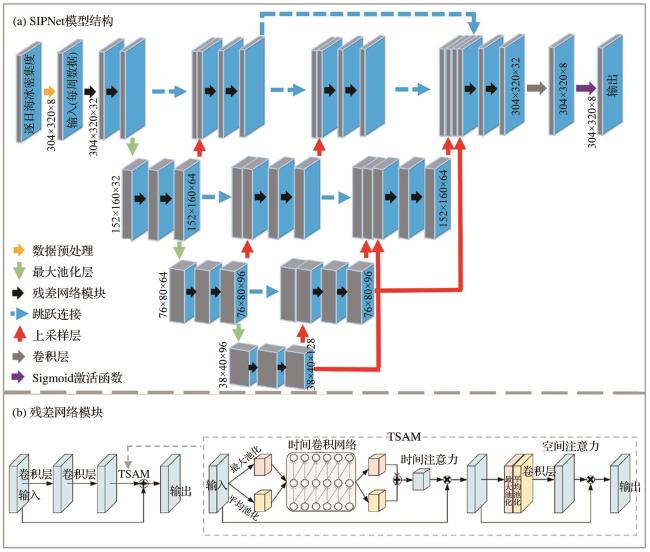
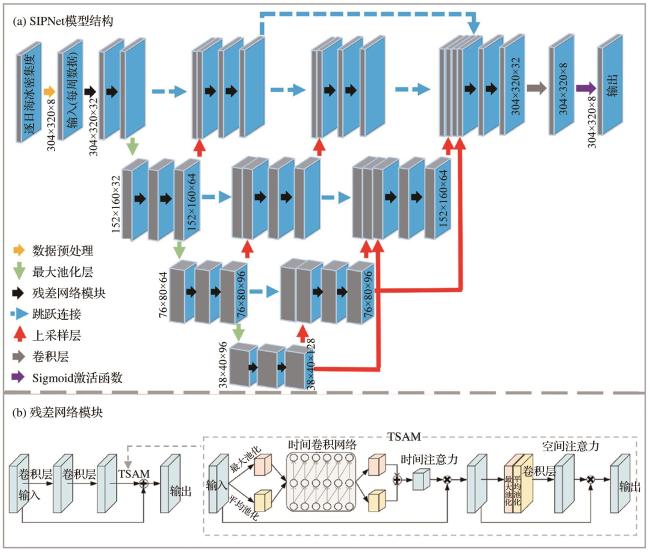
图1 SIPNet模型结构(a)包括输入、编码器、解码器和输出的模型结构,编码器模块包括残差网络模块和最大池化层,解码器由残差网络模块、上采样和串联层组成;(b)ResNet TSAM 块的结构(据参考文献[41]修改)。 Fig. 1 SIPNet model Structure (a) The model structure includes input, encoder, decoder, and output. The encoder consists of a residual network module and a max-pooling layer, while the decoder is composed of residual network modules, upsampling, and concatenation layers. (b) The structure of the ResNet TSAM block (modified after reference [41]). |
3 冰盖表面融水、表面湖与积雪含水层
4 冰盖底部融水与冰下湖
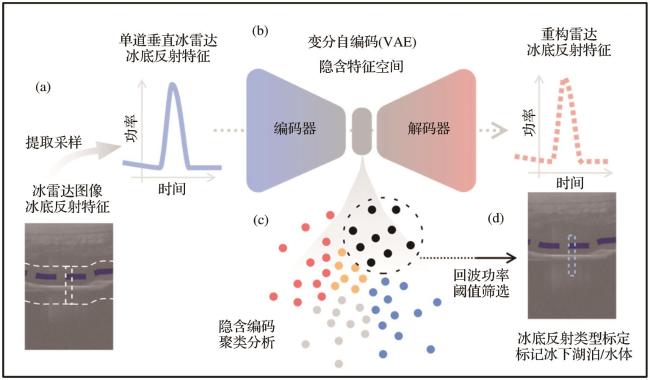
图3 冰下湖检测的流程(据参考文献[64]修改)(a)单道冰底反射特征提取;(b)变分自动编码器(VAE);(c)冰底反射降维特征聚类;(d)冰下湖标记。 Fig. 3 Flowchart of subglacial lake detection (modified after reference [64]) (a) Single-pulse ice bottom reflection feature extraction; (b) Variational AutoEncoder (VAE); (c) Dimensionality reduction and feature clustering of ice bottom reflections; (d) Subglacial lake labeling. |
5 冰架表面裂隙
6 冰盖内部冰层与冰下地形
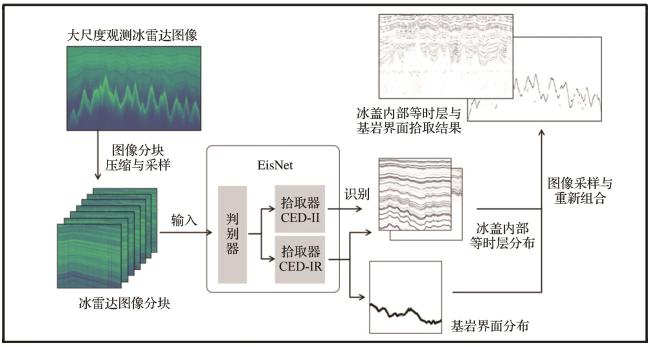
7 其他创新应用
8 讨 论
表1 中国在极地冰冻圈AI研究中的典型模型及性能对比Table 1 Comparison of typical models and performance in AI research of the polar cryosphere in China |
| | | | | | | | |
|---|---|---|---|---|---|---|---|
| | | | | | | | |
| | | | | | | | |
| | | | | | | | |
| | | | | | | | |
| | | | | | | | |
| | | | | | | | |
| | | | | | | | |
| | | | | | | | |
| | | | | | | | |
| | | | | | | | |
| | | | | | | | |
| | | | | | | | |
| | | | | | | | |
| | | | | | | | |
| | | | | | | | |
| | | | | | | | |
| | | | | | | | |
| | | | | | | | |
| | | | | | | | |
| | | | | | | | |
| | | | | | | |
|

 甘公网安备62010202000687


