藏东南地区米堆冰川表碛与退缩区重金属分布特征与风险
收稿日期: 2025-05-08
修回日期: 2025-06-12
网络出版日期: 2025-09-15
基金资助
四川省科技计划项目(2024NSFSC0839);西藏自治区财政项目(54000024T000001419692)
Distribution Characteristics and Risk of Heavy Metals in Debris and Retreat Area of Midui Glacier in Southeastern Xizang
Received date: 2025-05-08
Revised date: 2025-06-12
Online published: 2025-09-15
Supported by
the Sichuan Science and Technology Program(2024NSFSC0839);The Xizang Autonomous Region Finance Project(54000024T000001419692)
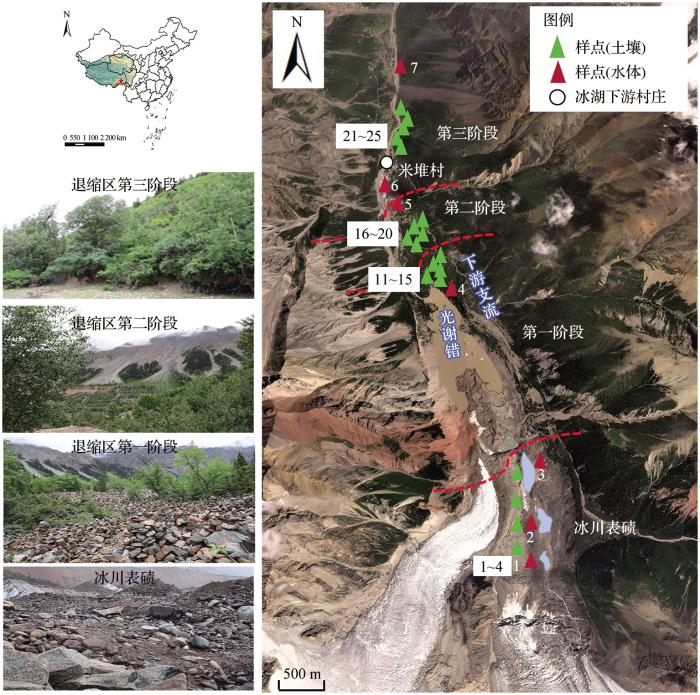
青藏高原冰川加速退缩导致冰川累积的重金属释放并发生迁移,对冰川下游生态系统与人类健康产生潜在风险,但目前针对冰川退缩区环境介质中重金属的赋存特征和生态风险的研究较为缺乏。选取藏东南海洋型冰川米堆冰川为对象,研究冰川表碛与退缩区土壤及冰川融水环境中典型重金属的分布特征与风险。结果表明,冰川表碛与退缩区土壤中重金属总含量为144.8~520.2 mg/kg,以Zn、As和Cr为主且空间变化较大,Cd和Hg含量较低。冰川从末端表碛覆盖的裸地开始,形成以沙棘和杨树为先锋树种,最终向林芝云杉和大果圆柏顶级树种过渡的演替序列。重金属含量随土壤发育、植被演替及退缩区内人类活动增加呈逐渐增加趋势,且在退缩区第三阶段重金属含量最高,多数重金属含量在不同阶段存在显著差异,与土壤pH值和碳氮磷等环境因子显著相关。冰湖至下游河流中的重金属总浓度范围为3.76~33.70 μg/L,以Zn和As为主,均远低于我国I类水限值,其中冰川观景台附近的冰前湖(光谢错)末端出口处及冰湖下游流经村庄段的重金属浓度相对较高,这与冰川区内人类活动密切相关。冰川表碛与退缩区土壤的重金属整体处于中等潜在生态风险水平,Cd和As为构成风险的主要重金属,冰湖及其下游水环境则无风险。研究结果可为进一步探究青藏高原冰川生态系统变化下重金属生物地球化学及其生态影响提供经典案例和基础数据。
雷蒙蒙 , 郑倩倩 , 胡义 , 毛雯靖 , 殷永胜 , 刘巧 , 关卓 , 鲁旭阳 , 刘琛 . 藏东南地区米堆冰川表碛与退缩区重金属分布特征与风险[J]. 地球科学进展, 2025 , 40(7) : 753 -765 . DOI: 10.11867/j.issn.1001-8166.2025.052
The accelerated retreat of glaciers on the Tibetan Plateau has led to the mobilization and downstream transport of accumulated heavy metals, posing a potential risk to downstream ecosystems and human health. However, current research on the distribution and ecological risk of heavy metals in glacier retreat areas remains limited. This study targeted the monsoon temperate Midui Glacier in southeastern Xizang China and investigated the distribution and ecological risk of typical heavy metals in its debris and soils in the retreat and water environments. The results showed that soil heavy metal content range from 144.8 to 520.0 mg/kg, which was dominated by Zn, As, and Cr, with relatively large spatial variation. The Cd and Hg concentrations were low. Soil heavy metal levels progressively increased from the debris to different stages of the retreat area, driven by soil development, vegetation succession, and intensified human activities, with the highest content observed in the third retreat stage. Most heavy metals (except Cu, Pb, and Hg) exhibited significant differences among the retreat stages but were significantly correlated with soil pH and nutrients. In glacial meltwater, the concentrations of heavy metals from proglacial lakes to downstream rivers vary between 3.76 and 33.37 μg/L, and remain well below Class I water quality standards. Notably, elevated levels were detected near the outlet of the proglacial lake (Guangxie Cuo) from the Midui Glacier viewpoint, and downstream, passing through the village, reflecting the strong influence of anthropogenic activities. The ecological risk assessment revealed that heavy metals pose a moderate potential ecological risk in soils, which are dominated by Cd and As, whereas there is no risk in the water environment. These findings offer critical baseline data and a valuable case study for understanding heavy metal biogeochemistry under glacier ecosystem changes on the Tibetan Plateau.
Key words: Midui glacier; Glacial debris; Retreat area; Heavy metals; Glacial meltwater
| [1] | ZHANG Y L, KANG S C, LUO X, et al. Microplastics and nanoplastics pose risks on the Tibetan Plateau environment[J]. Science Bulletin, 2024, 69(5): 589-592. |
| [2] | YU M W, GUO Y G, ZHANG J, et al. Spaciotemporal distribution characteristics of glacial lakes and the factors influencing the Southeast Tibetan Plateau from 1993 to 2023[J]. Scientific Reports, 2025, 15(1): 1966. DOI:10.1038/s41598-025-86546-2 . |
| [3] | LIU X L, DONG Z W, WEI T, et al. Composition, distribution, and risk assessment of heavy metals in large-scale river water on the Tibetan Plateau[J]. Journal of Hazardous Materials, 2024, 476. DOI:10.1016/j.jhazmat.2024.135094 . |
| [4] | ZABORSKA A, STRZELEWICZ A, RUDNICKA P, et al. Processes driving heavy metal distribution in the seawater of an Arctic fjord (Hornsund, southern Spitsbergen)[J]. Marine Pollution Bulletin, 2020, 161. DOI:10.1016/j.marpolbul.2020.111719 . |
| [5] | JIAO X Y, DONG Z W, KANG S C, et al. New insights into heavy metal elements deposition in the snowpacks of mountain glaciers in the eastern Tibetan Plateau[J]. Ecotoxicology and Environmental Safety, 2021, 207. DOI:10.1016/j.ecoenv.2020.111228 . |
| [6] | SUN R Y, SUN G Y, KWON S Y, et al. Mercury biogeochemistry over the Tibetan Plateau: an overview[J]. Critical Reviews in Environmental Science and Technology, 2021, 51(6): 577-602. |
| [7] | WU R, DONG Z W, WEI T, et al. Comparison on distribution and sources of typical major and toxic trace elements in various glacial watersheds of the northeast Tibetan Plateau[J]. Ecotoxicology and Environmental Safety, 2023, 263. DOI:10.1016/j.ecoenv.2023.115271 . |
| [8] | LIU Yajun, ZHANG Yulan, KANG Shichang, et al. Characteristics of heavy metal elements deposited on glaciers in the southeastern Tibetan Plateau[J]. Journal of Glaciology and Geocryology, 2017, 39(6): 1 200-1 211. |
| 刘亚军, 张玉兰, 康世昌, 等. 青藏高原东南部冰川雪冰重金属元素特征[J]. 冰川冻土, 2017, 39(6): 1 200-1 211. | |
| [9] | LIU Xiaoli, GAO Wenhua, WEI Ting, et al. Distribution characteristics of heavy metals in Tibetan Plateau surface soils and its influencing factors[J]. China Industrial Economics, 2024(4): 2 198-2 207. |
| 刘小莉, 高文华, 魏婷, 等. 青藏高原地表土壤重金属元素组成分布特征及其对周边冰川区重金属沉降的物源示踪意义[J]. 中国环境科学, 2024(4): 2 198-2 207. | |
| [10] | LI Quanlian, ZHANG Chenglong, WU Xiaobo, et al. Heavy metal geochemistry characteristics of cryoconite in glaciers in western China[J]. Geochimica, 2015, 44(3): 238-244. |
| 李全莲, 张成龙, 武小波, 等. 中国西部冰川冰尘中重金属元素的地球化学特征[J]. 地球化学, 2015, 44(3): 238-244. | |
| [11] | DONG Z W, KANG S C, QIN X, et al. New insights into trace elements deposition in the snow packs at remote alpine glaciers in the northern Tibetan Plateau, China[J]. The Science of the Total Environment, 2015, 529: 101-113. |
| [12] | WU Fei. Distribution characteristics and influencing factors of mercury in different environmental media of typical marine glaciers in Qinghai-Tibet Plateau[D]. Guiyang: Guizhou Normal University, 2021. |
| 吴飞. 青藏高原典型海洋性冰川不同环境介质中汞的分布特征及影响因素[D]. 贵阳: 贵州师范大学, 2021. | |
| [13] | MA Juanjuan, LI Zhen. Heavy metal concentrations in mosses from Qiyi Glacier region[J]. Environmental Science, 2014, 35(6): 2 060-2 066. |
| 马娟娟, 李真. 七一冰川地区苔藓中重金属元素含量研究[J]. 环境科学, 2014, 35(6): 2 060-2 066. | |
| [14] | LIU X L, GAO W H, WEI T, et al. Distribution and source of heavy metals in Tibetan Plateau topsoil: new insight into the influence of long-range transported sources to the surrounding glaciers[J]. Environmental Pollution, 2024, 346. DOI:10.1016/j.envpol.2024.123498 . |
| [15] | CHEN Yali, WENG Liping, MA Jie, et al. Review on the last ten years of research on source identification of heavy metal pollution in soils[J]. Journal of Agro-Environment Science, 2019, 38(10): 2 219-2 238. |
| 陈雅丽, 翁莉萍, 马杰, 等. 近十年中国土壤重金属污染源解析研究进展[J]. 农业环境科学学报, 2019, 38(10): 2 219-2 238. | |
| [16] | ZHANG Z S, ZHENG D M, XUE Z S, et al. Identification of anthropogenic contributions to heavy metals in wetland soils of the Karuola Glacier in the Qinghai-Tibetan Plateau[J]. Ecological Indicators, 2019, 98: 678-685. |
| [17] | DONG Z W, KANG S C, QIN D H, et al. Temporal and diurnal analysis of trace elements in the cryospheric water at remote Laohugou basin in northeast Tibetan Plateau[J]. Chemosphere, 2017, 171: 386-398. |
| [18] | LIU N T, CAI X Y, JIA L Y, et al. Quantifying mercury distribution and source contribution in surface soil of Qinghai-Tibetan Plateau using mercury isotopes[J]. Environmental Science & Technology, 2023, 57(14): 5 903-5 912. |
| [19] | CHEN Peijia, WANG Xun, WANG Dingyong. Lead sources, accumulation and historical deposition in typical glacial retreat area: a case study of Hailuogou glacial retreat area, Qinghai-Tibet Plateau[J]. China Environmental Science, 2021, 41(8): 3 704-3 713. |
| 陈霈嘉, 王训, 王定勇. 典型冰川退缩区铅的来源、累积及历史沉降: 以青藏高原海螺沟冰川退缩区为例[J]. 中国环境科学, 2021, 41(8): 3 704-3 713. | |
| [20] | GONG Dianqing, WANG Zhaofeng, ZHANG Yili, et al. Enrichment levels and source apportionment of heavy metals in grassland soil of the one river and its two tributaries in Xizang[J/OL]. Environmental Science, 2025 [2025-04-12]. . |
| 宫殿清, 王兆锋, 张镱锂, 等. 西藏一江两河地区草地土壤重金属的富集程度及其源解析[J/OL]. 环境科学, 2025 [2025-04-12]. . | |
| [21] | TIAN Y, ZHA X J, GAO X, et al. Geochemical characteristics and source apportionment of toxic elements in the Tethys-Himalaya tectonic domain, Tibet, China[J]. Science of the Total Environment, 2022, 831. DOI:10.1016/j.scitotenv.2022.154863 . |
| [22] | YE Xintong, HU Yang, LIU Qiao, et al. Characteristics of soil microbial communities in typical temperate glacial debris and retreat zones: a case study of the Azha and Midui Glaciers YE[J]. China Environmental Science, 2024, 44(9): 5 108-5 121. |
| 叶鑫彤, 胡扬, 刘巧, 等. 海洋型冰川表碛与退缩区土壤微生物群落特征——以阿扎冰川和米堆冰川为例[J]. 中国环境科学, 2024, 44(9): 5 108-5 121. | |
| [23] | MA Xinggang, WANG Shijin, QIONG Da, et al. Strategies of deep developing the glacier tourism resources in China: a case study of the Midui Glacier, Tibet[J]. Journal of Glaciology and Geocryology, 2019, 41(5): 1 264-1 270. |
| 马兴刚, 王世金, 琼达, 等. 中国冰川旅游资源深度开发路径——以西藏米堆冰川为例[J]. 冰川冻土, 2019, 41(5): 1 264-1 270. | |
| [24] | CHEN Kui, ZHOU Yonghua, ZHANG Huaijing, et al. Pollution evaluation of heavy metal element of water and surface sediment in the Dongchang Lake[J]. Periodical of Ocean University of China, 2012, 42(10): 97-105. |
| 陈奎, 周勇华, 张怀静, 等. 东昌湖水体和表层沉积物重金属元素污染评价[J]. 中国海洋大学学报(自然科学版), 2012, 42(10): 97-105. | |
| [25] | LI Ping, HUANG Yong, LIN Yun, et al. Distribution, source identification and risk assessment of heavy metals in topsoil of Huairou District in Beijing[J]. Geoscience, 2018, 32(1): 86-94. |
| 李苹, 黄勇, 林赟, 等. 北京市怀柔区土壤重金属的分布特征、来源分析及风险评价[J]. 现代地质, 2018, 32(1): 86-94. | |
| [26] | ZHANG Xiaoping. Research on the environmental background values of soils in Xizang[J]. Scientia Geographica Sinica, 1994, 14(1): 49-55, 100. |
| 张晓平. 西藏土壤环境背景值的研究[J]. 地理科学, 1994, 14(1): 49-55, 100. | |
| [27] | MA Yingqun, SHI Yao, QIN Yanwen, et al. Temporal-spatial distribution and pollution assessment of heavy metals in the upper reaches of Hunhe River(Qingyuan Section), northeast China[J]. Environmental Science, 2014, 35(1): 108-116. |
| 马迎群, 时瑶, 秦延文, 等. 浑河上游(清原段)水环境中重金属时空分布及污染评价[J]. 环境科学, 2014, 35(1): 108-116. | |
| [28] | GUO Jing, WANG Chouming, HUANG Daizhong, et al. Pollution characterization and water quality assessment of Dongting Lake[J]. Environmental Chemistry, 2019, 38(1): 152-160. |
| 郭晶, 王丑明, 黄代中, 等. 洞庭湖水污染特征及水质评价[J]. 环境化学, 2019, 38(1): 152-160. | |
| [29] | WEI T, DONG Z W, KANG S C, et al. Atmospheric deposition and contamination of trace elements in snowpacks of mountain glaciers in the northeastern Tibetan Plateau[J]. The Science of the Total Environment, 2019, 689: 754-764. |
| [30] | SHENG J J, WANG X P, GONG P, et al. Heavy metals of the Tibetan top soils[J]. Environmental Science and Pollution Research, 2012, 19(8): 3 362-3 370. |
| [31] | YANG An, WANG Yihan, HU Jian, et al. Evaluation and source of heavy metal pollution in surface soil of Qinghai-Tibet Plateau[J]. Environmental Science, 2020, 41(2): 886-894. |
| 杨安, 王艺涵, 胡健, 等. 青藏高原表土重金属污染评价与来源解析[J]. 环境科学, 2020, 41(2): 886-894. | |
| [32] | DU Haolin, WANG Ying, WANG Jinsong, et al. Distribution characteristics and ecological risk assessment of soil heavy metals in typical watersheds of the Qinghai-Tibet Plateau[J]. Environmental Science, 2021, 42(9): 4 422-4 431. |
| 杜昊霖, 王莺, 王劲松, 等. 青藏高原典型流域土壤重金属分布特征及其生态风险评价[J]. 环境科学, 2021, 42(9): 4 422-4 431. | |
| [33] | WANG G X, ZENG C, ZHANG F, et al. Traffic-related trace elements in soils along six highway segments on the Tibetan Plateau: influence factors and spatial variation[J]. The Science of the Total Environment, 2017, 581/582: 811-821. |
| [34] | Weige NAN, DONG Zhibao, XUE Liang, et al. Distribution characteristics and ecological risk assessment of heavy metals in roadside soil of important national highways on the Qinghai-Xizang Plateau[J]. Environmental Science, 2024, 45(8): 4 825-4 836. |
| 南维鸽, 董治宝, 薛亮, 等. 青藏高原重要交通国道路侧土壤重金属分布特征及生态风险评价[J]. 环境科学, 2024, 45(8): 4 825-4 836. | |
| [35] | ZHANG F, XIE Y H, PENG R, et al. Heavy metals and nutrients mediate the distribution of soil microbial community in a typical contaminated farmland of South China[J]. Science of the Total Environment, 2024, 947. DOI:10.1016/j.scitotenv.2024.174322 . |
| [36] | MA Zhiwei, ZHANG Congzhi, ZHAO Zhanhui, et al. Research progress on soil health cultivation based on woody peat[J]. Ecology and Environmental Sciences, 2024, 33(12): 1 964-1 977. |
| 马志伟, 张丛志, 赵占辉, 等. 基于木本泥炭的土壤健康培育研究进展[J]. 生态环境学报, 2024, 33(12): 1 964-1 977. | |
| [37] | BAO Y P, BOLAN N S, LAI J H, et al. Interactions between organic matter and Fe (hydr)oxides and their influences on immobilization and remobilization of metal(loid)s: a review[J]. Critical Reviews in Environmental Science and Technology, 2022, 52(22): 4 016-4 037. |
| [38] | WEI X, BAI X Y, WEN X F, et al. A large and overlooked Cd source in Karst areas: the migration and origin of Cd during soil formation and erosion[J]. The Science of the Total Environment, 2023, 895. DOI:10.1016/j.scitotenv.2023.165126 . |
| [39] | DOU Weiqiang, AN Yi, QIN Li, et al. Advances in effects of soil pH on cadmium form[J]. Soils, 2020, 52(3): 439-444. |
| 窦韦强, 安毅, 秦莉, 等. 土壤pH对镉形态影响的研究进展[J]. 土壤, 2020, 52(3): 439-444. | |
| [40] | CHENG D M, LIU X H, ZHAO S N, et al. Influence of the natural colloids on the multi-phase distributions of antibiotics in the surface water from the largest lake in North China[J]. Science of the Total Environment, 2017, 578: 649-659. |
| [41] | FAN Jingjing, WANG Sai, TANG Jinpeng, et al. Spatio-temporal patterns and environmental risk of endocrine disrupting chemicals in the Liuxi River[J]. Environmental Science, 2018, 39(3): 1 053-1 064. |
| 樊静静, 王赛, 唐金鹏, 等. 广州市流溪河水体中6种内分泌干扰素时空分布特征与环境风险[J]. 环境科学, 2018, 39(3): 1 053-1 064. | |
| [42] | XU Z, MI W B, MI N, et al. Characteristics and sources of heavy metal pollution in desert steppe soil related to transportation and industrial activities[J]. Environmental Science and Pollution Research International, 2020, 27(31): 38 835-38 848. |
| [43] | HAN Lin, XU Xibo. Quantitative evaluation of human health risk of heavy metals in soils based on positive matrix factorization model and geo-statistics[J]. Environmental Science, 2020, 41(11): 5 114-5 124. |
| 韩琳, 徐夕博. 基于PMF模型及地统计的土壤重金属健康风险定量评价[J]. 环境科学, 2020, 41(11): 5 114-5 124. | |
| [44] | DU Jia, WANG Yonghong, HUANG Qinghui, et al. Temporal and spatial characteristics of heavy metals in suspended particulate matter in Pearl River Estuary and its influencing factors[J]. Environmental Science, 2019, 40(2): 625-632. |
| 杜佳, 王永红, 黄清辉, 等. 珠江河口悬浮物中重金属时空变化特征及其影响因素[J]. 环境科学, 2019, 40(2): 625-632. | |
| [45] | YANG Wenqiang, ZENG Xiwen, Zhan Lü, et al. Distribution, accumulation and sources of chromium in Hailuogou glacier retreated area[J]. China Environmental Science, 2022, 42(11): 5 229-5 238. |
| 杨闻强, 曾熙雯, 吕展, 等. 海螺沟冰川退缩区中铬的分布、累积与来源[J]. 中国环境科学, 2022, 42(11): 5 229-5 238. | |
| [46] | SHU Siqi, LUO Huan, SHI Xiaojun, et al. Functional mechanisms and application prospects of acid-tolerant bacteria in ameliorating acidic soils[J]. Microbiology China, 2025, 52(6): 2 424-2 440. |
| 舒思祺, 罗欢, 石孝均, 等. 耐酸细菌在酸性土壤改良中的功能机制与应用前景[J]. 微生物学通报, 2025, 52(6): 2 424-2 440. | |
| [47] | YAO Shun, FENG Guorui, ZHAO Dekang, et al. Research progress of clay minerals in the field of mine water treatment[J/OL]. Materials Reports, 2024: 1-20 (2024-12-06)[2025-04-12]. . |
| 姚顺, 冯国瑞, 赵德康, 等. 黏土矿物在煤矿矿井水治理领域的研究进展[J/OL]. 材料导报, 2024: 1-20 (2024-12-06)[2025-04-12]. . | |
| [48] | YU Dafu. Background values of 9 elements in the soils of Gongga Shan mountain area[J]. Acta Ecologica Sinica, 1984, 4(3): 201-206. |
| 余大富. 贡嘎山土壤中一些元素的背景值[J]. 生态学报, 1984, 4(3): 201-206. | |
| [49] | HAN Shengmei, LIU Yulong, Weige NAN, et al. Study on the distribution characteristics and ecological risk of potential toxic elements on the roadside of gemang highway in Qinghai-Tibet Plateau[J/OL]. Earth and Environment, 2025: 1-12 (2025-04-11)[2025-04-12]. . |
| 韩胜眉, 刘玉龙, 南维鸽, 等. 潜在有毒元素在青藏高原格茫公路路侧的分布特征及生态风险研究[J/OL]. 地球与环境, 2025: 1-12 (2025-04-11)[2025-04-12]. . | |
| [50] | FAN Zhiying, LI Jiangrong, GAO Tan, et al. Spatial distribution characteristics and pollution assessment of heavy metals in forest soils of the Sygera Mountain[J]. Journal of Northwest A & F University(Natural Science Edition), 2020, 48(8): 93-100. |
| 樊志颖, 李江荣, 高郯, 等. 色季拉山森林土壤重金属空间分布特征及污染评价[J]. 西北农林科技大学学报(自然科学版), 2020, 48(8): 93-100. |
/
| 〈 |
|
〉 |
 甘公网安备62010202000687