
微生物地球工程
收稿日期: 2025-11-03
修回日期: 2025-12-12
网络出版日期: 2025-12-10
基金资助
国家自然科学基金重大项目(42293290)
Microbial Geoengineering
Received date: 2025-11-03
Revised date: 2025-12-12
Online published: 2025-12-10
Supported by
the National Natural Science Foundation of China(42293290)
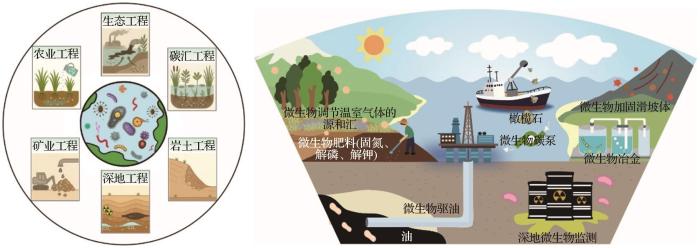
微生物时空分布广、地质作用大,不仅对地球重大环境转型产生了重要影响,而且在减污降碳、减灾降毒等方面也具有重大的工程实践价值,由此实现从微生物地球到微生物地球工程的发展。微生物是驱动生源要素和金属元素地球化学循环的引擎,在碳汇工程、生态工程和农业工程等领域发挥着不可或缺的关键支撑作用。微生物与矿物存在广泛而紧密的相互作用,在岩土工程、深地工程和矿业工程等领域应用微生物不仅可以节省成本、提高效率,还具有重要的环保价值。特别重要的是,微生物对地质环境变化具有广泛而灵敏的响应能力,不仅可以应用于许多重大工程的治理和防控,还可以应用于诸如生态灾害、气候环境灾害和地质灾害等领域的预警,布局微生物预警工程的建设尤其重要和紧迫。
谢树成 , 刘邓 , 戴兆毅 , 陈婷 , 赵璐璐 , 黄柳琴 , 黄咸雨 , 孙启良 , 吴耿 . 微生物地球工程[J]. 地球科学进展, 2026 , 41(1) : 1 -10 . DOI: 10.11867/j.issn.1001-8166.2026.001
Microbes are known to show a great spatiotemporal distribution, and exert extensive and intensive geological agents in both modern days and Earth history. These features make the microbes play important roles on great changes of Earth environments, enabling important and wide applications in geoengineering including the pollutant remediation, decrease of atmospheric CO2, geohazards prevention, as well as toxicity decrease. This necessitates the cross-disciplinary construction from microbial Earth to microbial geoengineering.It is well known that microbes, the engineer of elemental geochemical cycles, have played the key roles in the geoengineering fields including carbon sink, ecological remediation and the agriculture practice. The carbon pump and the microbial carbon pump, the important mechanisms to transport the atmospheric CO2 into the sediments or seawater, are documented to mainly regulate by the microbial communities either in the sea or on the land. Microbes are widely involved into, and known as the engineer of, the geochemical cycles of greenhouse gases including CH4, CO2 and N2O. These microbial processes could be exploited in the geoengineering to promote the carbon sink or decrease the carbon release. Microbial transformation of a series of metal ions as well as the degradation on organics has been widely used in the ecological remediation of polluted environments. Microbial release of elements including carbon, nitrogen, phosphor etc., from a variety of minerals is applied in agriculture practice. The artificial microbial mixtures on the basis of natural communities could be used as the nature-based fertilizers in the farming practice. Microbial roles, played on the precipitation and erosion of minerals, could also be applied into rocks and soils engineering, deep Earth engineering and mining industry. The microbial application to these geoengineerings will greatly save the costs, remarkably promote efficiency and noticeably protect the natural environments. Microbial transformation of the expansive clay minerals into no-expansive ones could be applied into the oil recovery by water flooding as well as the rocks and soils geotechnical engineering. Carbonate factory is known to be primarily induced by microbial communities via the precipitation of calcium carbonate from the fluids which could be introduced into the building of artificial islands in the sea, the filling and repairing of rock cracks, cementation of coarse grains in a variety of geoengineering. Microbial erosion of minerals could be exploited into the mining industry via the release of metals of economic significance from ores. The presence of the so-called deep biosphere, featured by the dominance of extreme environment microbes, will exert positive and negative effects on the underground storage of dangerous materials including the nuclear wastes, CO2 and hydrogen gas. The investigations on the microbial roles on these materials as well as the storage containers are of in particular importance.Whilst most microbial geoengineering has been conducted to prevent and control the geohazards that have come into being in natural environments, microbes could further provide the early warning of some geohazards including the biotic or ecological crisis, climatic and environmental disasters, as well as landslides due to their sensitive response to minor environmental changes. To construct the early warning geoengineering via the on-site filed observatory network is of importance so that we could take some measures to prevent the occurrence of the geohazards, or make the positive use of the microbial roles but suppress the negative roles.
Key words: Geomicrobiology; Geobiology; Deep Earth Science; Future Earth; Earth habitability
| [1] | Xie Shucheng, Jiao Nianzhi, Luo Genming, et al. Evolution of biotic carbon pumps in Earth history: microbial roles as a carbon sink in oceans[J]. Chinese Science Bulletin, 2022, 67(15): 1 715-1 726. |
| 谢树成, 焦念志, 罗根明, 等. 海洋生物碳泵的地质演化: 微生物的碳汇作用[J]. 科学通报, 2022, 67(15): 1 715-1 726. | |
| [2] | Xie Shucheng, Luo Genming, Zhu Zongmin. Surface system impact on the spatiotemporal evolution of deep Earth[J]. Chinese Science Bulletin, 2024, 69(2): 149-159. |
| 谢树成, 罗根明, 朱宗敏. 地球表层系统对深部圈层时空演变的影响[J]. 科学通报, 2024, 69(2): 149-159. | |
| [3] | Sun Chengquan. Earth engineering—Earth systems: from process understanding to Earth management [J]. Advances in Earth Science, 2000,15(6):760-762. |
| 孙成权. 地球工程学——地球系统: 从过程认识到地球管理[J]. 地球科学进展, 2000, 15(6): 760-762. | |
| [4] | Falkowski P G, Fenchel T, Delong E F. The microbial engines that drive Earth’s biogeochemical cycles[J]. Science, 2008, 320(5 879): 1 034-1 039. |
| [5] | Sun F N, Luo G M, Pancost R D, et al. Methane fueled lake pelagic food webs in a Cretaceous greenhouse world[J]. Proceedings of the National Academy of Sciences of the United States of America, 2024, 121(44): e2411413121. |
| [6] | Jiao N Z, Luo T W, Chen Q R, et al. The microbial carbon pump and climate change[J]. Nature Reviews Microbiology, 2024, 22(7): 408-419. |
| [7] | Kip N, Van Winden J F, Pan Y, et al. Global prevalence of methane oxidation by symbiotic bacteria in peat-moss ecosystems[J]. Nature Geoscience, 2010, 3(9): 617-621. |
| [8] | Kox M A R, Smolders A J P, Speth D R, et al. A novel laboratory-scale mesocosm setup to study methane emission mitigation by Sphagnum mosses and associated methanotrophs[J]. Frontiers in Microbiology, 2021, 12: 652486. |
| [9] | Huang X Y, Pancost R D, Xue J T, et al. Response of carbon cycle to drier conditions in the mid-Holocene in Central China[J]. Nature Communications, 2018, 9: 1369. |
| [10] | Günther A, Barthelmes A, Huth V, et al. Prompt rewetting of drained peatlands reduces climate warming despite methane emissions[J]. Nature Communications, 2020, 11: 1644. |
| [11] | Zou J Y, Ziegler A D, Chen D L, et al. Rewetting global wetlands effectively reduces major greenhouse gas emissions[J]. Nature Geoscience, 2022, 15(8): 627-632. |
| [12] | Zhang Y M, Huang X Y, Zhao B Y, et al. Microbial responses to changing plant community protect peatland carbon stores during Holocene drying[J]. Nature Communications, 2025, 16: 6912. |
| [13] | Freeman C, Fenner N, Shirsat A H. Peatland geoengineering: an alternative approach to terrestrial carbon sequestration[J]. Philosophical Transactions of the Royal Society A: Mathematical, Physical and Engineering Sciences, 2012, 370(1 974): 4 404-4 421. |
| [14] | Fenner N, Freeman C. Woody litter protects peat carbon stocks during drought[J]. Nature Climate Change, 2020, 10(4): 363-369. |
| [15] | Pei H Y, Yang H, Kuzyakov Y, et al. Archaeal lipids in soils and sediments: water impact and consequences for microbial carbon sequestration[J]. Soil Biology and Biochemistry, 2022, 173: 108801. |
| [16] | Luo G M, Liu D, Yang H. Microbes in mass extinction: an accomplice or a savior?[J]. National Science Review, 2023, 11: nwad291. |
| [17] | Xie Shucheng, Yin Hongfu. Progress and perspective on frontiers of geobiology [J]. Science China: Earth Science, 2014, 44(6): 1 072-1 086. |
| 谢树成,殷鸿福. 地球生物学前沿: 进展与问题[J]. 中国科学: 地球科学, 2014, 44(6): 1 072-1 086. | |
| [18] | Wagner M, Loy A. Bacterial community composition and function in sewage treatment systems[J]. Current Opinion in Biotechnology, 2002, 13(3): 218-227. |
| [19] | Lian Bin, Fu Pingqiu, Mo Deming, et al. A comprehensive review of the mechanism of potassium releasing by silicate bacteria[J]. Acta Mineralogica Sinica, 2002, 22(2): 179-183. |
| 连宾, 傅平秋, 莫德明, 等. 硅酸盐细菌解钾作用机理的综合效应[J]. 矿物学报, 2002, 22(2): 179-183. | |
| [20] | Song Changqing, Wu Jinshui, Lu Yahai, et al. Advances of soil microbiology in the last decade in China[J]. Advances in Earth Science, 2013, 28(10): 1 087-1 105. |
| 宋长青, 吴金水, 陆雅海, 等. 中国土壤微生物学研究10年回顾[J]. 地球科学进展, 2013, 28(10): 1 087-1 105. | |
| [21] | Xue D, Chen H, Yang X H, et al. Sphagnum cultivation enhances soil carbon stock by alleviating microbial phosphorus limitation[J]. Agriculture, Ecosystems & Environment, 2025, 386: 109587. |
| [22] | Kennedy M, Droser M, Mayer L M, et al. Late Precambrian oxygenation; inception of the clay mineral factory[J]. Science, 2006, 311(5 766): 1 446-1 449. |
| [23] | McMahon W J, Davies N S. Evolution of alluvial mudrock forced by early land plants[J]. Science, 2018, 359(6 379): 1 022-1 024. |
| [24] | Zeichner S S, Nghiem J, Lamb M P, et al. Early plant organics increased global terrestrial mud deposition through enhanced flocculation[J]. Science, 2021, 371(6 528): 526-529. |
| [25] | Kim J, Dong H L, Seabaugh J, et al. Role of microbes in the smectite-to-illite reaction[J]. Science, 2004, 303(5 659): 830-832. |
| [26] | Zhang N Y, Li H C, Xu F, et al. Drag acting on suspended sediment increased by microbial colonization[J]. Nature Geoscience, 2025, 18(5): 396-401. |
| [27] | Chen Z Q, Tu C Y, Pei Y, et al. Biosedimentological features of major Microbe-Metazoan Transitions (MMTs) from Precambrian to Cenozoic[J]. Earth-Science Reviews, 2019, 189: 21-50. |
| [28] | Zhao Xiaoming, Niu Zhijun, Tong Jinnan, et al. The distinctive sediments in the early Triassic recovery time: “anachronistic facies”[J]. Acta Sedimentologica Sinica, 2010, 28(2): 314-323. |
| 赵小明, 牛志军, 童金南, 等. 早三叠世生物复苏期的特殊沉积: “错时相”沉积[J]. 沉积学报, 2010, 28(2): 314-323. | |
| [29] | Chaussemier M, Pourmohtasham E, Gelus D, et al. State of art of natural inhibitors of calcium carbonate scaling: a review article[J]. Desalination, 2015, 356: 47-55. |
| [30] | Kawano M, Hwang J. Roles of microbial acidic polysaccharides in precipitation rate and polymorph of calcium carbonate minerals[J]. Applied Clay Science, 2011, 51(4): 484-490. |
| [31] | Liu Hanlong, Xiao Peng, Xiao Yang, et al. State-of-the-art review of biogeotechnology and its engineering applications[J]. Journal of Civil and Environmental Engineering, 2019, 41(1): 1-14. |
| 刘汉龙, 肖鹏, 肖杨, 等. 微生物岩土技术及其应用研究新进展[J]. 土木与环境工程学报(中英文), 2019, 41(1): 1-14. | |
| [32] | Tang Chaosheng, Pan Xiaohua, Chao Lü, et al. Bio-geoengineering technology and the applications[J]. Geological Journal of China Universities, 2021, 27(6): 625-654. |
| 唐朝生, 泮晓华, 吕超, 等. 微生物地质工程技术及其应用[J]. 高校地质学报, 2021, 27(6): 625-654. | |
| [33] | Wang X X, Maselli V, Flessati L, et al. Preconditioning of sediment failure by astronomically paced weak-layer deposition[J]. Nature Communications, 2025, 16: 7244. |
| [34] | DeJong J T, Fritzges M B, Nüsslein K. Microbially induced cementation to control sand response to undrained shear[J]. Journal of Geotechnical and Geoenvironmental Engineering, 2006, 132(11): 1 381-1 392. |
| [35] | Rothschild L J, Mancinelli R L. Life in extreme environments[J]. Nature, 2001, 409(6 823): 1 092-1 101. |
| [36] | Colman D R, Poudel S, Stamps B W, et al. The deep, hot biosphere: twenty-five years of retrospection[J]. Proceedings of the National Academy of Sciences of the United States of America, 2017, 114(27): 6 895-6 903. |
| [37] | Patsis A C, Schuler C J, Toner B M, et al. The potential for coupled organic and inorganic sulfur cycles across the terrestrial deep subsurface biosphere[J]. Nature Communications, 2025, 16: 3827. |
| [38] | Libert M, Schütz M K, Esnault L, et al. Impact of microbial activity on the radioactive waste disposal: long term prediction of biocorrosion processes[J]. Bioelectrochemistry, 2014, 97: 162-168. |
| [39] | Xie Heping, Liu Jifeng, Gao Mingzhong, et al. The research advancement and conception of the deep-underground medicine[J]. Journal of Sichuan University (Medical Science Edition), 2018, 49(2): 163-168. |
| 谢和平, 刘吉峰, 高明忠, 等. 深地医学研究进展及构想[J]. 四川大学学报(医学版), 2018, 49(2): 163-168. | |
| [40] | Bosecker K. Bioleaching: metal solubilization by microorganisms[J]. FEMS Microbiology Reviews, 1997, 20(3/4): 591-604. |
| [41] | Brown L R. Microbial Enhanced Oil Recovery (MEOR)[J]. Current Opinion in Microbiology, 2010, 13(3): 316-320. |
| [42] | Safdel M, Anbaz M A, Daryasafar A, et al. Microbial enhanced oil recovery, a critical review on worldwide implemented field trials in different countries[J]. Renewable and Sustainable Energy Reviews, 2017, 74: 159-172. |
| [43] | Li L, Wan Y Y, Mu H M, et al. Interaction between illite and a Pseudomonas stutzeri-heavy oil biodegradation complex[J]. Microorganisms, 2023, 11(2): 330. |
| [44] | Wang X B, Chi C Q, Nie Y, et al. Degradation of petroleum hydrocarbons (C6-C40) and crude oil by a novel Dietzia strain[J]. Bioresource Technology, 2011, 102(17): 7 755-7 761. |
| [45] | Hu Xiaoli, Zhang Wei, Liu Deng, et al. Effect of interaction between pristine thermophilic bacteria and bentonite on anti-swelling of oil reservoir[J]. Acta Microbiologica Sinica, 2019, 59(6): 1 197-1 208. |
| 胡小丽, 张蔚, 刘邓, 等. 油藏嗜热菌与膨润土的相互作用及其对储层防膨的意义[J]. 微生物学报, 2019, 59(6): 1 197-1 208. | |
| [46] | Mewafy F M, Atekwana E A, Werkema D D, et al. Magnetic susceptibility as a proxy for investigating microbially mediated iron reduction[J]. Geophysical Research Letters, 2011, 38(21): L21402. |
| [47] | Zhang M, McSaveney M J. Is air pollution causing landslides in China?[J]. Earth and Planetary Science Letters, 2018, 481: 284-289. |
| [48] | Danovaro R, Canals M, Tangherlini M, et al. A submarine volcanic eruption leads to a novel microbial habitat[J]. Nature Ecology & Evolution, 2017, 1(6): 144. |
| [49] | Li Ying, Chen Zhi, Hu Le, et al. Advances in seismic fluid geochemistry and its application in earthquake forecasing[J]. Chinese Science Bulletin, 2022, 67(13): 1 404-1 420. |
| 李营, 陈志, 胡乐, 等. 流体地球化学进展及其在地震预测研究中的应用[J]. 科学通报, 2022, 67(13): 1 404-1 420. | |
| [50] | Cheng H. Future earth and sustainable developments[J]. The Innovation, 2020, 1(3): 100055. |
| [51] | O’Riordan T. EDITORIAL: future Earth: a refreshed sustainability science[J]. Environment Science and Policy for Sustainable Development, 2013, 55(3): 2. |
/
| 〈 |
|
〉 |
 甘公网安备62010202000687