
收稿日期: 2025-07-15
修回日期: 2025-09-26
网络出版日期: 2025-10-20
基金资助
国家重点研发计划项目(2023YFC3709900);国家水文地质调查项目(DD20242500-1);中国地质科学院基本科研业务费项目(SK202404)
Research on the Prevention and Control Mechanism of Characteristic Heavy Metals in Soil-Groundwater by Naiman Banner Maifanite
Received date: 2025-07-15
Revised date: 2025-09-26
Online published: 2025-10-20
Supported by
Project suppoted by the National Key Research and Development Program of China(2023YFC3709900);National Hydrogeological Survey Project(DD20242500-1);Chinese Academy of Geological Sciences Basal Research Fund(SK202404)
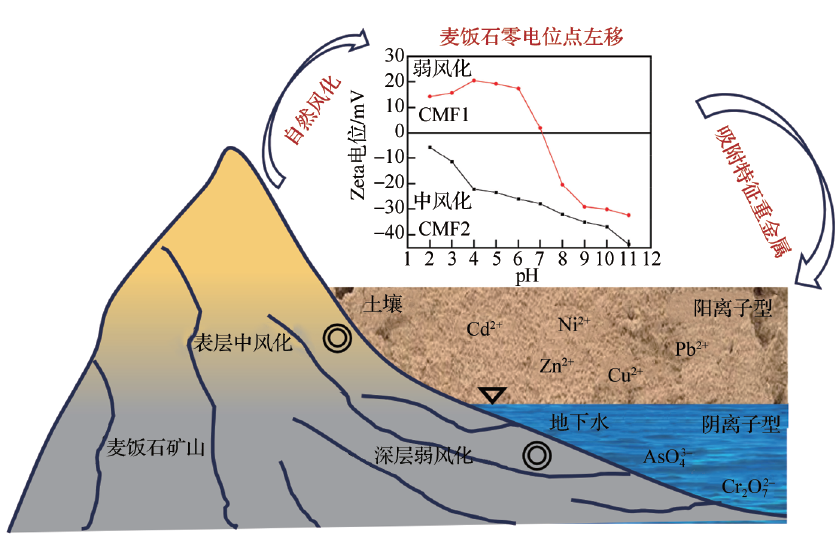
内蒙古自治区通辽市奈曼旗的天然矿物麦饭石可应用于水质净化及环境修复等多个领域。风化作用可改变麦饭石的理化性质,进而影响其对重金属的吸附性能。针对奈曼旗南部山区麦饭石产地不同深度的麦饭石样品开展风化程度鉴定和重金属吸附实验,并结合理化性质表征进行防控机制探析。研究表明,奈曼旗麦饭石主要受物理风化作用影响,根据表观特征、化学蚀变指数和风化系数可判断深层样品为微风化状态,表层样品为中等—强风化状态。风化作用使得表层麦饭石中石英和斜长石晶体发生破坏,比表面积增加66.81%,3.6~4.0 nm的孔径占比由12.36%增加到40.05%,伴随碱性元素流失,零点电位明显左移,由7.09移至2.00以下。深层麦饭石更易吸附地下水中的阴离子型重金属特征污染物铬,理论最大吸附量为0.90 mg/g;表层麦饭石更有利于对土壤中阳离子型重金属特征污染物镉的吸附,理论最大吸附量为5.57 mg/g。吸附过程的表面扩散、中孔内扩散和微孔内扩散3个阶段均在24 h内达到平衡。麦饭石对重金属的多分子层吸附过程以静电作用为主,也包括表面羟基络合等。自然地质风化作用造成麦饭石零点电位左移等理化性质改变,由此产生对土壤—地下水中特征重金属的综合防控能力,为奈曼旗麦饭石在地下水水质净化方面的可持续开发利用提供了理论依据。
张荣 , 宋乐 , 马翠艳 , 张娟娟 , 付世骞 , 任宇 , 鲁重生 , 曹文庚 . 奈曼旗麦饭石对土壤—地下水中特征重金属的防控机制研究[J]. 地球科学进展, 2025 , 40(12) : 1350 -1362 . DOI: 10.11867/j.issn.1001-8166.2025.086
Chinese Maifanite, a natural mineral from Naiman Banner,Tongliao City, Inner Mongolia Autonomous Region, has potential applications in water purification, environmental remediation, healthcare, and agricultural improvement. Weathering processes alter the physicochemical properties of Maifanite, thereby influencing its heavy metal adsorption performance. This research systematically investigated Maifanite samples collected from different depths in the southern mountainous mining area of Naiman Banner, conducted comprehensive analyses including weathering degree assessment, heavy metal adsorption experiments, and prevention and control mechanism studies combining physicochemical characterization. The research reveals that Naiman Banner Maifanite primarily undergoes physical weathering. Based on macroscopic characteristics, Chemical Index of Alteration (CIA), and weathering coefficient Kf , deep-layer samples were identified as slightly weathered, while surface samples exhibited moderate to strong weathering. Weathering increased the specific surface area of Maifanite by 66.81%, reduced pores smaller than 3.6 nm, and increased pores between 3.6~4.0 nm from 12.36% to 40.05%. Additionally, weathering caused the destruction of quartz and plagioclase crystals, leaching of alkaline elements (Na, Mg, Si, K, Ca). The zero potential point shifted markedly from 7.09 to below 2. Notably, deep-layer Maifanite demonstrated preferential adsorption toward anionic chromium (Cr)-a characteristic groundwater contaminant-with a maximum theoretical adsorption capacity of 0.90 mg/g. Conversely, surface-weathered Maifanite exhibited enhanced adsorption capacity for cationic cadmium (Cd)-a typical soil pollutant-reaching 5.57 mg/g. The adsorption process, comprising three distinct stages (surface diffusion, mesopore diffusion, and micropore diffusion), achieved equilibrium within 24 hours. Multilayer heavy metal adsorption mechanisms were predominantly governed by electrostatic interactions with additional contributions from surface hydroxyl complexation. In conclusion, natural geological weathering induces significant physicochemical modifications in Maifanite, including the observed zero potential point shift, which collectively enhance its capacity for comprehensive heavy metal prevention and control in both soil and groundwater systems. This research provides crucial theoretical foundations for the sustainable development and utilization of Naiman Banner Maifanite in groundwater purification applications.
Key words: Naiman Banner; Maifanite; Weathering; Heavy metals; Zeta potential
| [1] | LI Hailong. Magical Maifanite and premium mineral water[J]. Earth,2025(2): 23-25. |
| 李海龙. 神奇的麦饭石和优质矿泉水 [J]. 地球, 2025(2): 23-25. | |
| [2] | Naiman Banner People’s Government. Naiman Banner: rich in resources and diverse in products[EB/OL]. (2025-06-23)[2025-06-30]. . |
| 奈曼旗人民政府.奈曼旗:资源富集·物产多样 [EB/OL]. (2025-06-23)[2025-06-30]. . | |
| [3] | ZHOU Liu, LIU Zheng, QIAN Xilong, et al. SEM-EDS and XRD analysis of the “rice” and “non-rice” parts of mineral medicine Maifanitum and quality evaluation through morphological identification[J]. China Journal of Chinese Materia Medica, 2025,50(17): 4 767-4 775. |
| 周柳, 刘政, 钱喜龙, 等. 矿物药麦饭石“饭”与“非饭”部位SEM-EDS、XRD分析与辨状论质 [J]. 中国中药杂志,2025,50(17): 4 767-4 775. | |
| [4] | REN Juan, LIU Jiuwei, FENG Lei. Adsorption of heavy metal ions by Chinese medical stone[J]. Water Purification Technology, 2018, 37(11): 88-94. |
| 任娟, 刘玖伟, 冯雷. 中华麦饭石对重金属离子的吸附作用 [J]. 净水技术, 2018, 37(11): 88-94. | |
| [5] | LIANG Cheng, CAO Hecai, ZHANG Huajing, et al. Geochemical, dissolution and adsorption characteristics of Maifanite in northern Mengshan, Mengyin County, Shandong Province[J]. Geology and Exploration, 2023, 59(3): 608-616. |
| 梁成, 曹和才, 张华婧,等. 山东省蒙阴县蒙山北部麦饭石地球化学、溶出与吸附特征 [J]. 地质与勘探, 2023, 59(3): 608-616. | |
| [6] | GAO J T, ZHANG X L, BAI J, et al. Comparison of hexavalent chromium and cadmium removal from wastewater in constructed rapid infiltration system with Layered Double Hydroxides (LDHs) modified maifanite substrates: physical, chemical and microbial mechanism[J]. Journal of Water Process Engineering, 2024, 61. DOI:10.1016/j.jwpe.2024.105331 . |
| [7] | LI Juan, ZHANG Panyue, GAO Ying, et al. Overview of Maifanshi: its physi-chemical properties and nutritious function in drinking water[J].Environmental Science & Technology, 2008(10): 63-66, 75. |
| 李娟, 张盼月, 高英, 等. 麦饭石的理化性能及其在水质优化中的应用 [J]. 环境科学与技术, 2008(10): 63-66, 75. | |
| [8] | JIN Xiaodan, HE Junhe, HUANG Yuzhao, et al. The study on immobilization of heavy metal contaminated water and soils by Manfan stone[J]. Environmental Science and Technology, 2021, 34(4): 23-28. |
| 金晓丹, 何俊贺, 黄宇钊, 等. 麦饭石在修复水体和土壤中重金属污染方面的研究 [J]. 环境科技, 2021, 34(4): 23-28. | |
| [9] | KUANG X X, LIU J G, SCANLON B R, et al. The changing nature of groundwater in the global water cycle [J]. Science, 2024, 383(6 686). DOI: 10.1126/science.adf0630 . |
| [10] | HOU D Y, JIA X Y, WANG L W, et al. Global soil pollution by toxic metals threatens agriculture and human health [J]. Science, 2025, 388(6 744): 316-321. |
| [11] | SONG L, CAO W G, REN Y, et al. Aging influence and long-term stable mechanism of biofuel ash immobilizing cadmium in alkaline soil combining artificial aging simulation[J]. Environmental Research, 2025, 277. DOI:10.1016/j.envres.2025.121570 . |
| [12] | SONG L, QIAN J Z, ZHANG F W, et al. An ecological remediation model combining optimal substrate amelioration and native hyperaccumulator colonization in non-ferrous metal tailings pond[J]. Journal of Environmental Management, 2022, 322. DOI:10.1016/j.jenvman.2022.116141 . |
| [13] | YANG S S, FENG W Z, WANG S Q, et al. Farmland heavy metals can migrate to deep soil at a regional scale: a case study on a wastewater-irrigated area in China[J]. Environmental Pollution, 2021, 281. DOI:10.1016/j.envpol.2021.116977 . |
| [14] | XIA Yafei, LIU Yuhui, GAO Ting, et al. Advances in the application of metal stable isotopes for the identification of heavy metal sources in soil in mining- and smelting-affected areas [J]. Advances in Earth Science, 2023, 38(4): 331-348. |
| 夏亚飞, 刘宇晖, 高庭, 等. 基于金属稳定同位素的矿冶影响区土壤重金属污染源解析研究进展 [J]. 地球科学进展, 2023, 38(4): 331-348. | |
| [15] | SUN Houyun, MA Feng, CHEN Ziran, et al. Source apportionment and ecological risk of soil heavy metals in typical vanadiumtitanium magnetite mining areas affected by intensive transportation activities in Chengde[J]. Environmental Science, 2025, 46 (4): 2 486-2 500. |
| 孙厚云, 马峰, 陈自然, 等. 高强度运输活动影响下承德钒钛磁铁矿集区土壤重金属生态风险与来源解析 [J]. 环境科学, 2025, 46 (4): 2 486-2 500. | |
| [16] | CAO Wengeng, WANG Yanyan, REN Yu, et al. Status and progress of treatmenttechnologies for arsenic-bearing groundwater[J]. Geology in China, 2022,49(5): 1 408-1 426. |
| 曹文庚, 王妍妍, 任宇,等. 含砷地下水的治理技术现状与进展[J]. 中国地质, 2022, 49(5): 1 408-1 426. | |
| [17] | REN Yu, CAO Wengeng, XIAO Shunyu, et al. Research progress on distribution, harm and control technology of heavy metals in soil [J]. Geology in China, 2024, 51(1): 118-142. |
| 任宇, 曹文庚, 肖舜禹,等. 重金属在土壤中的分布、危害与治理技术研究进展 [J]. 中国地质, 2024, 51(1): 118-142. | |
| [18] | QIAN J Z, PENG Y X, ZHAO W D, et al. Hydrochemical processes and evolution of karst groundwater in the northeastern Huaibei Plain, China[J]. Hydrogeology Journal, 2018, 26(5): 1 721-1 729. |
| [19] | RHEINHEIMER dos S D, CAMBIER P, MALLMANN F J K, et al. Prospective modeling with Hydrus-2D of 50 years Zn and Pb movements in low and moderately metal-contaminated agricultural soils[J]. Journal of Contaminant Hydrology, 2013, 145: 54-66. |
| [20] | GUO W J, GAO Z P, GUO H M, et al. Hydrogeochemical and sediment parameters improve predication accuracy of arsenic-prone groundwater in random forest machine-learning models[J]. Science of the Total Environment, 2023, 897. DOI:10.1016/j.scitotenv.2023.165511 . |
| [21] | GUO H M, LIU C, YAN S, et al. Source, distribution, and geochemical processes of geogenic high chromium groundwater around the world: a critical review[J]. Journal of Hydrology, 2024, 638. DOI:10.1016/j.jhydrol.2024.131480 . |
| [22] | GAO Weibin, CHEN Yang, WANG Haoxian. Enhanced silicate rock weathering—a new path of “carbon neutrality”[J]. Advances in Earth Science,2023,38(2):137-150. |
| 高伟斌, 陈旸, 王浩贤. 增强硅酸盐岩风化——“碳中和”之新路径 [J]. 地球科学进展, 2023, 38(2): 137-150. | |
| [23] | LI Qin, WEI Wei, LING Sixiang, et al. Mineralogy and major element characteristics of black shale weathering profiles in eastern Chongqing and the influence mechanism of fractures on weathering process[J]. Bulletin of Mineralogy, Petrology and Geochemistry,2025, 44(4): 798-811. |
| 黎覃,魏巍,凌斯祥,等. 渝东黑色页岩风化剖面矿物—主量元素特征及裂隙带对风化过程的影响机制 [J]. 矿物岩石地球化学通报, 2025, 44(4): 798-811. | |
| [24] | ZHOU Zhihua. The influence of rock properties on weathering processes [J]. Nonferrous Metals, 2023, 13(10): 153-153. |
| 周志华. 岩石性质对风化作用的影响 [J]. 有色金属工程, 2023, 13(10): 153-153. | |
| [25] | WANG Qiang. Adsorption of humic acid and heavy metal lic ions by marfan stone[J]. Geological Science and Technology Information, 1998(3): 60-63. |
| 王强. 麦饭石对腐殖酸及重金属离子的吸附作用 [J]. 地质科技情报, 1998(3): 60-63. | |
| [26] | DU Juan, SHI Baoming, SHAN Anshan. Research on the absorption of cadmium by medical stone under different conditions in vitro[J]. China Animal Husbandry & Veterinary Medicine, 2012, 39(12): 70-72. |
| 杜鹃, 石宝明, 单安山. 麦饭石对重金属镉吸附效果的研究 [J]. 中国畜牧兽医, 2012, 39(12): 70-72. | |
| [27] | GAO Xiaojiang, RONG Qiutao. Study on the adsorption effect of Maifanite on heavy metal ions[J]. Environmental Pollution & Control,1997(4): 4-7. |
| 高效江,戎秋涛. 麦饭石对重金属离子的吸附作用研究 [J]. 环境污染与防治, 1997(4): 4-7. | |
| [28] | WANG Yinye, SONG Zengxi. The modified main-fan rocks can be used for the development and the application as the adsorbent to remove the compositions of the lead. Cadmium and mercury in waste wate[J]. Journal of Shanxi Normal University (Natural Science Edition), 1996(1): 25-28. |
| 王银叶,宋增喜. 改性麦饭石用于除铅、镉、汞废水吸附剂的开发与应用 [J]. 山西师大学报(自然科学版), 1996(1): 25-28. | |
| [29] | GAO J Q, GUO Q Z, HUANG Z Z, et al. Performance and mechanisms of sodium dodecyl benzene sulfonate-modified maifanite for Cr(VI) and Cd(II) removal from aqueous solution[J]. International Journal of Environmental Science and Technology, 2023, 20(2): 1 857-1 874. |
| [30] | Ministry of Housing and Urban-Rural Development of the People’s Republic of China, General Administration of Quality Supervision, Inspection and Quarantine of the People’s Republic of China. Engineering rock mass classification standards: GB/T 50218-2014[S] Beijing: Standards Press of China, 2015. |
| 中华人民共和国住房和城乡建设部,中华人民共和国国家质量监督检验检疫总局. 工程岩体分级标准: [S]. 北京: 中国标准出版社, 2015. | |
| [31] | Ministry of Construction of the People’s Republic of China General Administration of Quality Supervision, Inspection and Quarantine of the People’s Republic of China. Code for geotechnical engineering investigation: [S]. Beijing: Standards Press of China, 2002. |
| 中华人民共和国建设部,中华人民共和国国家质量监督检验检疫总局. 岩土工程勘察规范: [S]. 北京: 中国标准出版社, 2002. | |
| [32] | NESBITT H W, YOUNG G M. Prediction of some weathering trends of plutonic and volcanic rocks based on thermodynamic and kinetic considerations[J]. Geochimica et Cosmochimica Acta, 1984, 48(7): 1 523-1 534. |
| [33] | FEDO C M, WAYNE N H, YOUNG G M. Unraveling the effects of potassium metasomatism in sedimentary rocks and paleosols, with implications for paleoweathering conditions and provenance[J]. Geology, 1995, 23(10). DOI:10.1130/0091-7613(1995)023<0921:UTEOPM>2.3.CO;2 . |
| [34] | XU Duanping, JIANG Ziwei, ZHANG Zhen. Adsorption kinetics of lead and cadmium ions on magnetic biochar[J]. Applied Chemical Industry,2021, 50(8): 2 108-2 112, 2 119. |
| 许端平, 姜紫微, 张朕. 磁性生物炭对铅镉离子的吸附动力学 [J]. 应用化工, 2021, 50(8): 2 108-2 112, 2 119. | |
| [35] | SONG J M, HUANG G X, HAN D Y, et al. Alpha-MnO2 nanoneedle embedded in MgO-chitosan biochar for higher removal of arsenic from groundwater: co-effects of oxidation and adsorption[J]. Journal of Alloys and Compounds, 2023, 947. DOI:10.1016/j.jallcom.2023.169643 . |
| [36] | MO Binbin, LIAN Bin. Study on feldspar weathering and analysis of relevant impact factors [J]. Earth Science Frontiers, 2010, 17(3): 281-289. |
| 莫彬彬, 连宾. 长石风化作用及影响因素分析 [J]. 地学前缘, 2010, 17(3): 281-289. | |
| [37] | CAO Wengeng, LU Chongsheng, ZHUANG Haiyan,et al. Formation mechanism and exploitation potential of strontium and metasilicic acid -rich groundwater in the southern mountainous area of Naiman Banner[J/OL]. Advances in Earth Science (2025-10-11) [2025-11-14]. . |
| 曹文庚,鲁重生,庄海艳,等. 奈曼旗南部山区富锶—偏硅酸地下水形成机制与开发潜力 [J/OL]. 地球科学进展(2025-10-11)[2025-11-14]. . | |
| [38] | LU Chongsheng,CAOWengeng, ZHUANG Haiyan,et al. Study on the formation mechanism and background values of groundwater hydrochemistryin farming-pastoralzone,Naiman Banner[J/OL]. Advances in Earth Science (2025-10-11)[2025-11-14]. . |
| 鲁重生,曹文庚,庄海艳,等. 奈曼旗农牧交错带地下水水化学形成机制与背景值研究 [J/OL]. 地球科学进展(2025-10-11)[2025-11-14]. . | |
| [39] | LUO Kai, MA Jinlong. Recent advances in migration and enrichment of rare earth elements during chemical weathering of granite[J]. Advances in Earth Science, 2022, 37(7):692-708. |
| 雒恺, 马金龙. 花岗岩风化过程中稀土元素迁移富集机制研究进展 [J]. 地球科学进展, 2022, 37(7): 692-708. | |
| [40] | HUANG Laiming, SHAO Mingan, JIA Xiaoxu, et al .A review of the methods and controls of soil weathering rates[J].Advances in Earth Science, 2016, 31(10): 1 021-1 031. |
| 黄来明, 邵明安, 贾小旭, 等. 土壤风化速率测定方法及其影响因素研究进展 [J]. 地球科学进展, 2016, 31(10): 1 021-1 031. | |
| [41] | LI Qiuru, CAI Jingjing, LI Hua, et al. Comparison of adsorption and passivation effects of inorganic and organic materials on cadmium[J]. Acta Agriculturae Zhejiangensis, 2024, 36(12): 2 774-2 783. |
| 李秋铷, 蔡晶晶, 李华,等. 几种无机与有机材料对镉的吸附和钝化效果比较 [J]. 浙江农业学报, 2024, 36(12): 2 774-2 783. | |
| [42] | LIU Wenjun, LIU Tong, HU Weiwu, et al. Study on Chinese Maifanite in promotion of heterotrophic denitrification in water[J]. Geoscience, 2022, 36(2): 574-582. |
| 刘文君, 刘通, 胡伟武,等. 麦饭石促进异养反硝化去除水中硝酸盐的研究 [J]. 现代地质, 2022, 36(2): 574-582. | |
| [43] | WEN Xiaocui, LI Jiuyu, SONG Jie, et al. Research progress on the acid-base properties of variable charge soils using potentiometric titration[J]. Acta Pedologica Sinica, 2022, 59(4):910-923. |
| 温晓翠, 李九玉, 宋洁, 等. 电位滴定法研究可变电荷土壤表面酸碱性质的进展 [J]. 土壤学报, 2022, 59(4): 910-923. |
/
| 〈 |
|
〉 |
 甘公网安备62010202000687