
收稿日期: 2025-05-27
修回日期: 2025-10-27
网络出版日期: 2025-11-11
基金资助
江西省自然科学基金项目(20232BAB203072);国家自然科学基金项目(42404150)
Research on Lithology Identification Method for Sandstone-Type Uranium Deposits Based on PCA-Stacking Model
Received date: 2025-05-27
Revised date: 2025-10-27
Online published: 2025-11-11
Supported by
the Jiangxi Provincial Natural Science Foundation(20232BAB203072);The National Natural Science Foundation of China(42404150)
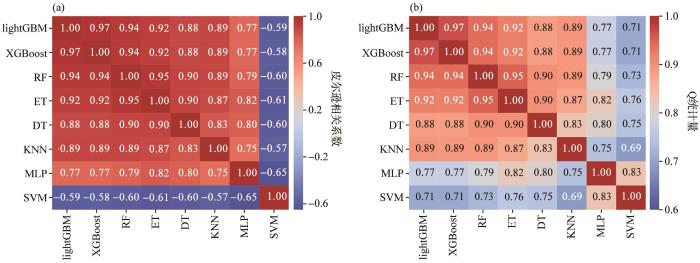
为了提高铀矿钻孔地层岩性识别的准确性,解决传统集成学习模型识别地层岩性效果不佳的问题,提出了一种基于主成分分析优化的Stacking集成学习模型。首先,基于皮尔逊相关系数量化测井参数与目标岩性的线性关联强度,结合测井地球物理机理,筛选出与岩性关系较为密切的6个测井参数作为输入特征。同时,计算基学习器预测误差的皮尔逊相关系数,并使用Q统计量矩阵评估预测结果的相关性,从中筛选出误差互补性强(即低相关性)且预测模式差异显著(即低Q值)的基模型组合。通过主成分分析算法对基模型的预测结果进行加权融合,并将这些融合后的特征作为输入,构建第二层元模型的训练数据,从而实现一个高精度的多层次集成学习模型。实验结果表明,基于主成分分析优化的Stacking模型的识别精度达97.19%,明显优于传统Stacking模型以及所有个体模型的性能,这一结果验证了所提出方法的有效性,为砂岩型铀矿钻孔地层岩性识别研究提供了新的思路和方法。
陈梦诗 , 肖昆 , 李红星 , 张华 , 杨亚新 , 胡旭东 , 徐艺宸 , 焦常伟 , 尹德宁 . 基于PCA-Stacking模型的砂岩型铀矿地层岩性识别方法研究[J]. 地球科学进展, 2025 , 40(11) : 1196 -1210 . DOI: 10.11867/j.issn.1001-8166.2025.084
To improve the accuracy of lithology identification in uranium mine borehole strata and address the limitations of traditional ensemble learning models in achieving satisfactory lithology recognition performance, this study proposes a PCA-optimized Stacking ensemble learning model. The methodology begins by quantitatively evaluating the linear correlation strength between various logging parameters and the target lithology using Pearson correlation coefficients. This statistical analysis is further refined by incorporating geophysical mechanisms of well logging, leading to the selection of six logging parameters that demonstrate strong lithological relevance as input features. These parameters effectively capture essential petrophysical characteristics while minimizing redundancy in the feature set. Simultaneously, the model employs a dual-faceted approach to base learner selection. The Pearson correlation coefficients of prediction errors among base learners are systematically calculated to assess their error interdependence. Additionally, the Q-statistic matrix is utilized to evaluate the correlation and diversity of prediction outcomes. From this, a combination of base models with strong error complementarity (i.e., low correlation) and significant prediction mode differences (i.e., low Q-value) is selected. To optimally consolidate the predictive information, the PCA algorithm is utilized to perform a weighted fusion of the prediction results derived from the diverse base models. The resulting principal components, which represent the most discriminative fused features, then form the refined input feature space for training the second-layer meta-model, thereby achieving a sophisticated and high-accuracy multi-level ensemble learning framework. Experimental results show that the PCA-optimized Stacking model achieves a recognition accuracy of 97.19%, significantly outperforming traditional Stacking models and all individual models. The experimental results indicate that the recognition accuracy of the PCA-optimized Stacking model reaches 97.19%, significantly outperforming both the traditional Stacking model and all individual models. Furthermore, the study provides valuable insights and a novel technical framework for lithology identification in sandstone-type uranium mine borehole strata, contributing to more reliable and efficient geological interpretation in uranium exploration and mining operations.
| [1] | SUN Kui. Logging identification method of complex lithology in buried hill based on the improved KNN algorithm[J]. Special Oil & Gas Reservoirs, 2022, 29(3): 18-27. |
| 孙岿. 基于改进KNN算法的潜山复杂岩性测井识别方法[J]. 特种油气藏, 2022, 29(3): 18-27. | |
| [2] | GUO Yushan, WANG Wanyin. A method for identifying lithology based on a feature-weighted KNN model[J]. Geophysical and Geochemical Exploration, 2024, 48(2): 428-436. |
| 郭雨姗, 王万银. 基于特征加权的KNN模型岩性识别方法[J]. 物探与化探, 2024, 48(2): 428-436. | |
| [3] | WANG X D, YANG S C, ZHAO Y F, et al. Lithology identification using an optimized KNN clustering method based on entropy-weighed cosine distance in Mesozoic strata of Gaoqing field, Jiyang depression[J]. Journal of Petroleum Science and Engineering, 2018, 166: 157-174. |
| [4] | WU Siyuan, LI Shouding, CHEN Dong,et al. An intelligent-while-drilling steering method of global closed-loop servo control[J]. Chinese Journal of Geophysics,2021,64(11): 4 215-4 226. |
| 吴思源,李守定,陈冬,等. 大闭环伺服控制随钻智能导向钻井方法[J]. 地球物理学报,2021,64(11): 4 215-4 226. | |
| [5] | ZHOU Jinyu, GUO Haopeng, ZHANG Shaohua,et al. Study on lithology identification for volcanic rock logging data in Songliao Basin[J]. Journal of Oil and Gas Technology,2014,36(3):72-76. |
| 周金昱,郭浩鹏,张少华,等. 松辽盆地火山岩岩性测井识别方法研究[J]. 石油天然气学报,2014,36(3):72-76. | |
| [6] | XU Han, YAO Kongxuan, CHENG Danyi,et al. Stratigraphic lithology identification based on no-dig logging while drilling system and random forest[J]. Bulletin of Geological Science and Technology,2021,40(5): 272-280. |
| 徐晗,姚孔轩,程丹仪,等. 基于非开挖随钻检测系统与随机森林的地层岩性识别[J]. 地质科技通报,2021,40(5): 272-280. | |
| [7] | LIU Kai, ZOU Zhengyin, WANG Zhizhang, et al. Intelligent identification and prediction of lithology of volcanic reservoirs based on machine learning[J]. Special Oil & Gas Reservoirs, 2022, 29(1): 38-45. |
| 刘凯, 邹正银, 王志章, 等. 基于机器学习的火山岩岩性智能识别及预测[J]. 特种油气藏, 2022, 29(1): 38-45. | |
| [8] | BRESSAN T S, de KEHL S M, GIRELLI T J, et al. Evaluation of machine learning methods for lithology classification using geophysical data[J]. Computers & Geosciences, 2020, 139. DOI: 10.1016/j.cageo.2020.104475 . |
| [9] | HUANG Yu, SHAO Yanlin, WEI Wei,et al. Study on the decision tree model for carbonate rock lithology identification based on hyperspectral data[J]. Laser & Optoelectronics Progress,2025,62(8): 416-424. |
| 黄宇,邵燕林,魏薇,等. 基于高光谱数据的碳酸盐岩岩性识别决策树模型研究[J]. 激光与光电子学进展,2025,62(8): 416-424. | |
| [10] | XIE Y X, ZHU C Y, HU R S, et al. A coarse-to-fine approach for intelligent logging lithology identification with extremely randomized trees[J]. Mathematical Geosciences, 2021, 53(5): 859-876. |
| [11] | DUAN Zhongyi, XIAO Kun, YANG Yaxin, et al. Automatic lithology identification of sandstone-type uranium deposit in Songliao Basin based on ensemble learning[J]. Atomic Energy Science and Technology, 2023, 57(12): 2 443-2 454. |
| 段忠义, 肖昆, 杨亚新, 等. 基于集成学习的松辽盆地砂岩型铀矿地层岩性自动识别研究[J]. 原子能科学技术, 2023, 57(12): 2 443-2 454. | |
| [12] | ZHAO Ranlei, YANG Liushuan, XU Xiao, et al. Lithology identification method and research of volcanic rock based on XGBoost algorithm[J]. Progress in Geophysics, 2025, 40(2): 646-657. |
| 赵然磊, 杨留栓, 徐晓, 等. 基于XGBoost算法的火山岩岩性识别方法与研究[J]. 地球物理学进展, 2025, 40(2): 646-657. | |
| [13] | PAN Shaowei, WANG Chaoyang, ZHANG Yun,et al. Lithology identification based on LSTM neural networks completing log and hybrid optimized XGBoost[J]. Journal of China University of Petroleum (Edition of Natural Science),2022,46(3): 62-71. |
| 潘少伟,王朝阳,张允,等. 基于长短期记忆神经网络补全测井曲线和混合优化XGBoost的岩性识别[J]. 中国石油大学学报(自然科学版),2022,46(3): 62-71. | |
| [14] | FENG Huan, ZHANG Guoqiang, CAO Jun, et al. Application of WOA optimized LightGBM in lithology identification of igneous logging[J]. Progress in Geophysics, 2025, 40(1): 230-242. |
| 冯欢, 张国强, 曹军, 等. WOA优化LightGBM在火成岩测井岩性识别中的应用[J]. 地球物理学进展, 2025, 40(1): 230-242. | |
| [15] | GU Yufeng, ZHANG Daoyong, BAO Zhidong, et al. Lithology prediction of tight sandstone formation using GS-LightGBM hybrid machine learning model[J]. Bulletin of Geological Science and Technology, 2021, 40(4): 224-234. |
| 谷宇峰, 张道勇, 鲍志东, 等. 利用GS-LightGBM机器学习模型识别致密砂岩地层岩性[J]. 地质科技通报, 2021, 40(4): 224-234. | |
| [16] | LI Qing, LONG Xunrong, WU Xiuhui, et al. One method to predict porosity in tight sandstone reservoirs based on SAO-LightBGM algorithm[J]. Natural Gas Technology and Economy, 2024, 18(4): 9-14, 86. |
| 李庆, 龙训荣, 吴秀慧, 等. 基于SAO-LightGBM算法的致密砂岩储层孔隙度预测方法[J]. 天然气技术与经济, 2024, 18(4): 9-14, 86. | |
| [17] | GU J Y, LIU S G, ZHOU Z Z, et al. A Stacking ensemble learning model for monthly rainfall prediction in the Taihu Basin, China[J]. Water, 2022, 14(3). DOI: 10.3390/w14030492 . |
| [18] | ZHAN Y, ZHANG H J, LI J H, et al. Prediction method for ocean wave height based on Stacking ensemble learning model[J]. Journal of Marine Science and Engineering, 2022, 10(8). DOI: 10.3390/jmse10081150 . |
| [19] | HOU S K, LIU Y R, YANG Q. Real-time prediction of rock mass classification based on TBM operation big data and Stacking technique of ensemble learning[J]. Journal of Rock Mechanics and Geotechnical Engineering, 2022, 14(1): 123-143. |
| [20] | DING W Z, LI X H, YANG H, et al. A novel method for damage prediction of stuffed protective structure under hypervelocity impact by Stacking multiple models[J]. IEEE Access, 2020, 8: 130 136-130 158. |
| [21] | DING Ziwei, GAO Chengdeng, ZHANG Ling, et al. Prediction method for data-driven lithology identification of TBM tunneling strata[J]. Journal of Mining and Safety Engineering, 2025, 42(1): 147-160. |
| 丁自伟, 高成登, 张玲, 等. 基于数据驱动的TBM掘进地层岩性识别预测方法[J]. 采矿与安全工程学报, 2025, 42(1): 147-160. | |
| [22] | CAO Maojun, GONG Weijia, GAO Zhiyong. Research on lithology identification based on Stacking integrated learning[J]. Computer Technology and Development, 2022, 32(7): 161-166, 172. |
| 曹茂俊, 巩维嘉, 高志勇. 基于Stacking集成学习的岩性识别研究[J]. 计算机技术与发展, 2022, 32(7): 161-166, 172. | |
| [23] | ZOU Qi, HE Yueshun, YANG Xi, et al. Construction of lithology identification model by well logging based on ensemble learning[J]. Intelligent Computer and Applications, 2020, 10(3): 91-94. |
| 邹琪, 何月顺, 杨希, 等. 基于集成学习的测井岩性识别模型的构建[J]. 智能计算机与应用, 2020, 10(3): 91-94. | |
| [24] | LIN X C, YIN S T. Lithology identification based on interpretability integration learning[J]. Earth Science Informatics, 2023, 16(3): 2 211-2 222. |
| [25] | ZHANG Chi, PAN Mao, HU Shuiqing, et al. A machine learning lithologic identification method combined with vertical reservoir information[J]. Bulletin of Geological Science and Technology, 2023, 42(3): 289-299. |
| 张驰, 潘懋, 胡水清, 等. 融合储层纵向信息的机器学习岩性识别方法[J]. 地质科技通报, 2023, 42(3): 289-299. | |
| [26] | HUO Fengcai, LI Qingzhi, DONG Hongli, et al. Prediction method of reservoir evaluation parameters based on improved Stacking fusion model[J]. Progress in Geophysics, 2025, 40(2): 691-704. |
| 霍凤财, 李青志, 董宏丽, 等. 基于改进Stacking融合模型的储层参数预测方法[J]. 地球物理学进展, 2025, 40(2): 691-704. | |
| [27] | LUO Shuiliang, QI Yingqiang, TANG Song, et al. Lithology logging identification method and application to carbonate reservoirs based on improved Stacking algorithm[J]. Special Oil & Gas Reservoirs, 2025, 32(4): 58-67. |
| 罗水亮, 漆影强, 唐松, 等. 基于改进Stacking算法的碳酸盐岩储层测井岩性识别方法与应用[J]. 特种油气藏, 2025, 32(4): 58-67. | |
| [28] | ZHAO J, LIN Z P, LAI Q, et al. A fluid identification method for caved-fracture reservoirs based on the Stacking model[J]. Frontiers in Earth Science, 2023, 11. DOI: 10.3389/feart.2023.1216222 . |
| [29] | LIU Xin, WANG Changdong, CAI Jianfang, et al. Characteristics of stratigraphic sequences and their controlling effect on uranium mineralization in southern Songliao Basin [J]. Uranium Geology, 2025, 41(5): 757-772. |
| 刘鑫, 王常东, 蔡建芳, 等. 松辽盆地南部层序地层特征及其对铀成矿的制约作用分析[J]. 铀矿地质, 2025, 41(5): 757-772. | |
| [30] | ZHANG Hongjing, YU Haoyi, ZHANG Lingling, et al. Discussion on metallogenic conditions of sandstone-type uranium deposits in Upper Cretaceous Yaojia Formation in Changling area, central depression, Songliao Basin[J]. Uranium Geology, 2024, 40(5): 850-863. |
| 张红静, 于浩依, 张玲玲, 等. 松辽盆地中央坳陷区长岭地区上白垩统姚家组砂岩型铀矿成矿条件分析[J]. 铀矿地质, 2024, 40(5): 850-863. | |
| [31] | YAN Zhanglei, GUO Qiang, XIAO Jing. Geochemical characteristics and provenance analysis of clastic rocks for sandstone-type uranium deposit in Yuliangbao area, southern Songliao Basin[J]. Uranium Geology, 2024, 40(5): 864-880. |
| 严张磊, 郭强, 肖菁. 松辽盆地南部余粮堡地区砂岩型铀矿含矿层碎屑岩地球化学特征及物源分析[J]. 铀矿地质, 2024, 40(5): 864-880. | |
| [32] | LIU Yuhu, CAO Chunhui, LI Ruilei, et al. The control of the spatial and temporal differential evolution of boundary faults on faulted basins: taking the fulongquan fault depression in the southern Songliao Basin as an example[J]. Advances in Earth Science, 2020, 35(1): 79-87. |
| 刘玉虎, 曹春辉, 李瑞磊, 等. 边界断裂时空差异演化对断陷盆地的控制作用: 以松辽盆地南部伏龙泉断陷为例[J]. 地球科学进展, 2020, 35(1): 79-87. | |
| [33] | ZHANG Hang, NIE Fengjun, LUO Min, et al. Discussion on metallogenic conditions and prospecting direction of sandstone-type uranium deposits in Yaojia Formation, Baiquan area, northeast Songliao Basin[J]. Uranium Geology, 2022, 38(3): 425-435. |
| 张航, 聂逢君, 罗敏, 等. 松辽盆地东北部拜泉地区姚家组砂岩型铀成矿条件与找矿方向探讨[J]. 铀矿地质, 2022, 38(3): 425-435. | |
| [34] | SHANG Gaofeng, QIAO Haiming, SONG Zhe,et al. Geochemical characteristics of sandstone type uranium depositsin interlayer oxidation zone,Baxiankou area[J]. Advances in Earth Science,2012,27():245-250. |
| 尚高峰,乔海明,宋哲,等. 八仙口砂岩型铀矿层间氧化带的地球化学特征[J]. 地球科学进展,2012,27():245-250. | |
| [35] | ZHAO Xingqi, CUI Shoukai, CAI Ya, et al. Metallogenic conditions and prospecting targeting of sandstone-type uranium mineralization in Mahai area, northern Qaidam Basin[J]. Acta Geoscientia Sinica, 2021, 42(5): 593-604. |
| 赵兴齐, 崔守凯, 蔡亚, 等. 柴达木盆地北缘马海地区砂岩型铀成矿条件及找矿方向[J]. 地球学报, 2021, 42(5): 593-604. | |
| [36] | PENG Hu, JIAO Yangquan, RONG Hui, et al. Spatial-temporal coupling of key ore-controlling factors for sandstone-type uranium deposits in Tiefa area, Songliao Basin[J]. Earth Science, 2024, 49(9): 3 182-3 198. |
| 彭虎, 焦养泉, 荣辉, 等. 松辽盆地铁法地区砂岩型铀矿关键控矿因素的时空耦合[J]. 地球科学, 2024, 49(9): 3 182-3 198. | |
| [37] | ZHAO Zhonghua, ZHANG Zhenqiang, YU Wenbin, et al. The major controlling factors and prospecting guide of sandstone-type uranium mineralization in southern Songliao Basin[J]. World Nuclear Geoscience, 2012, 29(4): 199-202, 226. |
| 赵忠华, 张振强, 于文斌, 等. 松辽盆地南部砂岩型铀矿成矿主控因素及找矿方向[J]. 世界核地质科学, 2012, 29(4): 199-202, 226. | |
| [38] | WOLPERT D H. Stacked generalization[J]. Neural Networks, 1992, 5(2): 241-259. |
| [39] | SONG Yanjie, LIU Yingjie, TANG Xiaomin, et al. Evaluation method of total organic carbon content in shale based on Stacking algorithm ensemble learning[J]. Well Logging Technology, 2024, 48(2): 163-178. |
| 宋延杰, 刘英杰, 唐晓敏, 等. 基于Stacking算法集成学习的页岩油储层总有机碳含量评价方法[J]. 测井技术, 2024, 48(2): 163-178. | |
| [40] | WANG Zhihan, WEN Tao. Prediction of rock brittleness index using two-layer Stacking model optimized by tree-structured Parzen estimator[J]. China Petroleum Exploration, 2025, 30(2): 115-132. |
| 王芷含, 温韬. 基于树结构Parzen估计器优化后两层Stacking模型的岩石脆性指数预测[J]. 中国石油勘探, 2025, 30(2): 115-132. | |
| [41] | MA Liangyu, GENG Yanzhu, LIANG Shuyuan,et al. Anomaly warning of wind turbine gearbox oil pool temperature based on Stacking fusion of multiple models[J]. Proceedings of the CSEE,2023,43(): 242-251. |
| 马良玉,耿妍竹,梁书源,等. 基于Stacking多模型融合的风电机组齿轮箱油池温度异常预警[J]. 中国电机工程学报,2023,43():242-251. | |
| [42] | ZHENG Yingying, LI Xin, CHEN Yanxu, et al. Short-term wind power forecasting method in extreme weather based on Stacking multi-model fusion[J]. High Voltage Engineering, 2024, 50(9): 3 871-3 882. |
| 郑颖颖, 李鑫, 陈延旭, 等. 基于Stacking多模型融合的极端天气短期风电功率预测方法[J]. 高电压技术, 2024, 50(9): 3 871-3 882. | |
| [43] | SHI Jiaqi, ZHANG Jianhua. Load forecasting based on multi-model by Stacking ensemble learning[J]. Proceedings of the CSEE, 2019, 39(14): 4 032-4 042. |
| 史佳琪, 张建华. 基于多模型融合Stacking集成学习方式的负荷预测方法[J]. 中国电机工程学报, 2019, 39(14): 4 032-4 042. | |
| [44] | WU Zhongqiang, MA Boyan. Real-time energy distribute strategy of PHEV hybrid energy storage system based on Stacking fusion model[J]. Acta Metrologica Sinica, 2024, 45(1): 73-81. |
| 吴忠强, 马博岩. 基于Stacking融合模型的PHEV复合储能系统实时能量分配策略[J]. 计量学报, 2024, 45(1): 73-81. | |
| [45] | SHI Pengyu, XU Sihui, FENG Jiaming, et al. Log identification of fluid types in tight sandstone reservoirs using an improved Stacking algorithm[J]. Progress in Geophysics, 2024, 39(1): 280-290. |
| 史鹏宇, 徐思慧, 冯加明, 等. 基于改进Stacking算法的致密砂岩储层测井流体识别[J]. 地球物理学进展, 2024, 39(1): 280-290. | |
| [46] | GUO Zhiqiang, ZHANG Botao, ZENG Yunliu. Study on sugar content detection of kiwifruit using near-infrared spectroscopy combined with Stacking ensemble learning[J]. Spectroscopy and Spectral Analysis, 2024, 44(10): 2 932-2 940. |
| 郭志强, 张博涛, 曾云流. 近红外光谱结合Stacking集成学习的猕猴桃糖度检测研究[J]. 光谱学与光谱分析, 2024, 44(10): 2 932-2 940. | |
| [47] | LIANG Haibo, MA Rui. Porosity prediction method based on Stacking ensemble learning[J]. Journal of Electronic Measurement and Instrumentation, 2024, 38(12): 202-210. |
| 梁海波, 马睿. 基于Stacking集成学习的孔隙度预测方法[J]. 电子测量与仪器学报, 2024, 38(12): 202-210. | |
| [48] | SADHASIVAM S K, KEERTHIVASAN M B, MUTTAN S. Implementation of max principle with PCA in image fusion for surveillance and navigation application[J]. ELCVIA Electronic Letters on Computer Vision and Image Analysis, 2011, 10(1): 1-10. |
| [49] | XU J J, ZHU M T, TANG P J, et al. Visualization enhancement by PCA-based image fusion for skin burns assessment in polarization-sensitive OCT[J]. Biomedical Optics Express, 2024, 15(7): 4 190-4 205. |
| [50] | DUAN Z J, LI H Q, LI C G, et al. A CNN model for early detection of pepper Phytophthora blight using multispectral imaging, integrating spectral and textural information[J]. Plant Methods, 2024, 20(1). DOI: 10.1186/s13007-024-01239-7 . |
| [51] | SHOJAEIAN A, SHAFIZADEH-MOGHADAM H, SHARAFATI A, et al. Extreme flash flood susceptibility mapping using a novel PCA-based model Stacking approach[J]. Advances in Space Research, 2024, 74(11): 5 371-5 382. |
| [52] | ABDI H, WILLIAMS L J. Principal component analysis[J]. WIREs Computational Statistics, 2010, 2(4): 433-459. |
| [53] | LI Chiyun, MIAO Jianming, SHEN Bingzhen. Operational effectiveness prediction of weapon equipment system based on improved Stacking ensemble learning method[J]. Acta Armamentarii, 2023, 44(11): 3 455-3 464. |
| 李驰运, 缪建明, 沈丙振. 基于改进Stacking集成学习方法的武器装备体系作战效能预测[J]. 兵工学报, 2023, 44(11): 3 455-3 464. | |
| [54] | CHAWLA N V, BOWYER K W, HALL L O, et al. SMOTE: synthetic minority over-sampling technique[J]. Journal of Artificial Intelligence Research, 2002, 16: 321-357. |
| [55] | HE Y L, LU X, FOURNIER-VIGER P, et al. A novel overlapping minimization SMOTE algorithm for imbalanced classification[J]. Frontiers of Information Technology & Electronic Engineering, 2024, 25(9): 1 266-1 281. |
/
| 〈 |
|
〉 |
 甘公网安备62010202000687