
玉龙雪山冰川区冰尘理化特征及微观形貌研究
收稿日期: 2025-01-29
修回日期: 2025-04-15
网络出版日期: 2025-07-03
基金资助
第二次青藏高原科学考察计划项目(2019QZKK0605);中国科学院青年创新促进会(2021429)
Micromorphology of Ice Dust in the Glacier Area of Yulong Snow Mountain
Received date: 2025-01-29
Revised date: 2025-04-15
Online published: 2025-07-03
Supported by
the Second Qinghai Tibet Plateau Scientific Investigation Program(2019QZKK0605);The Youth Innovation Promotion Association of the Chinese Academy of Sciences(2021429)
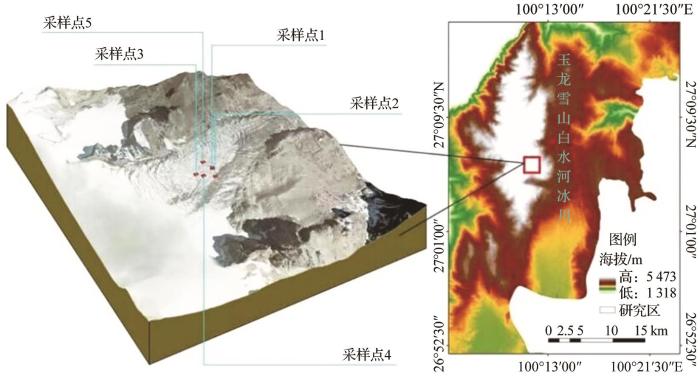
研究玉龙雪山冰尘的理化特征及其微观形貌,不仅可以揭示区域内冰尘的形成机理、来源和影响因素等,更为进一步理解影响冰川消融的机制提供了科学依据。以2023年8~9月在玉龙雪山冰川区消融冰表面采集的冰尘样品为研究载体,分析了冰尘的理化特征和形成机制,讨论了冰尘对冰川融化和冰川区碳循环的潜在影响。通过对冰尘样品进行粒度测试,对总有机碳和微观形貌进行分析,发现冰尘中矿物颗粒体积粒径分布众数介于2~28 μm,分布结构较为单一,主要源于粉尘沉降和局地岩石风化;雪冰样品中冰尘的总有机碳含量相对较高,且冰尘总有机碳含量随海拔降低而增加(采样点海拔范围在4 500~4 700 m),表明夏季冰川强烈消融对溶解性有机物质的输送和空间分布存在显著影响;冰尘微观形貌主要表现为致密泥质结构,无机物质和有机物质外观特征明显,内部存在不均匀且形态复杂的孔隙,分形维数较高,介于1.600 8~1.845 6,同时冰尘能谱分析检出了丰富的C、Si、O和Al等元素,表明冰尘中富含碳酸盐、硅酸盐和有机质等物质,这与冰川消融密切相关。研究结果有利于与其他冰川相关研究进行对比分析,对研究其他冰川冰尘理化特征及微观形貌具有指导意义。
张炜忠 , 牛贺文 , 卜爱军 . 玉龙雪山冰川区冰尘理化特征及微观形貌研究[J]. 地球科学进展, 2025 , 40(5) : 540 -550 . DOI: 10.11867/j.issn.1001-8166.2025.033
The study of the physical, chemical, and micromorphological characteristics of ice dust in the Yulong Snow Mountain glacier area reveals the formation mechanisms, sources, and influencing factors of ice dust in the region, providing a scientific basis for understanding glacier melting processes. Using ice dust samples collected from the melting ice surface in the glacier area between August and September 2023, the physical and chemical properties and formation mechanisms of ice dust were analyzed, and the potential effects of ice dust on glacier melting and the carbon cycle were discussed. Particle size analysis, total organic carbon measurement, and micromorphological examination of the samples revealed that the mode of mineral particle size distribution in ice dust ranged from 2 to 28 μm. The distribution structure was relatively simple, primarily due to dust deposition and local rock weathering. The total organic carbon content in ice dust from snow and ice samples was relatively high and increased with decreasing altitude (sampling point elevations ranged from 4 700 to 4 500 m). This suggests that strong glacier melting in summer substantially influences transport and spatial distribution of dissolved organic matter. Microscopic morphology of the ice dust was mainly a dense argillaceous structure, with distinct appearances of both inorganic and organic substances. The internal structure exhibited uneven and complex pores, with a high fractal dimension ranging from 1.600 8 to 1.845 6. Energy-dispersive spectroscopy detected abundant elements such as C, Si, O, and Al, indicating that the ice dust contains carbonates, silicates, organic matter, and other substances closely related to glacier melting. This study supports comparative analysis with other glacier-related research and provides guidance for future investigations into the physical and chemical characteristics and micromorphology of ice dust from other glaciers. Future in-depth studies will focus on determining mineral types and conducting quantitative elemental analysis of ice dust in the Yulong Snow Mountain glacier area, with an expanded sampling range and quantity.
| [1] | CHEN Yong, ZHOU Lihua, SUN Xike. The adaptation countermeasures to glacier shrinkage in some typical counties of Tibetan autonomous region[J]. Journal of Glaciology and Geocryology, 2011, 33(1): 205-213. |
| 陈勇,周立华,孙希科.青藏高原典型县域冰川退化情景下的适应对策研究[J].冰川冻土,2011,33(1):205-213. | |
| [2] | SHRESTHA A B, ARYAL R. Climate change in Nepal and its impact on Himalayan glaciers[J]. Regional Environmental Change, 2011, 11(1): 65-77. |
| [3] | DU Jiankuo, XIN Huijuan, HE Yuanqing, et al. Response of modern monsoon temperate glacier to climate change in Yulong Mountain[J]. Scientia Geographica Sinica, 2013(7): 890-896. |
| 杜建括,辛惠娟,何元庆,等.玉龙雪山现代季风温冰川对气候变化的响应[J].地理科学, 2013(7): 890-896. | |
| [4] | TAKEUCHI N, KOHSHIMA S, SEKO K,et al. Structure,formation and darkening process of albedo reducing material (cryoconite) on a Himalayan glacier:a granular algal mat growing on the glacier[J]. Arctic,Antarctic and Alpine Research,2001,33(2): 115-122. |
| [5] | TAKEUCHI N, MATSUDE Y, SAKAI A,et al. A large amount of biogenic surface dust (cryoconite) on a glacier in the Qilian Mountains,China[J]. Bulletin of Glaciological Research, 2005, 22: 1-8. |
| [6] | FENG Lin, XU Jianzhong, ZHAI Lixiang. The evolution characteristics of dissolved organic matter in cryoconite during ablation season on the surface of a typical continental glacier of Tibetan Plateau:a case study at Laohugou Glacier No.12[J]. Journal of Glaciology and Geocryology, 2021,43(3):874-884. |
| 冯琳,徐建中,翟立翔. 青藏高原典型大陆性冰川表面消融期溶解性有机质演化特征分析——以祁连山老虎沟12号冰川为例[J]. 冰川冻土,2021,43(3):874-884. | |
| [7] | XU Hui, LI Zhongqin, TAKEUCHI N,et al. Characteristics and formation analysis of the cry-oconite granuless: take the Urumqi Glacier No.1 as an example[J].Journal of Glaciology and Geocryology,2013,35(5): 1 118-1 125. |
| 徐慧,李忠勤, Takeuch Nozomu,等. 冰尘结构特征及形成分析——以乌鲁木齐河源1号冰川为例.[J].冰川冻土,2013,35(5):1 118-1 125. | |
| [8] | LI Quanlian, ZHANG Chenglong, WU Xiaobo, et al. Grain size distribution and mineral components of cryoconites of glaciers in western China[J]. Mountain Research, 2015, 33(2): 166-172. |
| 李全莲,张成龙,武小波,等.中国西部冰川冰尘的粒度及矿物组成[J].山地学报, 2015, 33(2): 166-172. | |
| [9] | XU Hui, LI Zhongqin, TAKEUCHI N, et al. Characteristics and formation analysis of cryoconite granules of Yushugou Glacier[J]. Arid Land Geography, 2014, 37(3): 429-438. |
| 许慧,李忠勤, NOZOMU Takeuchi,等.天山哈密榆树沟冰川冰尘特征及其成因[J].干旱区地理,2014, 37(3): 429-438. | |
| [10] | SHAN Shumo. China dictionary of famous mountains and rivers[M]. Jinan: Shandong Education Press, 1992. |
| 单树模. 中国名山大川辞典[M]. 济南: 山东教育出版社, 1992. | |
| [11] | ZHANG Dian, SHI Changxing, JIA La.Research on precipitation chemistry in Qinghai Tibet Plateau [J]. Journal of Environmental Sciences, 2004(3): 555-557. |
| 章典,师长兴,假拉.青藏高原降水化学研究[J].环境科学学报,2004(3):555-557. | |
| [12] | XIN Huijuan, HE Yuanqing, ZHANG Tao, et al. The features of climate variation and glacier response in Mt. Yulong, southeastern Tibetan Plateau[J]. Advances in Earth Science, 2013, 28(11): 1 257-1 268. |
| 辛惠娟, 何元庆, 张涛, 等. 青藏高原东南缘丽江玉龙雪山气候变化特征及其对冰川变化的影响[J]. 地球科学进展, 2013, 28(11): 1 257-1 268. | |
| [13] | XIE Junfeng, MO Fan, XI Shaoli, et al. Spatial and temporal variation of 3D temperature field in Yulong Snow Mountain area[J]. Acta Ecologica Sinica, 2021, 41(7): 2 548-2 556. |
| 谢俊峰, 莫凡, 奚绍礼, 等. 玉龙雪山地区地表三维温度场时空变化分析[J]. 生态学报, 2021, 41(7): 2 548-2 556. | |
| [14] | NIU Hewen, HE Yuanqing. Characteristics of the microparticles in atmospheric precipitation around the Mt. Yulong[J]. Journal of Glaciology and Geocryology, 2014, 36(1): 71-79. |
| 牛贺文, 何元庆. 玉龙雪山地区大气降水中粉尘颗粒物特征研究[J]. 冰川冻土, 2014, 36(1): 71-79. | |
| [15] | NIU Hewen, HE Yuanqing, XIN Huijuan, et al. Characteristics of mircroparticles in the snow cover in Mt. Yulong region[J]. Environmental Chemistry, 2014, 33(8): 1 347-1 353. |
| 牛贺文,何元庆,辛慧娟,等.玉龙雪山积雪中粉尘微粒的沉积特征[J].环境化学,2014, 33(8): 1 347-1 353. | |
| [16] | HE Zhong. Study on Holocene aeolian loess-soil material source and sedimentary dynamics in Yuzhou, Henan Province[D]. Xi’an: Shaanxi Normal University, 2006. |
| 何忠. 河南禹州全新世风成黄土—土壤物质来源与沉积动力研究[D]. 西安: 陕西师范大学, 2006. | |
| [17] | DONG Z W, LI Z Q, WANG F,et al. Characteristics of atmospheric dust deposition in snow on the glaciers of the eastern Tien Shan, China[J]. Journal of Glacioloy,2009,55(193): 797-804. |
| [18] | SHI Xiaofei. Temporal and spatial characteristics of dissolved organic carbon in precipitation and snow and ice in Yulong Snow Mountain area[D]. Lanzhou: Lanzhou University, 2018. |
| 石晓非. 玉龙雪山地区大气降水与雪冰中溶解性有机碳的时空特征研究[D]. 兰州: 兰州大学, 2018. | |
| [19] | FENG Lin, MA Xinggang, XU Jianzhong, et al. Variation of spectral characteristics of dissolved organic matter in snow/ice of Dagu Glacier in different seasons[J]. Journal of Glaciology and Geocryology, 2023, 45(6): 1 840-1 848. |
| 冯琳, 马兴刚, 徐建中, 等. 达古冰川不同季节雪冰中溶解性有机质光谱特征变化研究[J]. 冰川冻土, 2023, 45(6): 1 840-1 848. | |
| [20] | FENG Lin, AN Yanqing, XU Jianzhong, et al. Characteristics and sources of dissolved organic matter in a glacier in the northern Tibetan Plateau:differences between different snow categories[J]. Annals of Glaciology, 2018, 59(77): 31-40. |
| [21] | YU Miao. Spatial distribution characteristics of soil organic carbon and its influencing factors in Huma River basin[D]. Harbin: Harbin Normal University, 2023. |
| 于淼. 呼玛河流域土壤有机碳空间分布特征及其影响因素分析[D]. 哈尔滨: 哈尔滨师范大学, 2023. | |
| [22] | YAN F P, KANG S C, LI C L, et al. Concentration, sources and light absorption characteristics of dissolved organic carbon on a medium-sized valley glacier, northern Tibetan Plateau[J]. The Cryosphere, 2016, 10(6): 2 611-2 621. |
| [23] | HUANG J, KANG S C, GUO J M, et al. Mercury distribution and variation on a high-elevation mountain glacier on the northern boundary of the Tibetan Plateau[J]. Atmospheric Environment, 2014, 96: 27-36. |
| [24] | HE Canming, Minping OU, ZHANG Junxi. Single particle source apportionment technology of atmospheric particulate matter based on high spatial resolution scanning electron microscopy and artificial intelligence analysis [C]// Chinese Society of Environmental Sciences, China Environmental Monitoring Station. Proceedings of the Third conference on environmental monitoring and early warning technology. Foshan, 2023:185-191. |
| 何灿明,欧敏萍,张俊希.基于高空间分辨率扫描电镜及人工智能分析的大气颗粒物单颗粒源解析技术[C]// 中国环境科学学会,中国环境监测总站.第三届环境监测与预警技术大会论文集. 佛山, 2023: 185-191. | |
| [25] | NIU H W, KANG S C, WANG Y H, et al. Measurements of light-absorbing impurities in snow over four glaciers on the Ti‐betan Plateau[J]. Atmospheric Research,2020,243. DOI:10.1016/j.atmosres.2020.105002 . |
| [26] | LI Kui, JIA Yuan, HAN Yanlong, et al. Quantitative characterization of microscopic structure of carbonate rocks from coal measures in tectonic zone based on MIP and SEM[J]. China Coal, 2025, 51(1): 204-214. |
| 李魁, 贾圆, 韩艳龙, 等. 基于MIP和SEM的构造区煤系碳酸盐岩微观结构定量表征[J]. 中国煤炭, 2025, 51(1): 204-214. | |
| [27] | ZHANG Y L, KANG S C, GAO T G, et al. Microstructural characteristics of cryoconite on Tibetan glaciers and their radiative forcing[J]. The Cryosphere, 2020, 14(3): 967-985. |
| [28] | TAKEUCHI N, NIWANO M, UETAKE J, et al. Physical properties of cryoconite granules on glaciers in the Tibetan Plateau[J]. Journal of Glaciology, 2018, 64(247): 835-845. |
/
| 〈 |
|
〉 |
 甘公网安备62010202000687